






TANGZU FUDU
Redcarmoose Labs September 21, 2023
Redcarmoose Labs September 21, 2023


TANGZU FUDU VERSE 1
So here I am and I get a few IEMs in the mail. Actually at this point I’m slightly jaded. I mean how am I going to get my thrills………..maybe not from another $89.00 IEM. Meaning I’m happy to hear this new IEM, but the look on my face is one of casual boredom………this is probably just like all the other sub $100 IEMs from China. Yet I forgot my very own history here……that’s right I reviewed the $149.00 TANGZU Wu Zetian…and I loved it. I reviewed the $19.00 TANGZU Wan'er S.G, and again it was price-point leading, hence getting a great score. I reviewed the $15.00 TANGZU Princess Chang Le, and loved it for what it was. So why am I not more excited here?
Then I remembered what the TANGZU FUDU VERSE 1 was, it was a 10mm DD, in addition to 2 custom BA units. Wait a minute? I have never heard TANGZU do a hybrid up to this point……and hybrids are my favorite methodology to make ear-phones. Now I have left something out in this story…..I put them in my ears forgetting all the above.
Then I heard them. Yep, Wait what? The bass was fantastic, the midrange and treble too, this was insane. Insane because of how good these little guys were. I should have known, mix my favorite way to make IEMs, then have the tune designed by new legends of the industry…….of course this was going to be pay-dirt. Sold gold……really really special. I mean just like that the TANGZU FUDU VERSE 1 jumped ahead of all the others in my review schedule. This was going to be a super easy review to write…….I simply need to put down my experience in writing…..easy.
Build:
Let's start with how these are made. At only 4 grams a piece, they are a joy to wear. Somehow there is really good noise occlusion, even though they have two vents on the bottom side. A CNC metal faceplate is then topped upon a resin 3D printed shell. Such a shell is somewhat see-through showing the 10mm driver and some foggy views of sound tubes. The nozzles are metal with very good tip lips which hold my favorite ear-tips on perfectly. Also at times I can’t use my ear-tips as the nozzles are too short, but here they are perfect. Some reviews call the FUDU cheap due to a plastic build, where I am totally opposite finding the construction first rate? Now the question is do these fit close to the ear even though not being a semi-custom shape? Now my guess is it is the size in regards to fit, because they are a little semi-custom if you look, just not having any drastic fins, making them feel simply normal. To me they don’t feel cheap at all. Very low-key, even the cable is understated, flush for the 2Pin and I eventually got the 2Pin to join flush with the IEM, not like some of the pictures show. Also note how well done the nozzle filters are....as they are permanently set in place! Metal nozzles hold my favorite ear-tips on really well and are of the correct length, so fitment shows exceptional.


Let’s get into the music!
Disclaimer:
Before I get started realize that an IEM of this caliber will only do so much in comparison to (some) way more expensive examples of ear-phone build art. So no matter how great I describe the FUDU to be, just simply keep this in mind.
https://keephifi.com/products/tangzu-fudu-verse-1-1dd-2ba-driver-earphone-hifi-iem-in-ear-monitor-with-ergonomic-shape-and-detachable-oxygen-free-silver-plated-copper-2pin-cable-for-audiophile-musician?_pos=1&_psq=fudu&_ss=e&_v=1.0
Meaning it’s $89.00, and in that realm compared with other under $100.00 IEMs it’s great, but by no means equal to a $400.00 or a $2000.00 IEM. The reasons why you may like it anyway are due to balance/tone and simply getting involvement by listening to your favorite songs. But the more I review and the more products pass my desk, I am able to generalize things. The one main generalization is size of replay. So no matter how great the FUDU is made out to be with my descriptions, just keep in mind that typically more expensive IEMs are generally going to offer a bigger stage to encompass more of your perception. Literally stuff in the (grander) stage will often be closer and farther away. Imaging is bigger (and often) more detailed to project items farther outwards with more expensive examples. These are just the facts of life!
Later after the music section, I will get into the general sound properties of the FUDU.

Lorne Balfe and Andrew Kawcznski
Grand Turismo OST
And We’re Off
44.1 kHz - 24 bit
Grand Turismo OST
And We’re Off
44.1 kHz - 24 bit
Wow, the start of this OST has it all. Great violins and chorus showcase this particular start-off. Deep plentiful bass hits, and just like that……….this game leads up to the adventure at hand. Being this is the start, it could in-fact be also the ending of the movie in theme. At 02:26 life gets slightly more emotional and subdued, yet the pace is still catered to by the bass. At 03:06 there is a breakdown and we are given silence from the rhythm. Anyone who knows this style of music knows that there may be quietness before the storm. At 03:14 fast drum hits take place, yet the FUDU makes everything simply accessible and not harsh. At 03:20 we are brought back inside the mix………..full-on. The FUDU makes sense of this song and its myriad of additives. My favorite part is the accent that is basically the feeling of race cars traveling by, only it is done with a synth that travels incredibly fast from the right to the left ear. I would go on, except we have a lot of music to cover here, proving just how well-rounded and special our little FUDU is.

Klangwelt
Here and Why
Cold War Child
44.1 kHz - 24 bit
Here and Why
Cold War Child
44.1 kHz - 24 bit
This is the song that blew my mind and showed me really what the FUDU was ultimately about. At 00:37 the piano is totally accurate as far as timbre. And to be vocal here these are some of the very best non-named (neither Knowles or Sonion) BAs I have ever heard? It is both how the tune is done, but also the very careful timbre that simply sounds real. It sounds musical and involving due to the correct tone. At 00:52 the bass metronome hits……and I got chills from hearing this. Again I don’t get chills that often anymore, but I did here. It was maybe the separation and pace of the bass, the overall tone of the bass? I don’t know, why? There is a place in this song where you truly start to understand the soundstage you’re working with. At 01:26 the simple use of the keys along with the bass makes this presence of stage known, and appreciated. The FUDU is just too good to be under $100…………..end of statement.

Hans Zimmer
DUNE OST
Ripples in the Sand
48 kHz - 24 bit
DUNE OST
Ripples in the Sand
48 kHz - 24 bit
Here we are gifted with a naturalness that allows a song that I have numerous times heard on more expensive gear, sound correct this time, but more than correct the flamboyance is what we came for. Surprisingly the bass in this song is often mixed just at the threshold of our hearing, yet the FUDU goes there, the FUDU brings it, it brings it all. At 02:08 there are vocals being sung, and deep lows enhancing the contrast at hand, yet it is all these ultimately detailed variations in lower tones that sounds like (so much more) IEM? Over here at Redcarmoose Labs, it’s the bass transients that are making my day.
There is more going on than at first guessed. At 02:46 there is a string instrument that is full-on enhanced with effects, but also it is traveling across and back into the stage. This element has a way about it, just like the race car sound in the previous Grand Turismo OST track. But then there are these knocks……….at 02:54……….these knocks are well separated (of course Hybrid) this is what hybrids do naturally….they simply delineate the music, especially when you have highs and lows going on at the same time like the present. But it is slightly more than that…….the tune? The technicalities of this little FUDU have me shaking my head……I’m simply surprised the FUDU can take on this music at this level and pull-it-off. At 03:05 the bass size (the drop) is enhancing the stage, and of course the stage size (brought into reality) due to bass presence. It’s big, it really is……bigger than you would first guess, by reading this?

Hans Zimmer
Wonder Woman 1984 (sketch)
The Monkey Paw
44.1 kHz - 24 bit
Wonder Woman 1984 (sketch)
The Monkey Paw
44.1 kHz - 24 bit
Here we are shown a stage and bass speed that up-until the very last song in this review sequence, was thought to be coming from the FUDU. Little did I know, the source is supper important here. So with my Sony WM1A it’s wonderful, in fact the FUDU grabs hold of the speedy bass transients and makes it work-out. At 01:06 this heart beat style drum takes the pace. Outside of that there are small noises of random thought. Then a waltz starts up. A syncopated rhythm with this wonderful bass laying below….and each note of that bass follows a timing…..walking back and forth to the notes. And while not the most detailed, the FUDU has the musicality down in this number. As violins travel out to the sides and add the required contrasts, there is a slow progression into the fact that this song really goes nowhere, except I’m sure supports the visuals well. Oh, that's right, this is only a sketch!
Intermission:
The previous songs were done with the Sony WM1A with included cable and my regular wide-bore ear-tips. The only slight advantage from a stock WM1A would be the aftermarket firmware provided by MrWalkman. For the next song I will change to the MacBook Air/Shanling UA3 (in 4.4mm) combo, as an attempt to learn more about the FUDU. Also in use is the included cable and ear-tips. Computer software is Colibri 2.0.2.

Ray Lynch
Deep Breakfast
Celestial Soda Pop
44.1 kHz - 16 bit
Deep Breakfast
Celestial Soda Pop
44.1 kHz - 16 bit
In many ways this is like the Klangwelt song above, though the one difference is it is from another older generation of synth ideas. Kind of a home brew style of creation, selling 72,000 copies in 1984 from his apartment before going platinum a few years later. Using a few home-made musical tricks upon release, Deep Breakfast went to show there are really many ways to make music fun and intriguing. The TANGZU FUDU takes and creates a wonderful head-stage, and for many this was one of the first popular albums in its day to showcase headphone imaging……besides Pink Floyd of course. Here there is this simplistic joining of a few musical elements into a correct and calm style of (new age) fantasy music. Around the 00:43 second mark the minimalistic drums appear……….and somehow even though stripped down the song goes to add (additional) elements one by one. It’s that everything goes by a balance and while this does sound like Ray is using different overall volume levels to alter intensity, still it all works out in the end. Really this song comes from a time when playbacks were not monitored, hence as an early listener of such music we never knew when the song was ending……there were no digital sound counters on vinyl replay or tape players. One of the tricks here is what seems like the song’s ending, just to go about one more charming verse. Just like the FUDU in its creation, this is only FUDU verse one, as verse two will arrive at some point in time to signal a new addition to the TANGZU family. What will the second verse of FUDU be like, your guess is as good as mine, and that is part of the fun, as not knowing everything has its charms.


The Shanling UA3 conclusion, plus FUDU generalizations:
This was surprising and not in the planned review sequence. Why? While the FUDU is thick and harmonically rich, it is still increasingly dependent on source for that richness. Here the Shanling UA3 was simply just getting us by. What I mean is it started me off on a tangent of trying a bunch of music and devices. And I learned that somehow the FUDU really does express what thickness you give it. What that means to you as a consumer is that while always audiophile and well balanced, the TANGZU FUDU will only offer so much thickness/stature from a Dongle or Phone. This is in contrast to the last two IEMs I’ve just reviewed, that while (they were) way more money, they also made phone playback slightly better……..more well rounded and full sounding. It doesn’t mean the FUDU sounds cheap, except there will be times in use when truly a Dongle of Phone will not emphasize the size of stage or depth of bass, that and the extent of the stage. Going to a higher quality source the FUDU will scale and show a better demeanor. Now this in itself is an interesting facet of FUDU playback. It means that yes, it has the quality to verify source level, but also plays a little different out of each source. The inevitable outcome of such skills or lack of skills depending on how you look at it…………. is a spectrum of takes on playback. This means the TANGZU FUDU wasn’t as well rounded as first guessed. Still, there is a quality obtained through playback, yet in a way it needs to be catered to…….to reach those quality levels.
Remember those DAP reviews when the reviewer was stating that the DAP made the IEMs ear-candy, well this is that style of IEM that will scale up to ear-candy but will also not become that inspiring if you power it wrongly.
This may in fact be due to the driver count, or design……I mean it is only made up of three drivers 1DD and 2 BAs…..so? To summarize this paragraph, while great, the FUDU has its limits of what it chooses for sources. Where there can be other IEMs both higher priced and lower priced that are in general more well rounded to source. At its worst the FUDU will sound thin and even reserved to contain an authoritative bass, while still smooth, there may be times when the thickness needs enhancing from a thicker source. At the same time get the FUDU what (source) it asks for and be amazed at what sound this little IEM can shoot for. At Head-Fi this basically means there will be (other) conflicting reviews to a point, where some reviewers simply don’t realize just how far this FUDU can change with source. The fall-out of such means the FUDU may actually get interpreted many ways, at least that was even my very own (mistaken) first take on playback, finding the deep bass emotional and moving, yet what I didn’t realize is the speedy bass transients were (obviously) coming from upstream with my DAP, as the FUDU was simply playing what was there. Yep, get it a thin source and find out just how thin the FUDU will go. It never goes to a really bad place, except scales back depending on the signal, and character of that signal.
Sound design:
While smooth and complete the above critical aspects about replay need to be addressed. As in my testing there have been a few better IEM all-rounders that seem to make note-weight out of thin-air, which we don’t have here, yet at the same time there is an honest transparency that allows the FUDU to scale to an extra beautiful level. Inside that level (which can even be obtained with a DAP) a complete natural and correctly even response can be obtained.
Bass:
While carefully set-back the FUDU 10mm DD produces well defined and clear examples of bass replay. Never going out of character and overshadowing the midrange or treble, we are gifted with completeness and while not class leading, there is a composure to the bass that is unarguable? A tone that seems to go the extra mile to almost not sound like a disjoined separate driver?

Graph of the Tangzu Fu Du via IEC711 coupler. 8 kHz is a coupler artifact peak.
Mids:
Mids:
Now interestingly enough the mids get their personality starting at a lower energy 2kHz peak, then finding focus at 4kHz…..bypassing little of the 3kHz energy. Such a way goes with standard thoughts by balancing out the low-end energy with almost an exact 4kHz placement, and that’s how it sounds.
Treble:
Going with a subtle 5kHz peak, the 8kHz is measuring tool resonances. Once again here we are never in danger of getting an unnatural hyper treble creating outstanding detail, thus what details are there seem to blend with the character provided by the whole? That softer line is a path that may in fact be responsible for our appreciated lack of BA timbre. I mean really the tuning was a goal of cohesive balance without the brightness, making big stage reaches or subsequent inherent heat. Keep in mind about the transparency here, meaning get the FUDU a bright source (lacking bass presence) and discover (strangely) just how resolving three drivers can be in the end to show source. Though for myself it was nurturing note-weight as a path to success, regardless of just how much bass was obtained.
TANGZU FUDU VERSE 1
HIFI IN-EAR HEADPHONES 1 DYNAMIC DRIVER + 2 BALANCED ARMATURE IN EAR MONITORS EARPHONES
- Elegantly Crafted CNC Metal Panel
- 3D Printing Resin Cavity
- Powerful 10mm Dynamic Drivers
- Two Customized Balanced Armature Drivers
- Gold-plated Headphone Plug
- High-purity Oxygen-free Copper Wire
- Exquisite Accessories
Packaging:
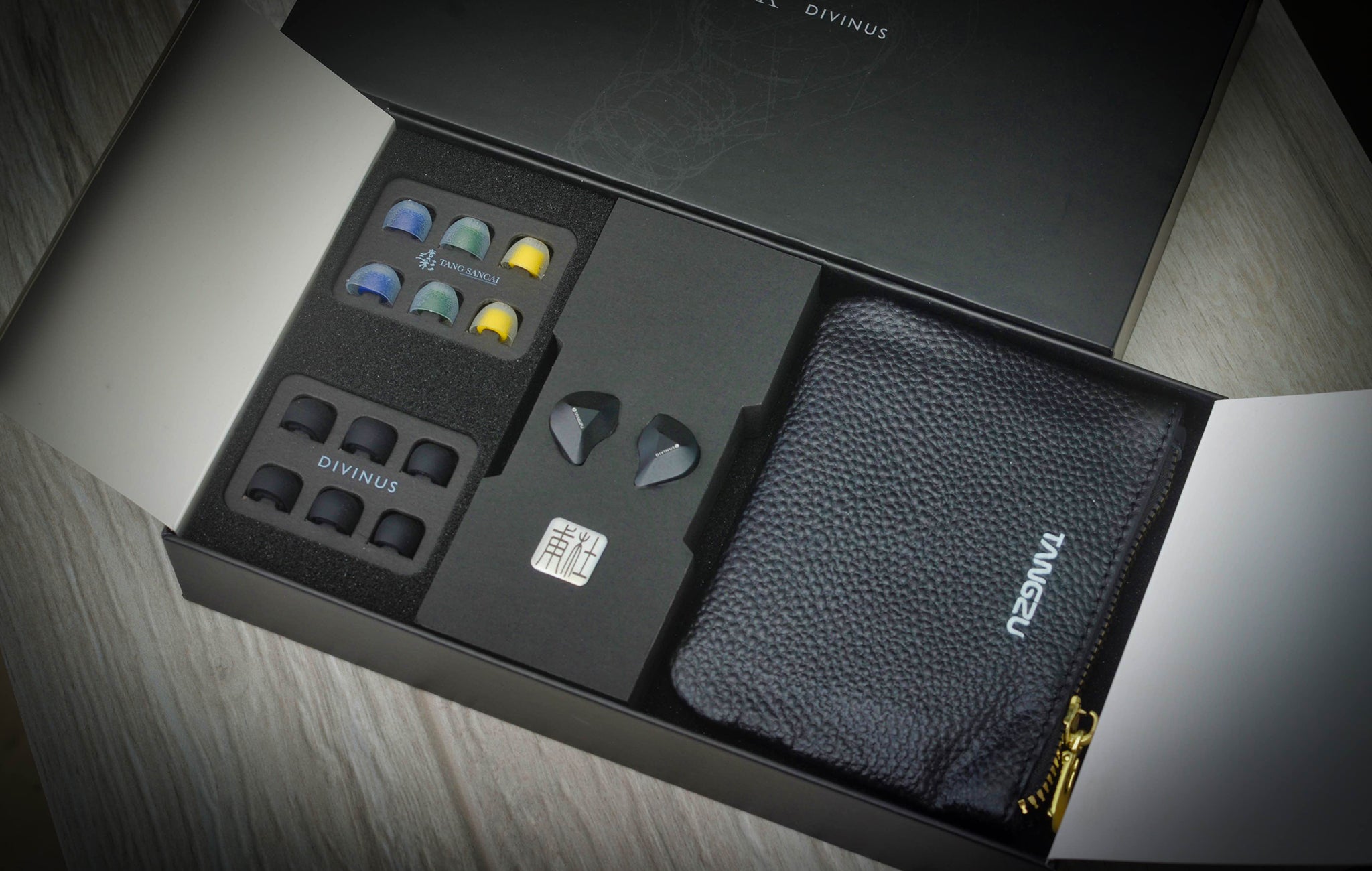
Interesting as this particular IEM came with a thorough packaging set-up. Probably way more elaborate than with other examples in the price-point. Along with the incredibly special designer Tangzu Tang Sancai ear-tips you also get the black Divinus Velvet silicone ear tips. Plus one extra (M) set on the IEM, which are different all together….sorry I didn't get a picture of the two (extra) ear-tips. So S,M,L of both Sancai and Divinus ear-tips and one set of medium generic ear-tips. It should be noted that TANGZU also just introduced new wide-bore Tangzu Tang Sancai ear-tips, but those are not included. Besides the IEMs themselves you get a great cable and a pouch. A super nice big-gold-zipper works well in dark lighting to help with case use. TANGZU has their own faux leather work which successfully covered other cases in the past, only this black color is new.


The Cable:
Both the splitter and chin-cinch are aluminum as is the actual 4.4mm plug. When you order your only choice is if you want to go with 3.5mm or 4.4mm. Much of the time I need to change-out cables to access the 4.4mm better amp in my players, but once again TANGZU provides the win-win here, allowing me to complete this whole review with a dynamite cable! While after so many aftermarket cables (in my testing) the included cable may seem on the thin size.....though sonically it’s great and the ergonomics are fine. Interesting too there is no branding anywhere to be seen. The only words are on the IEM faceplates, next to a very small R or L marker.................And the whole shebang works out here, it really does. The 2Pin barrels came designated with red or blue painted rings showing a nice ear-hook design. Probably my favorite aspect of the cable choice is just how maneuverable it truly is. Such a cable goes into a small coil and easily gets put away into the pouch. When out and about such a cable lays very well, keeping microphonics to a minimum. There is no fight here with this cable, only love!


Conclusion:
First my plans were to think this was like any other sub-$100 choices out there. And while the FUDU is not price point leading as far as technicalities, there is an understated and smooth quality that seems to never escape this IEM. And if you’re on-board with just how this frequency response is placed, there will be no looking back. Yet also the FUDU is very reactionary of source, so reactionary that you hear past the IEM into the very nature of the source you have chosen, quite the accomplishment for the price-point. That is supposed to be good, at least it sounds good to read, except if you don’t have the magic source on hand you may find yourself with less than optimal playback. That less than optimal may center around note-weight…..maybe possible stage, even bass depth. Such a Chameleon means that this beast is a little harder to review, because I’m not sure what source you have. So, the scalability is real and present.
Accessories:
The FUDU still comes in incredibly complete accessory wise. Yep, the swanky case, the silky smooth yet understated cable, the clear Tangzu Tang Sancai ear-tips, the Divinus ear-tips. The presentation in how all these goodies are introduced to you, the fact that every FUDU made comes with its very own serial number. The IEM themselve, the way the BAs have zero off BA character, the 10mm dynamic driver which together creates a Hybrid listening experience, a first for TANGZU! The understated markings on the IEMs themselves and the unique faceplate design. You see what has been given is the complete package with attention to detail…..even simply the no-fuss way the cables attach to the IEM and the ergonomics resulting due to only 4 grams a piece. The fact that they are actually super small a point that I have should have emphasized sooner, and finally the sound is spectacular and totally coherent.
Desktop:
I mean I did something crazy here. I hooked up the FUDU to my reference system as a way to discover if truly there was an undiscovered genuine quality about playback. But the little secret is that the Sony TA-ZH1ES desk-top holds superior note-weight. Yep, that and the fact that the bass isn’t too shabby either. I can’t help thinking this was in-line with equipment used in FUDU design at TANGZU headquarters? At least here we are truly discovering the true personality of TANGZU’s latest creation. Joining the TA is the Sony WM1A's (black background) file player, and the Sony Walkman holder as a mount. Transfer takes place with the AudioQuest Carbon USB, and we are shown the FUDU in the best of light.
Take it to the Max:
To maximize all this potential sound quality a file was chosen. While everything matters in playback, many audiophiles believe the quality has to start at the top. I can truly say that the tone was both detailed and natural, holding exquisite positioning, reminding me how Hybrids are my favorite way to go. Now obviously the FUDU isn’t everything, I mean even in this set-up I could understand the drawbacks in relation to TOTL IEMs. Still I have to say the FUDU doesn’t ever try to be more than it’s not……not trying to boost the treble into a bright unnatural way to obtain detail, same as the bass where it’s not earth shaking or too much. What we are presented with is balance, balance and note-weight. Yet with this a careful musicality that holds a quality that is unarguably correct and wholesome.
TANGZU
I mean it’s a TANGZU, so you already know the tuning style, and in their 2 long years of life TANGZU is introducing their house sound again and again, reflecting off different driver methodologies. DDs, a Planar, a Hybrid…..and who knows what the future holds for them? Though I do know one thing, TANGZU hasn’t skipped a beat with every creation, continuing the tradition of excellence as a form of artistic expression. And while there are no surprises here, nothing is boring either..........as TANGZU has produced another workhorse of an IEM.
$89.00
https://www.linsoul.com/products/tangzu-fudu-verse-1
Linsoul website: https://www.linsoul.com/
Linsoul Aliexpress Store: https://ddaudio.aliexpress.com/store/2894006
Linsoul USA Amazon Store link: https://www.amazon.com/s?i=merchant-items&me=A267P2DT104U3C
Disclaimer:
I want to thank Kareena at Linsoul for the love and the TANGZU FUDU review sample.
Disclaimer:
These are one person's ideas and concepts, your results may vary.
Equipment Used:
Sony WM1Z Walkman DAP MrWalkman Firmware 3.5mm and 4.4mm
Sony WM1A Walkman DAP MrWalkman Firmware 3.5mm and 4.4mm
Sony TA-ZH1ES DAC/AMP Firmware 1.03
Electra Glide Audio Reference Glide-Reference Standard "Fatboy" Power Cord
Sony Walkman Cradle BCR-NWH10
AudioQuest Carbon USB
Shanling UA3 Dongle DAC/Amplifier 3.5mm and 4.4mm
Samsung phone 3.5mm
