







Specification:
- Sound pressure: 106dB, 1 kHz
- Impedance: 16Ω
- Frequency response range: 10-20kHz
- Cable: copper with silver-plated wire
- Drivers: 6 Balanced Armature Drivers, 1 EST Driver
Design and Build:
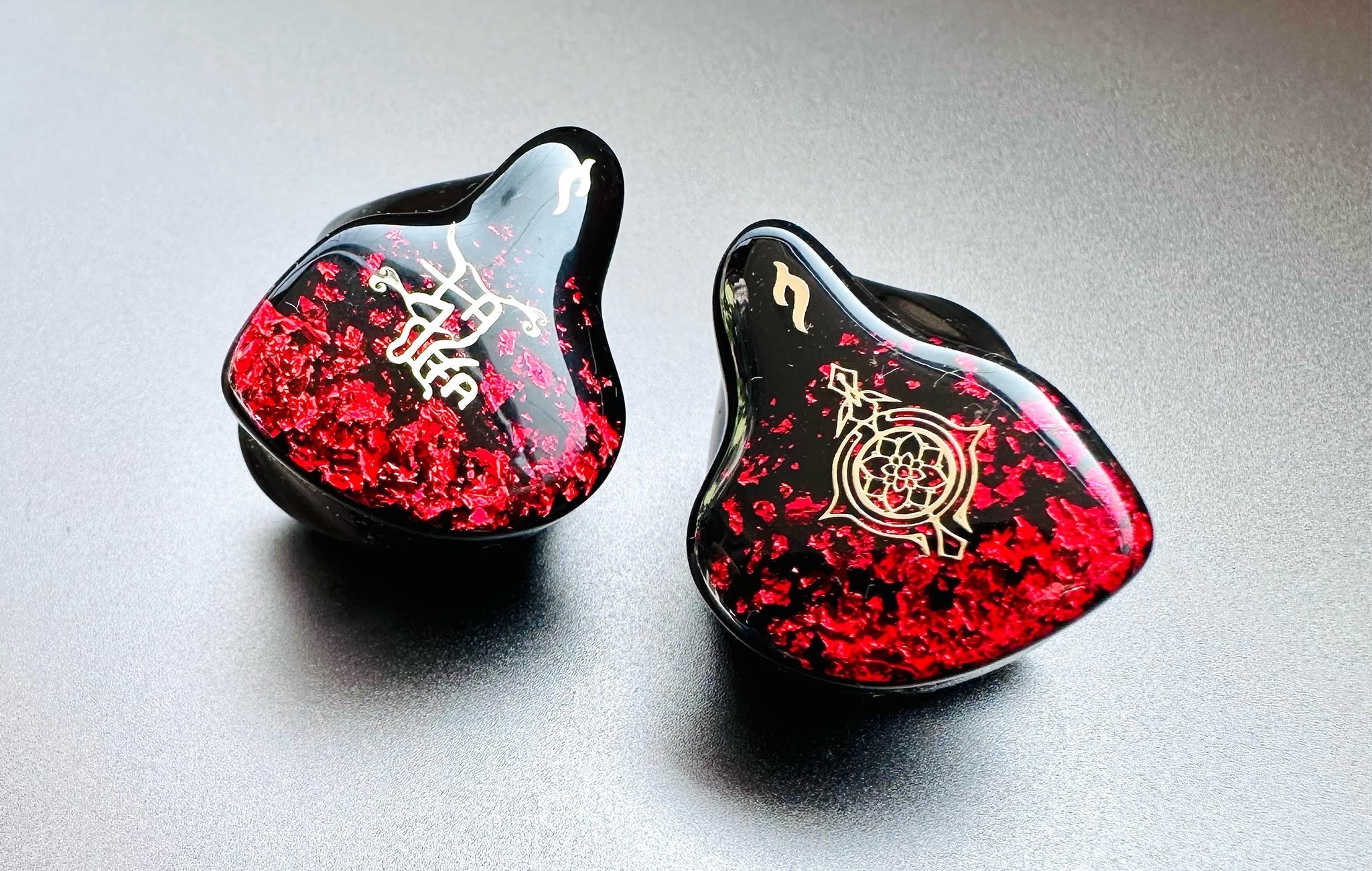
The Tangzu Nezha in-ear monitors (IEMs) have a visually striking design with a vibrant red and black color combination, creating an aesthetically pleasing and attention-grabbing appearance. Additionally, the IEMs exhibit an impressive shine, contributing to their overall appeal. Despite their seemingly big shells, these IEMs are quite lightweight, which ensures comfort during longer usage. I did not feel any fatigue whatsoever. So, quite confidently, I can say that fit should not be an issue for anyone. The package includes a nice set of accessories, notably a high-quality leather case that I really liked. It certainly adds a touch of sophistication to the product. I really like the Tang Sancai eartips that come with these IEMs. All these features collectively make the Tangzu Nezha IEMs a satisfactory product, providing value for their price point.
Accessories:
- 1 pair of headphones
- Oxygen-free copper silver-plated wire 1
- 4.4mm headphone plug
- 3.5mm headphone plug 1
- Tang Sancai (large diameter): 3 pairs
- Tang Sancai (balanced): 3 pairs

The included cable with the IEM features oxygen-free copper silver-plated wire and is of very decent quality. It's not prone to tangling. It comes with modular options and offers both 4.4mm and 3.5mm terminations. The cable quite nicely blends with the IEM's aesthetics. Sonically, it very well complements the IEMs sound, and I don't think there is any need to replace it unless you want to go for some cable rolling and find a well-suited pair.

Rating Criteria:
I want to lay out my rating criteria before we start off. For me, the primary criterion for evaluating audio gear is its intrinsic value rather than its price tag. A higher price doesn't always correlate with superior quality, and similarly, a low-priced product can give enough listening pleasure for it to be called outstanding. I consider the build, features, and, most importantly, the impact on the listening experience. I think the fundamental purpose of audio gear is to enhance the listening experience. So for me, this degree of enhancement in the listening experience is a key determinant in rating a product.
Rating below 4: I really won't be posting reviews of such items unless someone has asked for them.
Rating of 4: The product is good, and some users may find it more satisfactory, but it does come with a few caveats.
Rating of 4.5: The product is excellent and comes with an easy recommendation, reflecting its high quality and overall positive attributes.
Rating of 5: This product can be deemed groundbreaking, a trendsetter, and an eye-opener and deserves a spot on everyone's list due to its exceptional features and outstanding performance.
Sound Quality:
Most of my listening was done using the default cable and Azla Light tips, my go-to eartips. The Azla tips fit well on the slightly wider nozzle of these iems. As always, these tips provide a very decent level of isolation, which enhances the listening experience with these IEMs.
Sources Used for Review:
1. Lotoo Paw Gold Touch
2. Earmen Angel
3. iPad Pro
Straight out of the box, the Nezha proves to be good. I find the sound to be a bit on the warmer side. It's ease of driveability and pleasant sound quality remain consistent across different sources. The tuning is particularly likeable. What's even more surprising is the technical performance of these IEMs, which sometimes catch me off guard with their capabilities. The sound is rich in details, creating a sense of spaciousness, and the sound-stage reaches an impressive level. It very easily accommodates a wide range of genres, from metal to acoustics to jazz to everything, making it versatile for various musical preferences. Overall, the Nezha offers an immersive sound experience—something that will keep you hooked from the time you put it in your ears. Let's talk about how these IEMs handle different aspects.

Bass:
The bass in these in-ear monitors (IEMs) maintains the characteristic qualities of balanced-armature (BA) bass. More to that, the implementation of the bass is really different from what I have heard in other BA iems. The Sonion sub-woofers deliver a very pleasing sub-bass, adding a distinct flavor to the lower end. If you are looking for hard-hitting, layered bass, there may be a bit of disappointment. For those who appreciate the nuances and finesse of BA bass, I am sure you will be happy to find the way lower end has been handled on these iems. I am not sure why the bass has been kept so lean.
For example, in Limit to Your Love by James Blake, a song that literally tells how well subbass is handled on an iem, I feel the subbass on Nezha goes quite deep when it is called for but still fails to impress much. In cases where more impact is needed, for example, in metal and rock songs where there is a lot of drumming, there is a lean bass production, which is a bit of a turn-off.
Mids:
The mid-range performance of the Nezha is smooth and enjoyable. Vocals demonstrate a rich quality, and the sound from string instruments carries a good body. However, I perceive a slight thinness in the mid-range at times, particularly noticeable in female vocals, which makes me think that a bit more lushness and thickness could really enhance the overall experience. Per my personal preference, I want the mids and vocals to be a bit forward. I think jazz numbers are ideal for these IEMs, as those strings still sound good on them.
Personally, I haven't detected any peaks or sharpness in the upper mid-range, although for some people, it might approach the borderline for some tracks. In the case of the track Code Cool by Patricia Barber, I don't find any sharpness or sibilance, yet I believe there's room for improvement in rendering the vocals even richer.
On the song Helplessly Hoping by Crosby, Stills, Nash & Young, there is a good separation of the vocals. There is a hint of clarity in the midrange and a sense of warmth, which makes the song sound really good. The sound of male vocals on this track is rich enough to indicate that the male vocals on these iems carry good weight.
Treble:
The upper frequencies are well-extended, capturing the intricacies of instruments and vocals with a very good sense of space and airiness. The treble maintains a balanced presence, contributing to an overall non-fatiguing sound signature. The well-controlled treble on these IEMs contributes to a response that is free from any harsh or piercing elements. This makes the IEMs safely tuned and quite enjoyable, something you'd prefer for longer listening hours.
An example of a good and controlled treble can be heard in the song You've Got to Have Freedom by Pharoah Sanders. The saxophone sound from this track never sounds thin, harsh, or fatiguing. You can really enjoy the raw sound, which can very easily sound coarse on some other IEMs.
Technicalities:
Nezha is a decent pair when it comes to technical prowess. The sound-stage on these IEMs is quite wide, and there is a good sense of spaciousness with good layering. Nezha's open and spacious sound profile handles complex and busy tracks quite well, making it well-suited for genres like metal and rock. The instruments get enough space to breathe. The accuracy in imaging allows for precise positioning of instruments, making it a good choice, particularly with jazz compositions where it does its job really well. Nezha excels quite a lot at detailing too, throwing in those little nuances quite well. However, I need more clarity and a better overall resolution.
Comparison:
I do not generally believe in comparing IEMs as I think every one of them has its own characteristics and a distinct implementation. However, for the sake of positioning an IEM in terms of performance, I would compare these IEMs to my much-loved Simgot EA1000.
Needless to say, in the bass department, the EA1000 is the clear winner of the two. The bass on the EA1000 has a good impactful punch, whereas the Nezha has a very lean and unimpressive bass. This good bass adds quite a bit of fun to the sound on the EA1000 and makes it a lot more enjoyable. In terms of sound-stage, Nezha has a better and noticeably larger sound-stage and the EA1000 is a bit intimate and has just above-average sound-stage, lacking the spaciousness that Nezha has. The mid-range sounds more forward and lusher and has more weight on the EA1000 than on the Nezha. The treble on Nezha is more controlled, whereas on EA1000 it becomes quite hot and spicy at times. EA1000's sound has a cleaner and crisper resolution than on Nezha.
In comparison between the two, I lean more towards the EA1000, and it is a preferable pair for me, which is totally a personal preference based on the above-presented facts.
Areas of improvement for Nezha:
1. I would like the mids to be more forward. Female vocals need a touch of warmth.
2. The bass is not very impressive. The impact is missing.
3. A touch of crispiness and clarity in resolution is certainly needed.
Conclusion:
From the company's perspective, this release really puts Tangzu in the front seat. Nezha, if not an absolute gem, is certainly going to please a lot of listeners. It is still one of the noteworthy releases of the year 2023. The good looks, excellent package, and above-average sound make it a good IEM, and it's nothing short of a winner. I will give them a rating of 4/5: the product is good, and some users may find it more satisfactory, but it does come with a few caveats. The price, in my view, remains justified, but it's important to note that the performance of these IEMs doesn't necessarily exceed expectations for their price range. One can surely grab a unit if they find a really good deal on these IEMs. I will certainly be watching for the next releases from Tangzu.