
In this feature, Kurt reviews the TANGZU Zetian Wu Legend, a 2nd generation dual-planar driver IEM with an attractive Abalone-like finish. It is currently priced at $259.
Disclaimer: I received this sample in exchange for my honest opinion. Headfonics is an independent website with no affiliate links or services. I thank TANGZU and Linsoul for their support.
You can click here to learn more about Linsoul’s provided gear previously reviewed on Headfonics.
This post follows our current scoring guidelines, which you can read in more detail here.
TANGZU Zetian Wu Legend Review

When the Tangzu Zetian Wu was first launched, it quickly became a go-to planar IEM with its unique tuning and engaging sound. It stood out by delivering natural timbre, musicality, and near flawless balance at an affordable price.
Despite sharing its predecessor’s name, the $259 Tangzu Zetian Wu Legend isn’t positioned as a direct successor but carries forward its unique purple lotus design.
Now, featuring a dual-driver configuration and a higher price tag, does the Zetian Wu Legend live up to its prestigious name, and how does it compete with planar entries such as the LETSHUOER S12 2024 Edition and the 7Hz Timeless II?
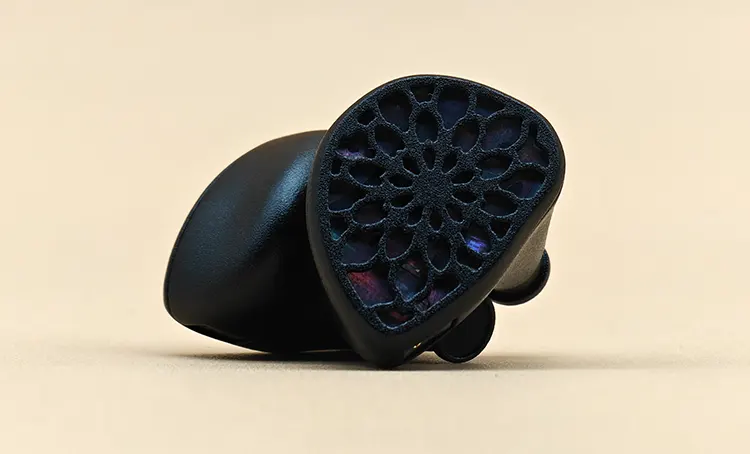
The Tangzu Zetian Wu Legend takes a different approach by using two planar drivers instead of one. It houses a 14.2mm planar driver and a 6mm flat diaphragm planar driver inside its compact shell.
The 14.2mm driver isn’t the largest Tangzu has used, as the original Zetian had a slightly bigger 14.5mm driver. Despite this, the addition of a secondary planar unit is a unique change while keeping the overall size similar.
The larger planar driver handles the bass, midrange, and treble, acting as the main powerhouse of the sound. The 6mm flat diaphragm driver focuses on the upper treble and air frequencies, improving clarity and detail.
Tangzu added this extra driver to reduce the workload on the main driver. The original Zetian Wu never had workload issues, but this upgrade is a welcome one as it aims to bring even better precision to the Zetian Wu Legend’s sound.
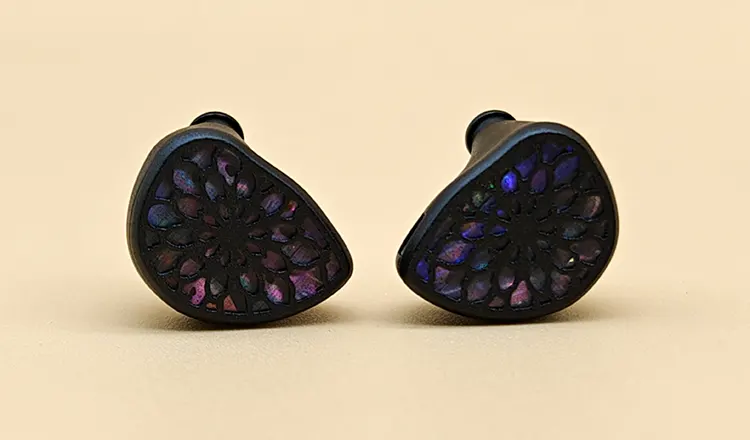
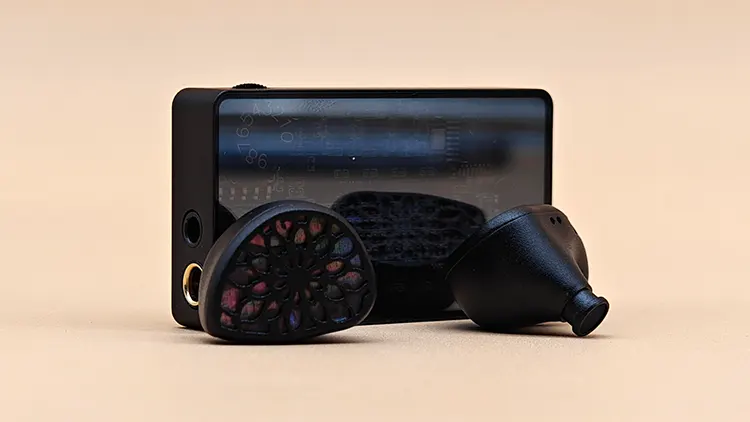
The Tangzu Zetian Wu Legend features a durable aluminum alloy shell without any sharp or pointed edges, giving it a strong yet comfortable build. It is only available in black, with its faceplate serving as the standout design element.
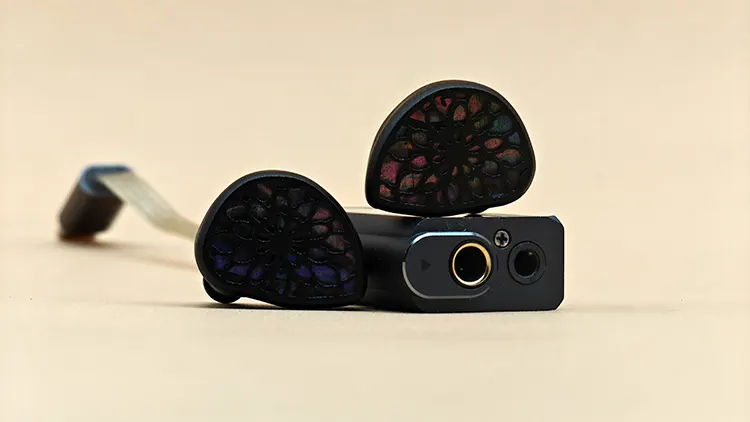
Tangzu continues the lotus-inspired theme from the original Zetian Wu but with a twist. Instead of an engraved pattern, the faceplate now features a lotus cutout with a colorful abalone-like material underneath as its centerpiece.
Under normal lighting, the faceplate displays various shades of purple, paying homage to the original Zetian Wu’s signature look. However, at certain angles, a full spectrum of colors appears, creating a striking rainbow effect.
In Chinese culture, abalones are associated with good fortune, making this design choice more than just aesthetic. Whether intentional or not, the Zetian Wu Legend could serve as a subtle lucky charm when one wears it.
The matte shell provides a smooth, non-sticky surface that remains comfortable to the touch. However, it absorbs temperature easily, making it noticeably hot or cold depending on the environment.
For managing air pressure, the Zetian Wu Legend includes three vents in the shell. Two are positioned near the 0.78mm connectors, while a third sits near the “L” and “R” markings on the shell.
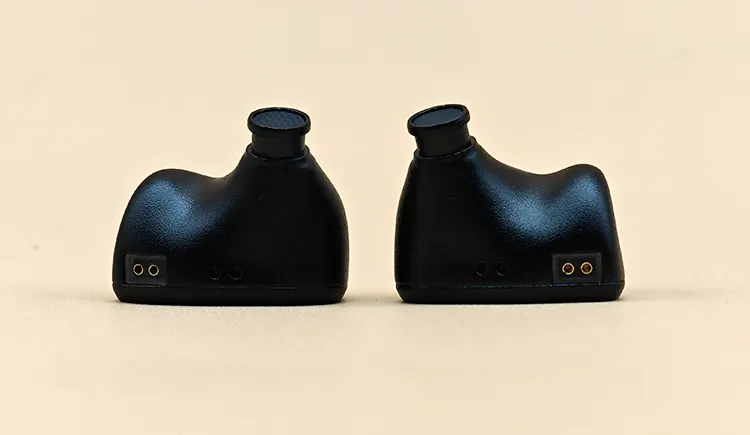
Since the Tangzu Zetian Wu Legend keeps the same overall shape as the original Zetian, comfort remains excellent. The aluminum shell rests naturally on the ears, forming a secure seal without any effort.
Most users will find the fit hassle-free, as its size is neither bulky nor awkward. Despite using a denser aluminum shell instead of the original Zetian’s 3D-printed resin, it remains lightweight and unobtrusive.
Its smooth, rounded design eliminates any sharp edges or rough textures, making it easy to wear for long sessions. The weight distribution between the IEM and cable also helps it feel almost weightless during use.
The nozzle isn’t overly large, but its shorter length sometimes requires a deeper insertion with shorter tips. Thankfully, the added nozzle lip keeps ear tips secure, preventing any risk of them slipping off inside the ears.
The Tangzu Wu Zetian Legend comes with three sets of Tang Sancai ear tips, each offering different sound experiences. They come in yellow, green, and blue, representing large, medium, and small sizes, with wide bore, balanced, and narrow bore designs, respectively.
The narrow bore ear tips performed the worst, despite providing a solid seal. They heavily altered the sound, masking details, clouding the midrange, and making vocals sound unnatural.
Treble performance also took a hit with the narrow bore tips, stripping away the expected planar detail retrieval. It dulled the highs significantly, making the overall sound less engaging and resolving.
Switching to the balanced ear tips instantly restored clarity, allowing the Zetian Wu Legend’s planar qualities to shine. The sound became more open and natural, bringing back the original tuning instantly.
The wide bore ear tips further enhanced this experience by boosting subbass presence and treble sparkle. Rumbles became more enjoyable, while the added air gave instruments and vocals extra life.
Comfort and fit were excellent across all three sets, thanks to their unique texture and premium feel. While all were well-made, the wide bore ear tips delivered the best sound experience, making them my top choice.
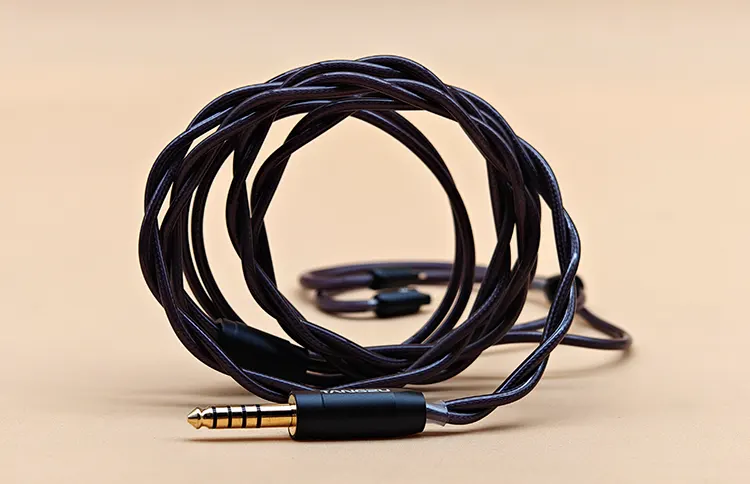
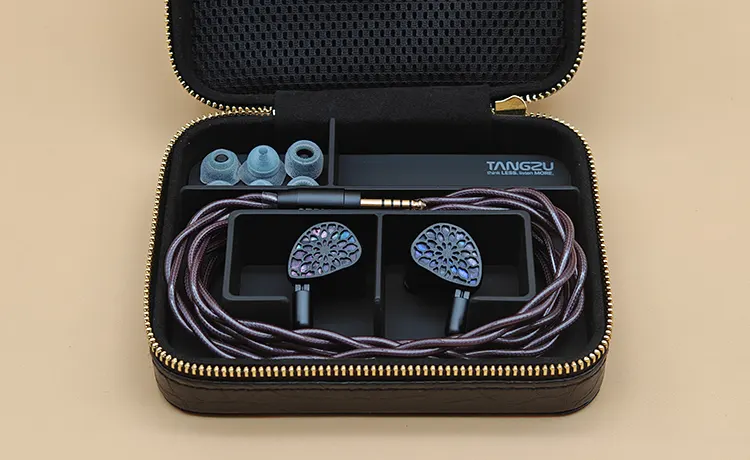
The Tangzu Zetian Wu Legend improves on its stock cable in nearly every way except for modularity. Instead of a 3.5mm termination, it includes a 4.4mm balanced connector, which is the better choice for a planar IEM.
This time, Tangzu upgraded the cable to a shielded LNOFC Litz design, a significant step up from the original Zetian’s OFC cable. The added shielding helps minimize distortion and static, ensuring a cleaner signal from various sources.
Its dark purple color complements the IEM’s aesthetic, with a two-braid design running from the 4.4mm connector to the splitter. After the splitter, it transitions into single strands leading to the left and right 0.78mm pins.
For convenience, the left and right connectors are clearly labeled with “L” and “R.” The splitter also features the Tangzu branding, adding a subtle yet premium touch to the overall design.
The cable’s feel and weight are excellent, rivaling high-end aftermarket options in both durability and flexibility. It remains tangle-free and lightweight, making it an ideal match for the equally lightweight Zetian Wu Legend.
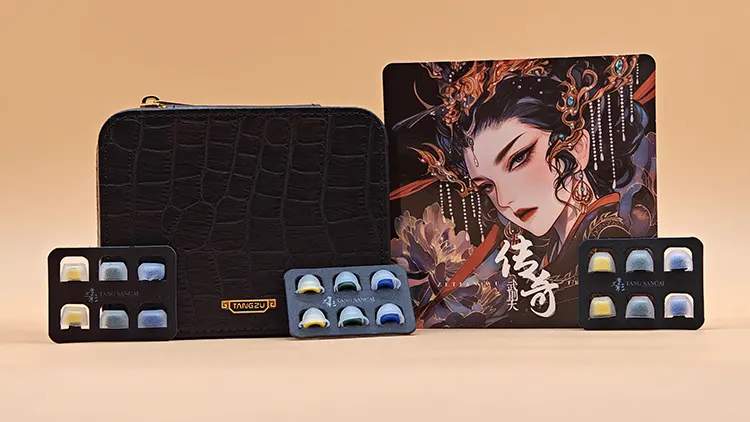
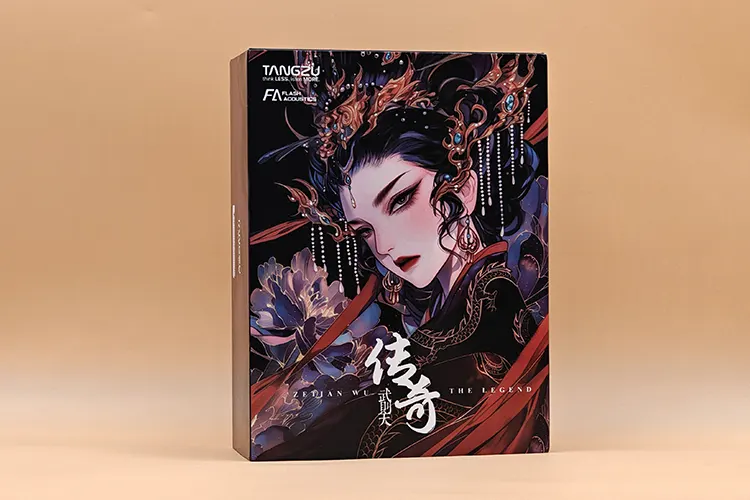
The front of the Tangzu Zetian Wu Legend’s box features an artistic rendering of Empress Zetian Wu. On the back, a Chinese dragon in a purple accent is displayed, with product details like impedance and sensitivity neatly placed in the bottom left corner.
Sliding off the cover reveals a gold-accented “Zetian Wu The Legend” text, adding a touch of elegance to the presentation. A Chinese character sits between the words, though its exact translation remains unknown, it likely says the same meaning.
The inner box carries Tangzu’s branding along with the tagline “Think Less. Listen More” on the side. It opens like a book from right to left, unveiling the accessories and IEMs in an organized layout.
A square photo card of Empress Zetian Wu sits atop the leather-like carrying case, adding a collectible element to the unboxing. The case itself has a refined, purse-like aesthetic, blending style with functionality.
At the center of the display, the Zetian Wu Legend comes pre-attached to its stock cable. Removing the carrying case and foam cutout reveals the rest of the cable along with the three sets of Sancai ear tips.
The bass of the Tangzu Zetian Wu Legend delivers a solid performance but never truly stands out. Subbass offers a decent rumble that keeps the sound from feeling dry, yet its decay is too fast to fully appreciate its depth.
The midbass lacks the impact needed for a satisfying punch, causing bass guitars to sound muted and blunted. Instead of delivering a powerful slam, it comes across as a light thud that is often overwhelmed by the subbass.
Due to the weaker midbass, the low-end presence can feel underwhelming and sometimes becomes an afterthought in the mix. It rarely grabs attention or elevates the overall sound as it struggles to match the liveliness of the high-end.
On the upside, bass note definition is excellent, with textures that remain detailed rather than overly smoothed out. Its cleanliness ensures there’s no bleed into the midrange, allowing the mids and treble to shine without interference.
The Tangzu Zetian Wu Legend’s midrange has a noticeable metallic timbre, making female vocals sound slightly unnatural. Male vocals, however, maintain a more natural tone and don’t suffer from the same issue.
A sharpness in the upper midrange makes female vocals occasionally grating, which could be fatiguing for those sensitive to sibilance. While the added breathiness enhances airiness and liveliness, it can sometimes feel excessive, pushing the midrange into an overly bright presentation.
But vocal nuances are captured well, with clear note definition that highlights subtle details in the performance. The note weight is balanced, avoiding a thin or dry presentation while still keeping enough body for an engaging experience.
Clarity is a strong point, but the vocals can become overbearing due to the strong upper midrange emphasis. This added intensity possibly contributes to the metallic timbre, making the presentation occasionally shouty.
The benefits of the 6mm flat diaphragm planar driver in the Tangzu Zetian Wu Legend come through in its treble presentation. It delivers impressive sparkle and air, adding definition and energy to the overall sound.
Treble extension is strong, offering high detail retrieval that brings out every subtle nuance in the mix. It outperforms many other planar IEMs in microdetail clarity, making hidden elements stand out effortlessly.
However, the treble doesn’t sound completely natural, likely receiving a slight boost to enhance its resolution. This added emphasis may contribute to the noticeable sibilance that bleeds into the upper midrange.
I enjoy the extra energy it brings, as instruments gain an additional layer of shimmer and liveliness. However, some listeners may find it overbearing, as the combination of sibilance and strong treble energy can be overwhelming.
The soundstage of the Tangzu Zetian Wu Legend is average, with a stage width slightly above normal and a height that remains average. The experience is in-head, unable to offer an expansive experience.
The staging primarily delivers horizontal imaging since it has limited capabilities for depth and height separation. It makes a lot of sounds placed correctly, but the overall presentation never feels truly immersive.
The imaging does a good job of positioning vocals and instruments accurately, but the constrained staging limits its potential for spaciousness. It’s still enjoyable, though it doesn’t provide the expansive sound to elevate the listening experience.
Dynamics are a strong suit, with the mids and treble taking the spotlight without clashing. The bass consistently plays a supportive role, adding just enough low end to balance the overall mix.
The focus on the high end is clear, with vocals remaining intimate and instruments sounding vibrant. Together, they deliver a truly detailed experience that remains consistent at any volume.
The Tangzu Zetian Wu Legend has a sensitivity of 106.5 dB at 1kHz and an impedance of 12.5Ω, making it easy to drive with almost any device. Its low impedance and high sensitivity ensure you can achieve high volume levels without extra amplification.
The stock cable is a shielded, balanced 4.4mm cable, so issues like distortion or static are virtually nonexistent. It provides consistent performance across various sources and volume settings.
At lower volumes, the bass nearly vanishes as both midbass and subbass drop off. Without strong low-end support, the midrange and treble take over completely, resulting in a dry and dull listening experience.
At higher volumes, the bass returns with more presence, but the sound grows noticeably brighter and more sibilant. Vocals become slightly shouty, though detail retrieval improves significantly across the board.
During my testing, I found that the Tangzu Zetian Wu Legend’s sound can be quite source-dependent. Different DACs, R2R systems, and portable dongles give noticeably different listening experiences.
My daily driver, the Colorfly CDA-M2 with a Cirrus Logic CS43198 chip, produces an analytical and brighter sound signature. However, it can be overly sharp and sometimes sibilant despite its impressive detail retrieval.
When paired with the HeartField R1, an R2R DAC-circuit device, the sound shifts to a warmer and more intimate presentation. The midbass becomes punchier, and vocals lose some sharpness, though the treble clarity takes a slight hit.
Using the FiiO JA11, a portable dongle DAC connected to my phone, the experience is similar to the Colorfly setup. The main difference is that the bass is even weaker, and the vocals are pushed more forward in the mix.
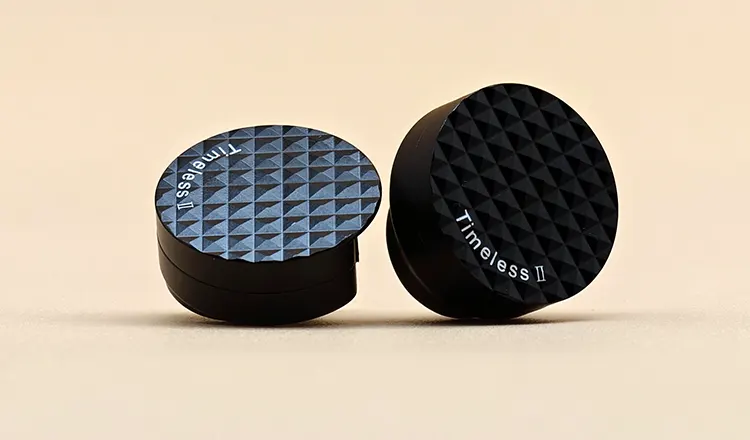
The 7Hz Timeless II features a new 14.5mm planar magnetic driver, a clear upgrade from the original Timeless’s 14.2mm unit. It is also the first planar IEM to incorporate dual-sided silver alloy-coated diaphragms, setting it apart from other planars.
This advanced diaphragm is paired with dual-sided N52 magnet arrays that deliver a more powerful and consistent magnetic field.
According to 7Hz, this combination significantly boosts responsiveness, representing a major leap forward in their planar technology.
The 7Hz Timeless II retains the classic design of its predecessor with a lightweight black circular shell and faceplate that keeps its iconic look intact.
The updated faceplate now features a shiny geometric pattern, and the branding is streamlined to “Timeless II” for a cleaner appearance.
New design updates include four interchangeable nozzles and a switch from MMCX to 0.78mm 2-pin connectors, making cable customization easier. Multiple vents on the shell effectively manage pressure, ensuring comfort during extended use.
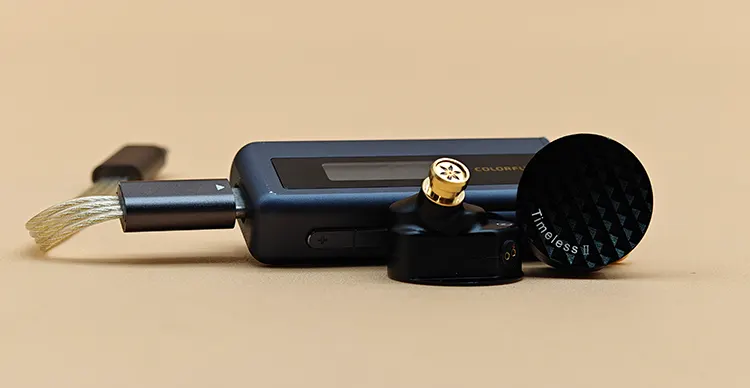
The Tangzu Zetian Wu Legend and 7Hz Timeless II continue the legacy of their predecessors, delivering a planar sound that closely mimics dynamic driver timbre while maintaining excellent treble extension. Both remain standout choices in the planar IEM market, each excelling in different areas.
The Timeless II delivers a deep, rumbling subbass with a strong midbass punch, making its low end feel more engaging and livelier. The Zetian Wu Legend, on the other hand, follows the typical planar bass presentation, maintaining similar quality but lacking the same weight and impact.
In the mids, the Zetian Wu Legend excels in note definition and vocal clarity, making details stand out more. However, this comes at the cost of warmth, as the Timeless II presents vocals more smoothly and naturally.
The Zetian Wu Legend’s timbre leans slightly metallic, making vocals sound sharper and thinner than they should. Meanwhile, the Timeless II avoids this issue, maintaining a natural tone that keeps instruments and voices more lifelike.
Treble is where the Zetian Wu Legend gains an edge, offering superior extension, microdetail retrieval, and extra sparkle from its additional 6mm driver. Yet, this added energy introduces some brightness and sibilance, while the Timeless II keeps its treble smooth and fatigue-free.
Both IEMs showcase strong imaging, but the Timeless II benefits from better stage height, adding depth to its presentation. This results in a more immersive experience, whereas the Zetian Wu Legend keeps everything mostly in the head.
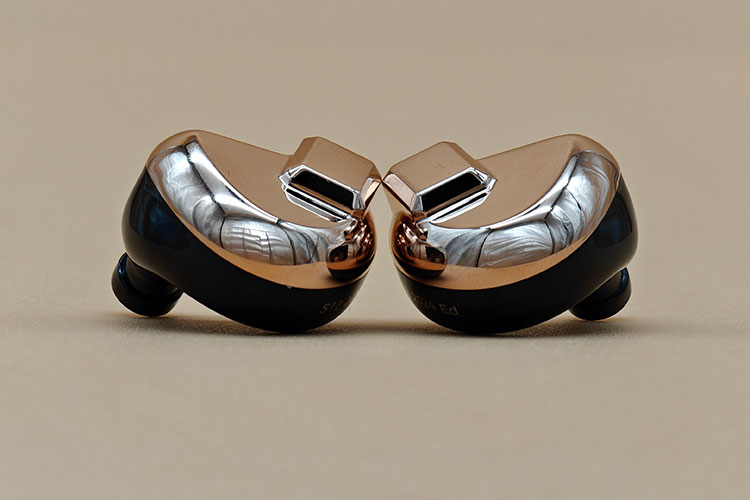
The LETSHUOER S12 2024 Edition comes equipped with a newly developed 14.8mm custom planar magnetic driver.
While it shares similarities with the S12 Pro’s driver, it incorporates new materials that LETSHUOER claims improve the soundstage and resolution.
This release serves as a refined refresh of the S12 Pro, featuring an upgraded driver, enhanced materials, and improved accessories. It builds upon the well-received tuning of its predecessor, offering a more polished and engaging listening experience.
The LETSHUOER S12 2024 Edition combines a gold-plated faceplate with a solid black shell, creating a refined look. Its titanium-alloy construction, enhanced by high-precision CNC milling, ensures durability and a premium feel of the shell.
While its shape remains unchanged from the original S12, this edition merges previous color options of the S12 series into one striking design. Each unit is uniquely numbered on the faceplate, marking its limited run of 2,024 pieces.
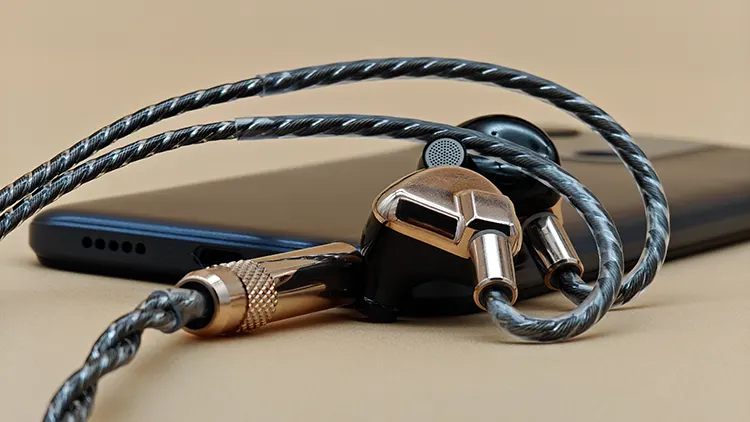
The LETSHUOER S12 2024 Edition and Tangzu Zetian Wu Legend continue the legacy of their predecessors as some of the best planar IEMs available. Both feature large planar drivers and deliver excellent treble extension with few drawbacks.
Their subbass performances are similar, providing enough energy to prevent dryness without adding bloat. The S12 2024 edges ahead with a slightly stronger and longer-lasting rumble, giving it a bit more low-end presence.
Midbass follows the same trend, with both offering a clean and controlled punch that avoids bleeding into the mids. Neither is tuned for bassheads, as they lack the weight and slam needed for a more engaging and lively low-end experience.
Their differences become clearer in the midrange, where the S12 2024 refines its timbre for a more natural vocal presentation. The Zetian Wu Legend, while more forward and engaging, introduces a metallic edge that makes vocals sound sharper and less organic.
Treble extension is where the Zetian Wu Legend takes the lead, revealing finer details and adding a layer of sparkle that the S12 2024 lacks. However, that extra energy comes at the cost of sibilance and an artificial timbre, while the S12 2024 keeps things smooth and fatigue-free.
Soundstage width slightly favors the Zetian Wu Legend, but neither IEM offers a particularly expansive stage. Imaging is strong on both, making effective use of their limited depth and height to place sounds with precision.
Tangzu refines its planar technology with the Zetian Wu Legend, introducing a dual-driver setup that enhances treble extension and microdetail retrieval. Its colorful abalone-like faceplate adds a unique aesthetic, giving it a standout look among planar IEMs.
It comes with a high-quality 4.4mm balanced cable and Sancai ear tips, ensuring both versatility and comfort. Offering top-notch treble extension and exceptional detail retrieval, the Tangzu Zetian Wu Legend stands out as the next step to better planar technology.

Spend Less Enjoy HIFI