







EarAcoustic Audio VSA-PM Review: A True Planar Flagship
EarAcoustic Audio’s Take on Planar Performance is Rock-Solid
EarAcoustics Audio has been entirely too-busy these past few months. They’ve launched IEM after IEM after IEM, leaving hardly a moment to breath before the next best thing shows up. And this blistering release strategy has a real victim: the VSA-PM. This is EarAcoutic Audio’s first true flagship IEM. It features a bespoke planar driver, enhanced shell design, and a unique accessory package — yet hardly anyone knows, or cares, that it’s been released. That’s a darn shame, and one I hope to correct with this review. Let’s get into the details.
About My Preferences: This review is a subjective assessment and is therefore tinged by my personal preferences. While I try to mitigate this as much as possible during my review process, I’d be lying if I said my biases are completely erased. So for you, my readers, keep this in mind:
- My ideal sound signature would be one with competent sub-bass, a textured mid-bass, a slightly warm midrange, and an extended treble.
- I have mild treble sensitivity.
Tech Specs
- Driver: 11.4mm “ribbon” planar
- Impedance: 16ohms
- Sensitivity: 105dB SPL/mW
- Cable: 0.78mm 2-pin w/ 4.4mm termination
Sound Signature
The VSA-PM has a V-shaped sound signature with an emphasis on its treble and upper-mids, which are similarly-lifted. The VSA-PM’s bass is placed a little before its lower-mids. Both the VSA-PM’s upper-treble and sub-bass are well-extended and articulate. In spite of its formidable treble and midrange emphasis, the VSA-PM is never sibilant, and seldom sharp.Sonic Breakdown:
Treble: Songs used: In One Ear, Midnight City, Outlands, Satisfy, Little One, Show Me How To Live (Live at the Quart Festival), Bittersweet SymphonyThe VSA-PM might have the smoothest, most-cohesive treble of any planar IEM I’ve heard — and it doesn’t need to fake it by recessing the entire upper-register (ala S08). Pop on any track with string instrumentation or crunchy electric guitars and bathe in the sea of texture presented to you. Likewise, the VSA-PM absolutely nails the cymbals and high-hats in In One Ear. Like many of driver-tech peers, the VSA-PM fully and completely captures the fade-out of each individual slam — but without the typical planar sheen.
While listening to Midnight City, I came across an interesting dichotomy with the VSA-PM: It manages to resolve nearly every fluctuation of texture, layer the instrumentation, and articulate vocals, but didn’t produce the massive sense of space I’m used to. Planar IEMs tend to do well on this front, but for whatever reason, the VSA-PM was entirely content with delivering a fairly pedestrian and “frank” stage for this track. Similarly, the VSA-PM was more than capable of resolving and layering the many background subtleties in Little One; but it didn’t sound as wide and spacious as I anticipated. The VSA-PM communicates a really powerful sense of depth, but seems to not really engage much with width.
On the subject of sharpness, the VSA-PM has little-to-none, even with treble sensitivity. Sharply-mastered tracks like Satisfy are essentially benign on the VSA-PM. Tracks with intense percussion are likewise predictable and well-behaved.
Midrange: Songs used: Flagpole Sitta, Jacked Up, I Am The Highway, Too Close, Little Black Submarines, Bohemian Rhapsody, Cash Machine, Chasm, Dead!, The Parts
To my ears, the VSA-PM might be the best-toned for vocals I’ve heard in years. It effortlessly and organically renders a wide variety of male and female vocals, and does well to tone and texture them. The subtle inflections in the desperate lyrics of Jacked Up come through with a pleasant realism. I usually reserve my use of the word “smooth” when discussing sound, as some readers interpret that as “lacking” texture, but that as silly as might sound, the VSA-PM’s vocals are both textured and “silky”, a phenomenon I’ve oft heard reserved for IEMs triple its (already hefty) price.
Even on dryly-mastered tracks like Flagpole Sitta, the VSA-PM delivers an engaging and robust midrange performance. The bass guitar is audible and articulate, as are the lead and rhythm guitars. The latter two instruments are soaked in texture, which makes for quite the rewarding listen in quiet spaces. The comparatively hypoxic choruses of Dead! display an impressive sense of layering and depth, particular during the mid-song bridge. The VSA-PM’s subtle warmth and honest toning makes it supremely genre-flexible and fairly mastering-agnostic; a true boon for the oft-shafted planar enthusiast.
Bass: Songs used: Moth, Gold Dust, In For The Kill (Skream Remix), War Pigs (Celldweller Remix)
The VSA-PM has a lifted lower-register, but not a dominant one. Its mid-bass is emphasized enough to deliver punch when needed, and its sub-bass is extended and healthy, allowing it to actually rumble on command. That said, do not expect the VSA-PM to compete with the likes of the Punch Audio Martilo, Xenns Mangrid Tea Pro, or HiSenior Cano Cristales — they’re deliberately tuned differently. Instead, you get an articulate, if not a somewhat soft, mid-bass that expresses depth and intensity when needed (but not when unprompted). Tracks like Gold Dust exemplify this behavior. While a basshead IEM might floor its listener with mid-bass immediately in the intro, the VSA-PM punches, gently, then delivers the goods during the track’s chorus.
Moth, for example, demonstrates the VSA-PM’s strong penchant for mid-bass articulation. The track is underpinned by weighty strumming, providing a solid foundation upon which the track’s vocals and instrumentation contrast. War Pigs (Cellweller Remix) also demands a fair bit of flexibility from IEMs, and the VSA-PM nearly gets there. It handles a number of the drum and synthetic elements with enough vigor, but occasionally forgot to dig deep enough into the sub-bass. This type of “drying-out” is somewhat problematic, from a basshead’s perspective, but can be rectified with a small increase to sub-bass via EQ (or by simply buying a different IEM).
Packaging / Unboxing
Build
 |
 |
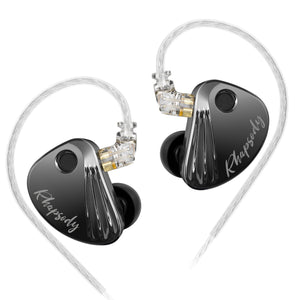
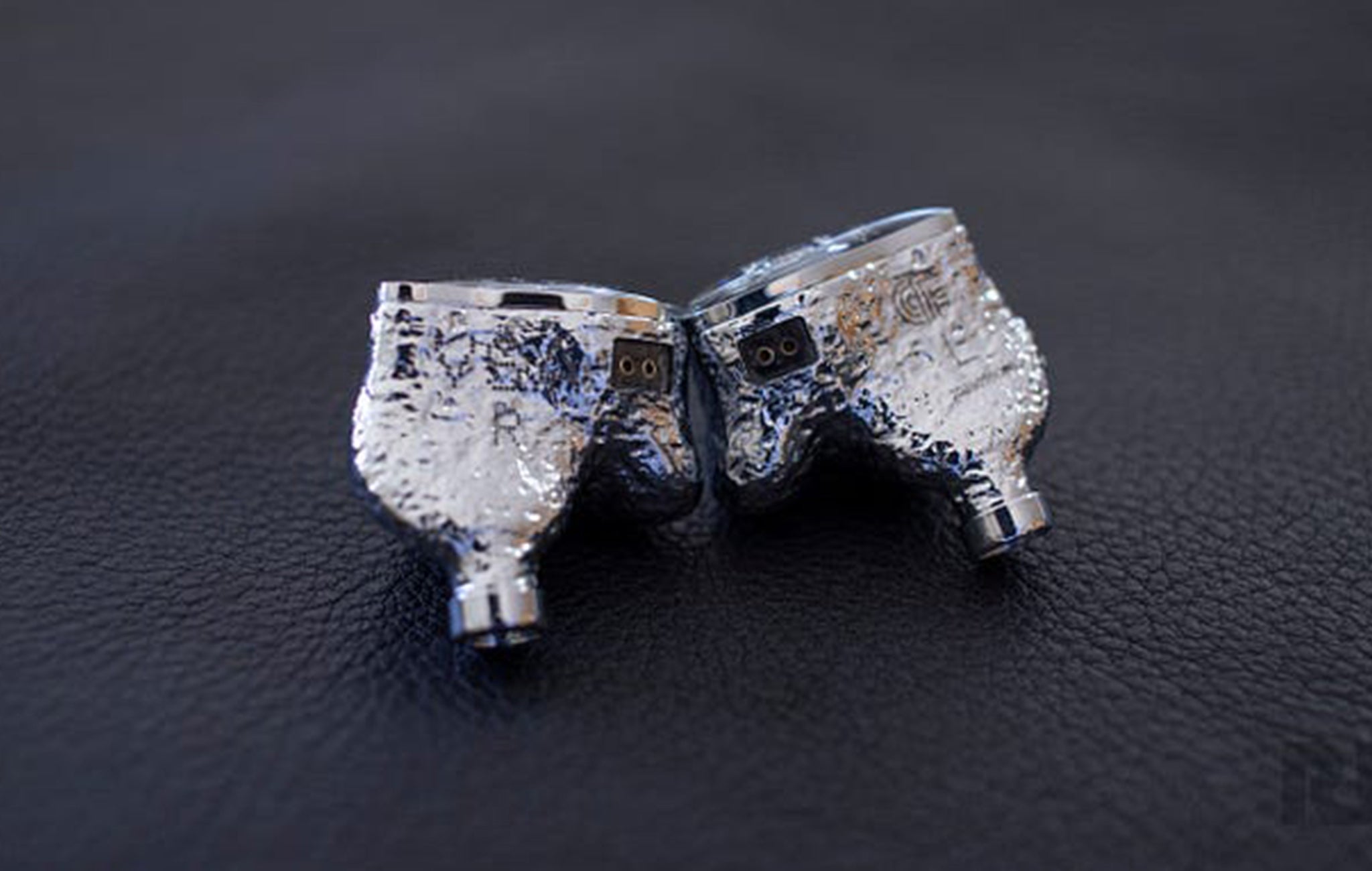
The VSA-PM’s construction is immaculate. Its CNC’d aluminum shells are finely machined and expertly shaped. An IEM this size and weight could easily cut or scratch the ear, but the VSA-PM has been softened and smoothed along each plane. Its nozzles are integrated into the shell’s main part and are similarly-precisely-cut. EAA ensured that the nozzles have an appropriately-wide lip, so swapping eartips is easy work.

The top of the VSA-PM’s shells host their 2-pin connectors. The block is clear plastic, but doesn’t wiggle or flex at all.
 |
 |
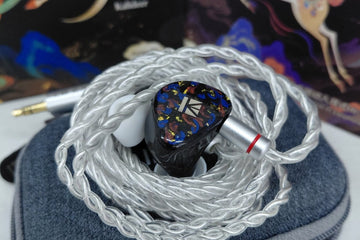
The VSA-PM’s cable is quite nice, and has intricate hardware. Its termination is a fixed 4.4mm plug, though a solid and premium-feeling one.


The attention to detail here is excellent, and EAA ensured that even the 2-pin shells had a bit of flair.
Comfort
Disclaimer: comfort is a highly individual metric — no two people will have the same experience.I struggle to get a seal with EarAcoustic Audio’s IEMs. The VSA-MAX, SPA-LE, SPA-Special Gift, and now the VSA-PM all fail to get a strong seal with their respective stock eartips. That said, the VSA-PM’s upgraded selection of eartips do seal better than the other listed IEMs, but still not as well as with my Plussound Hybrid eartips or Comply foams.
Power
The VSA-PM is easy to drive. At 16ohms of impedance and a sensitivity of 105dB, the VSA-PM requires significantly less power than the Campfire Audio Astrolith and S12 Pro (which is already fairly easy to drive). I was able to get a strong performance from my LG V40 (low gain), HiFiMAN SuperMini, and various USB-C dongles.Warranty and Repair
EarAcoustic Audio implements the same 1-year warranty on the VSA-PM as its other IEMs. They also offer repair services for damaged IEMs, though I don’t have much info about rates. I encourage EAA to:- Increase the duration of the warranty for their flagship IEMs
- Clarify the costs and terms associated with out-of-warranty repair
Accessories
Inside the box, you’ll find:
 |
 |
- 1x Semi-hard carrying case
- 4x Pairs silicone eartips
- 1x Leather cable clasp
Again, the VSA-PM’s inclusions aren’t garbage, but are simply insufficient for a product of this magnitude. And, honestly, an IEM this special deserves something more profound.
Comparisons
Comparisons are selected solely based on what I think is interesting. If you would like me to add more comparisons, feel free to make a request in the comments below!1: Campfire Audio Astrolith ($2199)
The Astrolith is legendary for a reason: it was the first to the market with performance and tuning. And, it does have a few key traits that can make it more-appealing to deep-pocketed buyers. The Astrolith is, firstly, more-ergonomic. Its shells are lighter and better-sculpted for very-long listening sessions. Secondly, the Astrolith’s bass is significantly more-engaging than the VSA-PM’s, at least when your preferences align with mine. This impressive contrast with the Astrolith’s massively detailed, bright, and resolving treble makes for a immersive listening experience in a wide variety of genres.
That said, the Astrolith can very easily step over the line of sonic comfort, leading to ear-exhaustion. The VSA-PM can be listened to for longer, and at higher-volumes, without issue, thanks to its gentler-treble. The VSA-PM’s soundstage may be narrower than the Astrolith’s, but it’s very close in terms of depth. Honestly, if you’re not treble-sensitive, and price isn’t a factor in your choice, you may want to go for the Astrolith and its more-engaging lower-end (and better accessory package). But for those who aren’t bass-centric, or are treble-sensitive, the VSA-PM is the better (and cheaper) choice.
2: EarAcoustics Audio SPA-Limited Edition ($429)

Firstly, the VSA-PM is brighter. It’s not that the treble itself is tuned that differently, but more that the VSA-PM has a “treble shelf” that’s lifted higher overall. Secondly, the VSA-PM has a slightly cooler midrange. The difference isn’t huge, but is one that is audible nonetheless. The VSA-PM’s mid-bass is slightly more-emphasized, as is its sub-bass, compared to the SPA-LE. The SPA-LE’s bass, however, sounds harder and more-precise.
In terms of technical performance, honestly, it’s a toss-up depending on how you interpret the psychoacoustic properties of each driver. The SPA-LE has a specific “spry” and crunchy texturing that’s almost tactile that the VSA-PM does not. The VSA-PM, however, has better extension, particularly in the upper-treble, and leverages that to resolve a lot of textures that the SPA-LE tends to leave deep in the background or miss. Is the VSA-PM a strictly-better IEM? I don’t think so — but it does have distinct advantages in certain key areas. I see myself rotating between these two IEMs, and neither is a clear winner, especially considering their large price differences. Now, if budget is a factor, honestly, you should strongly consider going with the SPA-LE. You get the lions-share of performance with a fraction of the cost, while also getting one of the highest-performance single-DD experiences of 2025. For those who want a more “upscale” experience, the VSA-PM’s extra goodies and exotic driver technology are pretty compelling features.
3: 7Hz Timeless II ($229)
The Timeless II has a strong reputation in the audiophile world and is often a go-to-recommendation for those looking to try out planar IEMs. Some go so far as to use it as their personal benchmark for how planar IEMs should perform. I don’t necessarily agree with that stratagem, but for those listeners, this comparison is for you.
The Timeless II is, clearly, outperformed by the VSA-PM in terms of technical capabilities. Not only does the Timeless II not handle its upper-register perfectly, as it can smudge/smear, but the VSA-PM has it beat on bass control. Tone-wise, the VSA-PM, again, is a winner. All three of the Timeless II’s tuning configurations have issues; and while the VSA-PM isn’t literally flawless, it has a cohesive, organic timbre that the Timeless II just doesn’t compete with.
Now, are these IEMs directly comparable? No, certainly not on price. But it’s worth noting that the VSA-PM does actually get you more in exchange for its $600+ increase in price. Is it worth the increase? I think so, but you’ll have to decide that yourself with an in-person A/B demo.
Conclusion
The VSA-PM is a remarkably-well-tuned planar IEM from EarAcoustic Audio. While it is lacking in the accessory department, and could use a tad more mid and sub-bass intensity, its flexibility and top-notch technical performance make it a compelling competitor in the premium planar IEM market. While there’s more price-conscious planar IEMs out there, the VSA-PM combines outstanding build quality with beautiful tuning in a way that its cheaper counterparts do not.Who This is For
- Those who want a well-executed, resolving planar IEM without sharpness
- Those who want a “north of neutral” planar experience without excess warmth
- Those who want a bright IEM without sibilance
Who This isn’t For
- Those seeking reference sound
- Bassheads
- Listeners with small ears
- Buyers seeking maximum performance-per-dollar