









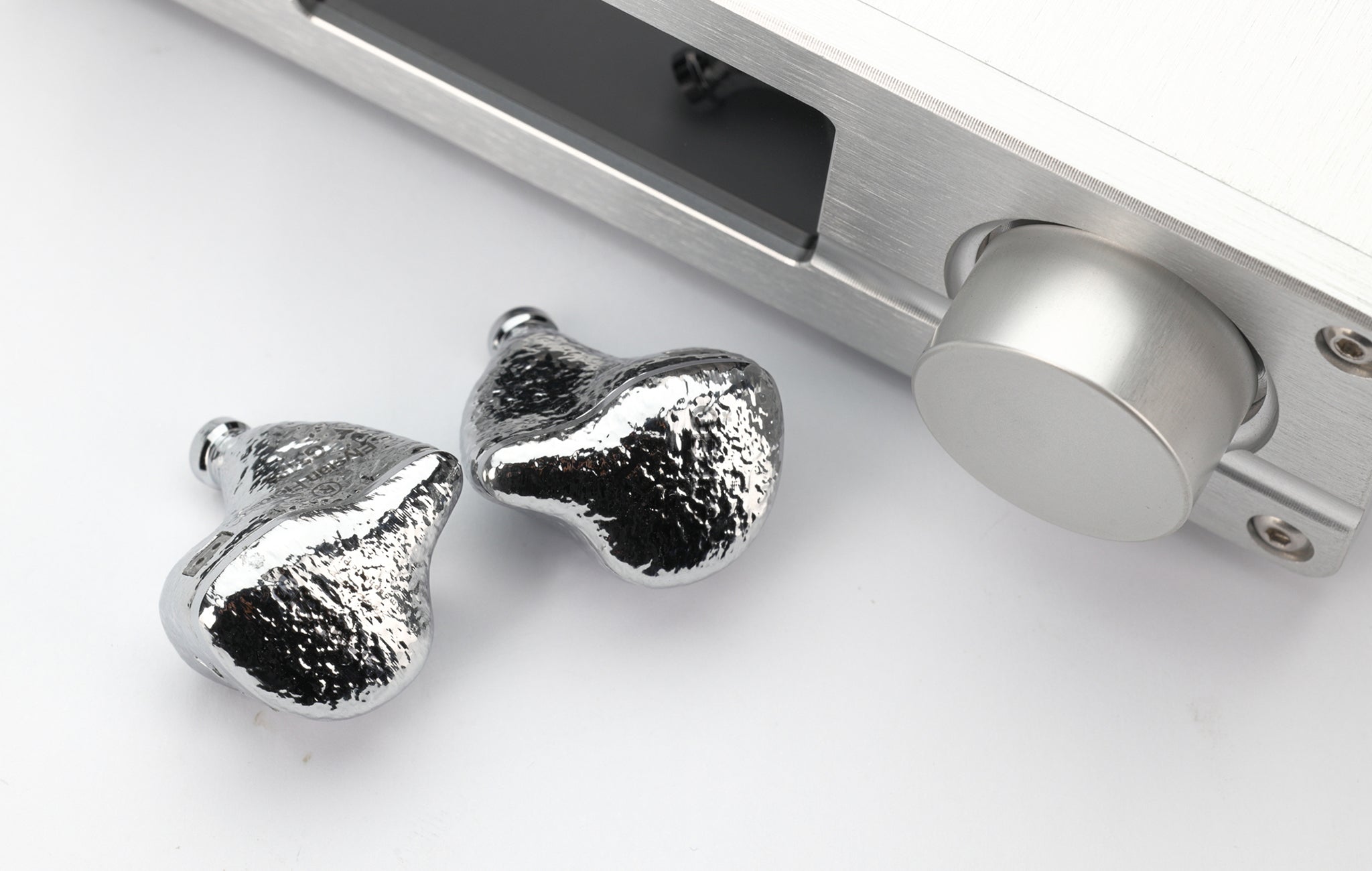


Today, I received the EarAcoustic-Audio GENESIS G318s Elysian Fields, which sells for $249. And I gotta tell you, this is one of the most beautiful shiny all-metal IEMs I’ve seen in my life. GENESIS G318s was sent to me for free in exchange for a review, but no money has exchanged hands. You can rest assured that everything I say in this review is my own thought and opinion.
I am always mesmerized by EarAcoustic-Audio’s design in their IEMs. I am puzzled by how they can make such beautiful shells on some of their IEMs, with patterns and contours, and still keep the cost relatively low.
I’m curious and excited every time I get to review a product with a new material and technology. Upon learning that I’d be reviewing the GENESIS G318s with its 8.3 mm titanium dome + diamond-coated suspension-diaphragm dynamic driver, I hoped it would offer something new and improve the sound.
GENESIS G318s is a limited-edition set and comes with two metal cards indicating the number; the other is personalized with my name. They forgot the letter c; they wrote Mars Han instead of Mars Chan, which is my name.
Will the GENESIS G318s meet my expectations? Or will it sound natural considering its use of esoteric diaphragm material? Find out in the review below.


Features
GENESIS G318s is a single-driver IEM featuring an 8.3 mm dual-magnet, dual-cavity, titanium-dome + diamond-coated-suspension diaphragm dynamic driver with above one Tesla of magnetic strength in the magnet gap.
GENESIS G318s also features a combination of two tuning styles: the so-called vinyl faith tuning + standard response curve, which, to my understanding, combines their own analog style and vintage sound signature, with inspiration from the Harman tuning curve or technical correctness. This is good, as this tuning combination should result in a sound that is neither too colored nor dull.
I’m happy to report that the GENESIS G318s features, in my opinion, the most important feature: a pressure relief system. This feature can prevent pressure buildup in the ear canal, which can cause headache, earache, nausea, and fatigue. GENESIS G318s don’t have that issue.
Design
In person, the GENESIS G318s look like jewelry or at least a decoration for the body; the all-metal, chrome finish shells have some random carving which somewhat resembles Hershey's kisses. The shell itself is slightly larger than average, but the 7.9-gram weight is average.
The nozzle and the shell are made from a single piece of metal, while the faceplate is a separate piece. Overall, the shell has a homogeneous look. There is a GENESIS logo on both the left and right faceplates. I don’t see a vent hole near the nozzle, but I see a tiny hole near the semi-recessed 2-pin connectors.
What makes this design special for me is that it is not a fingerprint magnet, thanks to the surface textures, unlike other IEMs with a chrome-like finish, where the smallest fingerprints and skin oil are very apparent.

Cable
GENESIS G318s comes with a very nice black nylon-sleeved 2-core cable made of Litz coaxial silver-plated oxygen-free copper wires, with 2-pin connectors and a 4.4 mm balanced plug. The cable is thick yet light and has enough stiffness to reduce tangling.
All the parts besides the wires are made of metal, and there is an ELYSIAN FIELDS branding on the plug and a serial number on the divider. However, I would have to say that the cable is on the stiffer side of normal.
Comfort and Isolation
I experience excellent comfort with the GENESIS G318s, thanks to its average weight, not-so-big size, ergonomically shaped shell, an average 6 mm nozzle diameter, and the aforementioned pressure relief system. I find it very comfortable for long listening sessions and during walking exercises.
Isolation is good; the ear tips and the shell seal well, and I get a slightly above-average noise isolation performance. Noise can come in, but it sounds muffled and can easily be drowned out by the music, even at low volume.


Packaging & Accessories
The black 250 x 160 x 70 mm box is big for an IEM set. The packaging design is neither simple nor elaborate. A black cardboard sleeve is printed with the IEM photo and surrounding text. There are two metal cards in front, indicating the serial number and the reviewer's name.
The package includes a pair of IEMs, a user manual, a nice-looking leather storage case, a cable, and seven pairs of ear tips.
Listening Condition
My standard burn-in period is 24 hours, however a friend told me the GENESIS G318s would benefit with much longer burn in period like a hundred hours, since I am busy with other reviews at that time, and no way I would review the GENESIS G318s soon, I did the 100 hour burn in, however, consumers don’t need to burn-in their IEMs, as they will burn-in naturally with regular use over time.
My burn-in method involves leaving the GENESIS G318s playing at my normal listening volume, continuously with a spare DAP for many hours a day, and checking in from time to time.
I used various sources, including the iBasso DC Elite and MUSE HIFI M6 Double, paired with my OnePlus 13 phone and my Fiio M15s DAP. The default sound settings were employed without any sound enhancement or equalization using the Sony, Poweramp, and UAPP music player apps.
I used the stock cable and the stock black ear tips throughout the review.

Measurement
My measurement shows a very good channel balance; there is a minor and inaudible imbalance below 100 Hz but above 500 Hz. GENESIS G318s is perfectly channel balanced. Indicating a good manufacturing quality.
The bass has a 12 dB of elevation, and the pinna gain has 11 dB at 2.5 kHz. There is a perceivable energy at 5 kHz. Still, the 8 kHz peak is inaudible, or at least not as peaky as in the graph, as it is a measurement artifact caused by the cavity resonance in my measuring tool. The upper treble peak adds air to the sound.
Sound Signature
That said, the GENESIS G318s has a bassy, moderately V-shaped sound signature characterized by apparently boosted bass, a slightly recessed midrange, an elevated, somewhat near-neutral pinna gain, and a slightly relaxed, smooth treble with a very extended upper treble.
The first thing I noticed was that the GENESIS G318s has a tight, deep, and impactful-sounding bass that is nicely textured and articulate. There is a deep rumbling subbass when the music demands it, and there is also good upper-bass presence; however, the bass balance is slightly biased toward midbass, where the majority of the bass notes I hear come from.
Midrange is neutral, including the upper midrange, as I don’t hear any shoutiness from high pinna gain, yet I hear good vocal presence and good imaging.
Aside from the deep, rumbling, powerful-sounding bass, I also noticed the unusually clean vocal and treble performance. There are a lot of details, resolution, and clarity, yet GENESIS G318s remain clean and non-fatiguing. At the first hearing of the GENESIS G318s, I was impressed by its strong technical performance.
Thankfully, GENESIS G318s is not a clinical, dry, or fatiguing-sounding set, which saves me from the agony of reviewing one. The combination tuning of the so-called vinyl faith tuning, coined by EarAcoustic-Audio, plus the standard response curve inspired by the global tuning standard, presumably Harman, might actually be true after all, and not just a promise.
However, if I had to nitpick the sound, I noticed a slight excess of energy around 5 kHz; it is not readily obvious, but on some songs, it adds a slight accentuation to the attack of the snare drum, cowbells, and other percussive instruments. It also adds excitement to the sound, making the GENESIS G318s sound more engaging when comaped to a dull-sounding neutral set. GENESIS G318s never sounded obviously colored or sibilant.
Technicalities
Thanks to the GENESIS G318s’ clean, high-resolution sound. The soundstage is big and spacious, and the stage is wide with very good depth and height. Making the stage near spherical with a good surround effect on some songs. There is a sensation that some instruments are coming from outside the head, and not just happening between the ears.
That said, GENESIS G318s imaging is good as well; there is good edge definition across all instruments, and there are spaces between them, so they seem to float right in front of me. When instruments pan laterally, the images never disintegrate anywhere on the stage; they remain intact.
The center vocals are remarkably good as well; it doesn’t favor male or female voices, it does them equally well. I hear good edge definition in the center vocals, with the backup singers and background instruments placed behind it. I must say, the GENESIS G318s has good image separation and layering, and a three-dimensional feel to its soundstage presentation.
I hear very good dynamics as well, especially in the bass. The overall sound of the GENESIS G318s is energetic and lively, even at low volumes, without becoming annoying; it sounds relaxed when the music is relaxed. I tried the GENESIS G318s at a loud volume to see its limits, and I must say, it can take a lot of power and go very loud without distorting or compressing. My hearing would be the first to do those. I also feel that it is efficient to drive.

GENESIS G318s pairs nicely with my iBasso DC Elite, MUSE HIFI M6 Double, and Fiio M15s, revealing the differences in sound among them.
When paired with the iBasso DC Elite, I can hear its ultra-detailed sound presentation, which I love about the DC Elite. And the slightly U-shaped tonality is revealed by the GENESIS G318s. In tube mode, I enjoy the MUSE HIFI M6 Double's tubey sound, no treble roll-off, and vintage/analog-like presentation.
And finally, with the Fiio M15s, I feel the increase in power, the tightness in the bass, as well as the sound's authority and control. There is an apparent increase in dynamics.
GENESIS G318s pairs well with all sources in this review, as well as with others not in this review, including small, lower-powered dongle DACs. I attribute this to the GENESIS G318s' easy-to-drive, efficient drivers.


I used all the sources in this review for this comparison, but I decided to mainly use the iBasso DC Elite, as I can hear the difference between the IEMs more easily with it.
Dunu Falcon Ultra
Falcon Ultra features Dunu’s All-New 2nd Generation ECLIPSƎ Architecture and Ring-Type Magnet Assembly with lithium-magnesium alloy dome diaphragm driver. Falcon Ultra has an impedance of 16 Ohms and a sensitivity of 108 dB.
Tonally, Falcon Ultra is more neutral, with much less boosted bass, a neutral midrange, and a neutral treble, while the GENESIS G318s has much more boosted bass and treble. There is a stark difference in sound when I switch between the two, and aside from the bass difference, I noticed much smoother treble with the GENESIS G318s.
When it comes to soundstaging, I find the GENESIS G318s apparently wider with about equal depth and height. I also find that the GENESIS G318s have a more defined, clearer sound at first, but with further listening, they are about equal. This must be due to the slightly elevated upper midrange and lower treble, which makes the vocals more forward in comparison.
In terms of dynamics, both are energetic. While the GENESIS G318s is most dynamic in the bass, the Falcon Ultra is more even across the frequency range. Both can take a lot of power without distorting and compressing, and seem to be efficient to drive.

Hidizs MK12 Turris Titanium Limited Edition
MK12 Limited Edition features a 12mm 91 percent pure magnesium diaphragm driver. A powerful motor system that reaches 1.5 Tesla of magnetic strength in the magnet gap, driving the larger-than-usual diaphragm. MK12 Limited Edition has an impedance of 32 Ohms and a sensitivity of 111 dB.
Both the GENESIS G318s and the MK12 Limited Edition use esoteric materials for their diaphragm dome. I don’t know the purity of the titanium dome on the GENESIS G318s’ 8.3 mm dynamic driver, but the MK12 Limited Edition has a bigger 12 mm 91 percent pure magnesium dome diaphragm dynamic driver.
Both are equally bassy, but the MK12 Limited Edition has a more prominent upper midrange, making the vocals sound more forward. Add to that the MK12’s polite-sounding treble, and the vocals have the purity of tones not found in common IEMs, at the expense of micro details in the treble.
GENESIS G318s has a similar purity of tones in the vocal region, albeit to a lesser degree, and the treble in GENESIS G318s is less polite than that of the MK12 Limited Edition.
In terms of soundstaging, GENESIS G318s has a wider soundstage with about equal depth and height compared to the MK12 Limited Edition. Regarding imaging, both are good, but I noticed a slightly more defined center image with the GENESIS G318s; the difference is small.
Both are energetic in their dynamics, especially in the bass. I find both engaging and lively-sounding, never lifeless and anaemic. Both can take a lot of power without distorting and compressing, and seem to be efficient to drive.

EarAcoustic-Audio SPA Pro Max
SPA Pro Max is an earlier release by EarAcoustic-Audio, and one of the first releases by the brand, released in April 2025. It features an 11.4 mm Graphene Diaphragm Dual Magnetic Dual Chamber dynamic driver. SPA Pro Max has an impedance of 30 Ohms and a sensitivity of 111 dB.
SPA Pro Max is much more V-shaped-sounding, with a perceivably more boosted bass, a deeper, recessed midrange, and a more forward treble. I am happy that EarAcoustic-Audio made the GENESIS G318s with a different tuning, featuring a less V-shaped sound and a smooth treble with improved cleanliness and micro details.
I find the SPA Pro Max has a darker stage with less width and feels more intimate, while the GENESIS G318s has a wider, livelier stage and sounds more spacious. In terms of imaging, the GENESIS G318s has more accurate, defined images; SPA Pro Max’s imaging, especially the center vocals, is somewhat too laid-back.
Both are dynamic-sounding, but the SPA Pro Max is less so in the mids, while the GENESIS G318s is more even overall across the frequency range. Both can take a lot of power without distorting and compressing, and seem to be efficient to drive.
GENESIS G318s Technical Details
Model name: GENESIS G318s
Driver configuration: 1 x 8.3 mm dual magnet, dual cavity
Diaphragm: Titanium dome + diamond-coated suspension
Cable material: Litz coaxial silver-plated oxygen-free copper
Connector: detachable, .78mm 2-pin
Cable length: 1.2mm
Plug: 4.4mm balance
Frequency response: 20Hz-20kHz
Sensitivity: 110 dB
Impedance: 38 Ohms
Weight: 7.9 grams each
Nozzle diameter: 6 mm
Pros
-Clean, detailed, and technical sound without sounding clinical.
-Highly resolved.
-Big soundstage and good imaging.
Cons
-Too much bass for people looking for neutrality.Conclusion
The EarAcoustic-Audio GENESIS G318s Elysian Fields has slightly exceeded my expectations, as I was surprised by how many micro details and resolution I get from its new tuning style and the 8.3 mm titanium dome + diamond-coated surround diaphragm dynamic driver. It seems like EarAcoustic-Audio delivered its promise of improved sound due to these two factors.
I highly appreciate GENESIS G318's beautiful design, the new tuning style, and the latest driver’s technical capability, as I enjoyed a musically engaging sound with very technical performance without sounding cold, analytical, and dry.
There is not much to complain about with the GENESIS G318s, but if I have to nitpick, I wish there were a little less bass and more treble energy. I also like it to have slightly more midrange and make the overall tuning more neutral. As it is, there is nothing wrong with it.
Still, I do wish that EarAcoustic-Audio made IEMs closer to neutral with the same technical capabilities as the GENESIS G318s.
All in all, EarAcoustic-Audio GENESIS G318s Elysian Fields offers surprisingly refined sound quality. I recommend you give it a high consideration if you are looking for a good-sounding single dynamic-driver in-ear monitor.
Non-affiliated purchase link:


