






DISCLAIMER
I would like to thank Tangzu Audio for providing this review unit. The Zetian Wu can be gotten here 40% OFF(no affiliate links): https://keephifi.com/discount/zetianwu-blog?redirect=%2Fproducts%2Ftangzu-zetian-wu-14-5mm-planar-magnetic-drivers-iem-earphones-in-ear-monitors.
I would like to thank Tangzu Audio for providing this review unit. The Zetian Wu can be gotten here 40% OFF(no affiliate links): https://keephifi.com/discount/zetianwu-blog?redirect=%2Fproducts%2Ftangzu-zetian-wu-14-5mm-planar-magnetic-drivers-iem-earphones-in-ear-monitors.

INTRODUCTION
Tangzu Audio (previously known as Tforce Audio) names their IEMs after famous historical figures of ancient China; storied characters such as Li Shimin, Li Yuan and a yet-to-be-released Shangguan Wan'er, are all IEMs gracing the Tangzu Audio stable.
The Zetian Wu IEM is no different. So who is Wu Zetian?
She ruled the Tang Dynasty in China from 665 - 705 AD, and remarkably, she was the first and only recognized female emperor of China. During her reign, China grew prosperous and influential, enlarged its borders and developed huge economic gains. Albeit, there was a dark side, as she had a controversial reputation of being heavy-handed during her rule.
Nevertheless, Wu Zetian was a well-regarded poet, she reformed the military, developed agriculture and promoted education among the people; her legacy continues on to this day.
SPECIFICATIONS
ACCESSORIES
Other than the IEM, these are included:
- Cable
- Semi-rigid carry case
- 3 pairs of bass silicone tips (S/M/L)
- 3 pairs of balanced silicone tips (S/M/L)
- 1 pair of wide bore tips
In an era of hackneyed anime waifu babes on CHIFI packaging (cough coughTanchjim, Moondrop), Tangzu Audio provides a very refreshing packaging with some ancient Chinese calligraphic brush strokes and a more elegant and mature royal princess on the outer sleeve.
An inner insert with calligraphic motifs completes the packaging.
Tangzu Audio (previously known as Tforce Audio) names their IEMs after famous historical figures of ancient China; storied characters such as Li Shimin, Li Yuan and a yet-to-be-released Shangguan Wan'er, are all IEMs gracing the Tangzu Audio stable.
The Zetian Wu IEM is no different. So who is Wu Zetian?
She ruled the Tang Dynasty in China from 665 - 705 AD, and remarkably, she was the first and only recognized female emperor of China. During her reign, China grew prosperous and influential, enlarged its borders and developed huge economic gains. Albeit, there was a dark side, as she had a controversial reputation of being heavy-handed during her rule.
Nevertheless, Wu Zetian was a well-regarded poet, she reformed the military, developed agriculture and promoted education among the people; her legacy continues on to this day.
SPECIFICATIONS
- Driver configuration: 14.5 mm planar driver
- Frequency response: 20 Hz – 20000 Hz
- Impedance: 16 Ohms
- Sensitivity: 100 dB (no units provided)
- Cable: 0.78 mm 2 pin, 5N OFC; choice of 3.5 or 4.4 mm termination
- Tested at $145 USD (4.4 mm cable), 138 USD (3.5 mm cable)
ACCESSORIES
Other than the IEM, these are included:
- Cable
- Semi-rigid carry case
- 3 pairs of bass silicone tips (S/M/L)
- 3 pairs of balanced silicone tips (S/M/L)
- 1 pair of wide bore tips
In an era of hackneyed anime waifu babes on CHIFI packaging (cough cough
An inner insert with calligraphic motifs completes the packaging.

The accessories are quite generous, nothing to complain about. Everything is quite usable out of the box, with no need to source for aftermarket accessories.

A myriad of tips are provided.
The bass tips have a narrower bore and boost the bass frequencies as advertised, though perhaps the soundstage may come across as slightly more intimate when they are installed.
A white set of wide bore tips increase the upper frequencies and improve soundstage perception.
The balanced tips are a mid-point between the above 2 tips. Do explore tip-rolling to see which tips suit your preference, as eartips are as personal as shoes, and not only affect sonic fidelity, but also isolation and comfort.
The bass tips have a narrower bore and boost the bass frequencies as advertised, though perhaps the soundstage may come across as slightly more intimate when they are installed.
A white set of wide bore tips increase the upper frequencies and improve soundstage perception.
The balanced tips are a mid-point between the above 2 tips. Do explore tip-rolling to see which tips suit your preference, as eartips are as personal as shoes, and not only affect sonic fidelity, but also isolation and comfort.

During ordering, one can opt for a 3.5 mm (single-ended) or 4.4 mm (balanced) termination for the cable. The provided cable is a 5N OFC cable, it is very well braided and tangle-free but has slight microphonics. An added chin-cinch provides stability during use.
I liked that it came in a 2-pin configuration, as I had my fair share of MMCX mishaps during frequent cable changes.
I liked that it came in a 2-pin configuration, as I had my fair share of MMCX mishaps during frequent cable changes.

The provided semi-rigid case is really one of the biggest IEM cases I've come across in my IEM journey. The insides are lined with a velvet material with webbing, and this case is elegant and hardy (though perhaps on the slightly larger side for portability).
The rest of this review was done with the stock cable and stock "balanced" tips. No aftermarket accessories were used, so as not to add any confounders to the sound.
BUILD/COMFORT
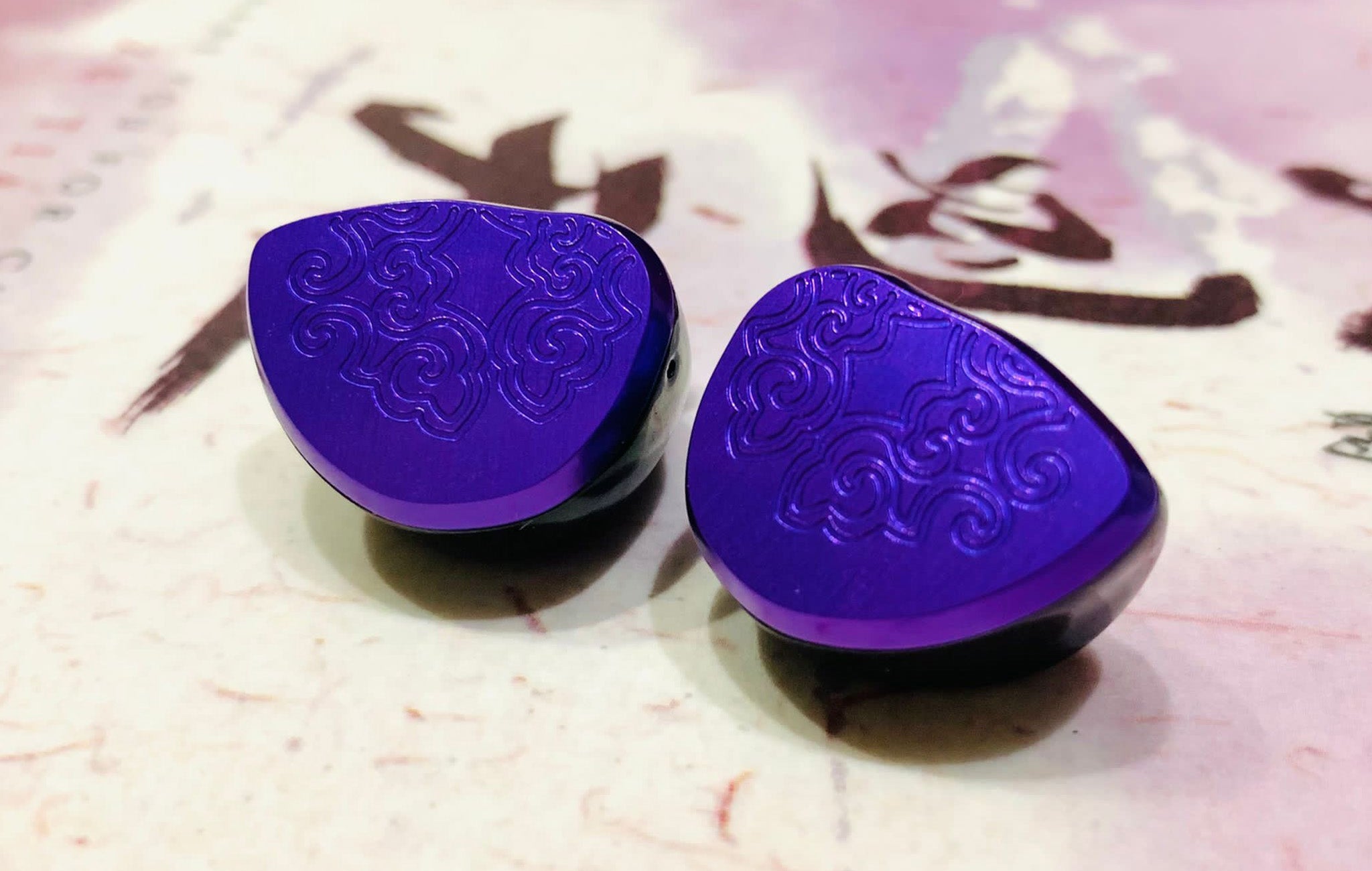
The Zetian Wu's faceplates are coloured purple (which in ancient China was the colour for nobility). There is an auspicious Chinese cloud pattern etched on the shells, amalgamating the ancient Chinese packaging/motif with the housings.
The rest of this review was done with the stock cable and stock "balanced" tips. No aftermarket accessories were used, so as not to add any confounders to the sound.
BUILD/COMFORT
The Zetian Wu's faceplates are coloured purple (which in ancient China was the colour for nobility). There is an auspicious Chinese cloud pattern etched on the shells, amalgamating the ancient Chinese packaging/motif with the housings.

The inner part of the shells are manufactured from 3D printed resin, whereas the faceplate is manufactured from CNC machining.
Ergonomics are top-notch, the shells are light and they are more comfortable than some planar rivals (which we will discuss below). There are no weird protruding edges, the inner aspects are smooth, with a concha protrusion providing some grip during usage. Tangzu Audio advertises that they designed the shells after accruing data of many human ears, and perhaps this is no hyperbole.
Ergonomics are top-notch, the shells are light and they are more comfortable than some planar rivals (which we will discuss below). There are no weird protruding edges, the inner aspects are smooth, with a concha protrusion providing some grip during usage. Tangzu Audio advertises that they designed the shells after accruing data of many human ears, and perhaps this is no hyperbole.

ISOLATION
Being vented, isolation is average, but the Zetian Wu are usable outdoors.
DRIVABILITY
I tested the Tangzu Zetian Wu with:
- Khadas Tone Board -> Schiit Asgard 3 amp
- Khadas Tone Board -> Topping L30 amp
- Sony Walkman NW A-55 DAP (Walkman One WM1Z Plus v2 Mod)
- Sony Walkman NW A-55 DAP (Walkman One Neutral Mod)
- Questyle M15 DAC/AMP dongle
- E1DA DAC/AMP dongle
- Colorfly CDA M1 DAC/AMP dongle
- Tempotec Sonata HD Pro dongle (BHD firmware)
- Smartphone
The Zetian Wu is relatively easy to drive for a planar, but it scales with amplification. Dynamics, bass tightness, micro-details and soundstage improve when juiced well.
SOUND & TECHNICALITIES
The Zetian Wu sports a well-balanced U-shaped signature. In essence, the Zetian Wu pairs well with most music genres, and ain't a one trick pony (unlike for example the Moondrop Stellaris) in terms of tuning.
Being vented, isolation is average, but the Zetian Wu are usable outdoors.
DRIVABILITY
I tested the Tangzu Zetian Wu with:
- Khadas Tone Board -> Schiit Asgard 3 amp
- Khadas Tone Board -> Topping L30 amp
- Sony Walkman NW A-55 DAP (Walkman One WM1Z Plus v2 Mod)
- Sony Walkman NW A-55 DAP (Walkman One Neutral Mod)
- Questyle M15 DAC/AMP dongle
- E1DA DAC/AMP dongle
- Colorfly CDA M1 DAC/AMP dongle
- Tempotec Sonata HD Pro dongle (BHD firmware)
- Smartphone
The Zetian Wu is relatively easy to drive for a planar, but it scales with amplification. Dynamics, bass tightness, micro-details and soundstage improve when juiced well.
SOUND & TECHNICALITIES
The Zetian Wu sports a well-balanced U-shaped signature. In essence, the Zetian Wu pairs well with most music genres, and ain't a one trick pony (unlike for example the Moondrop Stellaris) in terms of tuning.

Frequency response graph of the Tangzu Audio Zetian Wu via IEC711 compliant coupler. The 8 kHz area is a coupler artefact peak.
The Zetian Wu has bass north of neutral, but it is not a basshead set. Sub-bass is not the deepest in extension, but where songs have a rumble in the bassline, it will be heard. The mid-bass has moderate speed, and may sound one-noted at times with a lack of texturing. During very complex or fast bass lines, the bass may sound smeared at times. Thankfully, amplification improves the tightness of the bass somewhat.
Lower mids are a tinge recessed, with the upper mids having a slight boost. Vocals are forwards without being shouty, and the midrange is tuned quite well.
The lower treble continues on from the boosted upper midrange, this area is quite non-fatiguing. There's minimal sibilance, and the upper treble rolls off thereafter. Cymbals and high-hats are very natural sounding, unlike the S12 Pro. The treble is very safe: treble-heads might want more pizazz, but treble-sensitive folk will love the treble tuning here.
Most planar IEMs have an artificial sheen for timbral accuracy, with respect to vocals and acoustic instruments, possibly because they have lightning-fast transients, so things may sound unnatural, especially if one listens to music genres like classical and jazz. I'm really glad to report that the Zetian Wu sounds the most natural of the planars I've tried, with no artificial planar timbre on display.
Note weight is on the thicker side compared to the other planars, and the natural timbre and tonality make it a joy to listen to, after coming from the other traditional planar rivals.
In technicalities, imaging, instrument separation, micro-details and clarity are probably bang average for a midFI planar. Some of their competitors like the Stellaris, S12 Pro and Talos are better in this department, though they perhaps have worse timbre and/or tonal flaws (we will discuss below). While different eartips may affect soundstage perception, I would say the Zetian Wu has above average soundstage width and height, though perhaps not the best depth.
COMPARISONS
The Zetian Wu has bass north of neutral, but it is not a basshead set. Sub-bass is not the deepest in extension, but where songs have a rumble in the bassline, it will be heard. The mid-bass has moderate speed, and may sound one-noted at times with a lack of texturing. During very complex or fast bass lines, the bass may sound smeared at times. Thankfully, amplification improves the tightness of the bass somewhat.
Lower mids are a tinge recessed, with the upper mids having a slight boost. Vocals are forwards without being shouty, and the midrange is tuned quite well.
The lower treble continues on from the boosted upper midrange, this area is quite non-fatiguing. There's minimal sibilance, and the upper treble rolls off thereafter. Cymbals and high-hats are very natural sounding, unlike the S12 Pro. The treble is very safe: treble-heads might want more pizazz, but treble-sensitive folk will love the treble tuning here.
Most planar IEMs have an artificial sheen for timbral accuracy, with respect to vocals and acoustic instruments, possibly because they have lightning-fast transients, so things may sound unnatural, especially if one listens to music genres like classical and jazz. I'm really glad to report that the Zetian Wu sounds the most natural of the planars I've tried, with no artificial planar timbre on display.
Note weight is on the thicker side compared to the other planars, and the natural timbre and tonality make it a joy to listen to, after coming from the other traditional planar rivals.
In technicalities, imaging, instrument separation, micro-details and clarity are probably bang average for a midFI planar. Some of their competitors like the Stellaris, S12 Pro and Talos are better in this department, though they perhaps have worse timbre and/or tonal flaws (we will discuss below). While different eartips may affect soundstage perception, I would say the Zetian Wu has above average soundstage width and height, though perhaps not the best depth.
COMPARISONS

Comparisons were made with other midFI planars. Pure BAs, hybrids and single DDs and other driver types were left out of the equation as the different transducers have their pros and cons.
Shuoer S12 Pro
The Shuoer S12 Pro is more V shaped, and is much brighter with a thinner note weight. The S12 Pro has more sibilance and can be fatiguing for treble-sensitive folk. Timbre is noticeably more artificial on the S12 Pro.
The S12 Pro has better technicalities (imaging, instrument separation, clarity, transients, micro-details).
The S12 Pro has a modular cable, though fit is worst on it.
DUNU Talos (pure planar mode)
The Talos has a hybrid (BA + planar) and a normal pure planar mode. For the purposes of comparison, only the pure planar mode will be used (but suffice to say the hybrid mode with BA is super bright and fatiguing, and probably most consumers will not be using this mode anyway).
The pure planar mode of the Talos is more neutral bright than the U-shaped Zetian Wu. The Talos has less bass quantity and sub-bass extension than the Zetian Wu, but bass quality is superior.
The Talos has a thinner note weight and a more artificial timbre for acoustic instruments and vocals. However, the Talos is a league ahead in technicalities, with better imaging, instrument separation, clarity, micro-details, soundstage and transients.
Fit is a bit more uncomfortable on the Talos.
Moondrop Stellaris
The Stellaris is literally a Moondrop SSR on steroids, with a very bright niche and extreme tuning. The Stellaris has a thinner note weight, with much more sibilance and harshness in the treble. Vocals sound nasal and the tonality is unnaturally skewed to the upper frequencies, with the timbre sounding very wonky.
Shuoer S12 Pro
The Shuoer S12 Pro is more V shaped, and is much brighter with a thinner note weight. The S12 Pro has more sibilance and can be fatiguing for treble-sensitive folk. Timbre is noticeably more artificial on the S12 Pro.
The S12 Pro has better technicalities (imaging, instrument separation, clarity, transients, micro-details).
The S12 Pro has a modular cable, though fit is worst on it.
DUNU Talos (pure planar mode)
The Talos has a hybrid (BA + planar) and a normal pure planar mode. For the purposes of comparison, only the pure planar mode will be used (but suffice to say the hybrid mode with BA is super bright and fatiguing, and probably most consumers will not be using this mode anyway).
The pure planar mode of the Talos is more neutral bright than the U-shaped Zetian Wu. The Talos has less bass quantity and sub-bass extension than the Zetian Wu, but bass quality is superior.
The Talos has a thinner note weight and a more artificial timbre for acoustic instruments and vocals. However, the Talos is a league ahead in technicalities, with better imaging, instrument separation, clarity, micro-details, soundstage and transients.
Fit is a bit more uncomfortable on the Talos.
Moondrop Stellaris
The Stellaris is literally a Moondrop SSR on steroids, with a very bright niche and extreme tuning. The Stellaris has a thinner note weight, with much more sibilance and harshness in the treble. Vocals sound nasal and the tonality is unnaturally skewed to the upper frequencies, with the timbre sounding very wonky.
However, the Stellaris is more technical, with better imaging, clarity, micro-details and instrument separation than the Zetian Wu. The Stellaris has more air, sparkle, and a more expansive soundstage too.
Fit is very uncomfortable on the Stellaris due to a long nozzle and heavy shell.
CONCLUSIONS
Fit is very uncomfortable on the Stellaris due to a long nozzle and heavy shell.
CONCLUSIONS

The Zetian Wu is a well-balanced U-shaped planar that is pretty all-rounded for most music genres. While it may not be the most technical planar, the Zetian Wu sounds the most natural in terms of tonality and timbre, compared to other planar brethren, which may have flaws in these departments. As such, this allows the Zetian Wu to stand out from the competition.
The fit is also better than the other planar contemporaries, and the Zetian Wu comes with an attractive design and packaging, ergonomic fit and decent accessories. The Zetian Wu is also very suitable for treble-sensitive users.
Having said that, some areas for improvement include a not-so-tight bass with lack of treble sparkle/air, though these areas may be mitigated to some extent with eartip/source pairing.
Courses for horses, different strokes for different folks, some prioritize timbre/tonality over technicalities, and vice versa; but for those who already own one of the technical steroid-infused planar behemoths, the Zetian Wu has my recommendation, as it brings something very different to the planar buffet table.
The fit is also better than the other planar contemporaries, and the Zetian Wu comes with an attractive design and packaging, ergonomic fit and decent accessories. The Zetian Wu is also very suitable for treble-sensitive users.
Having said that, some areas for improvement include a not-so-tight bass with lack of treble sparkle/air, though these areas may be mitigated to some extent with eartip/source pairing.
Courses for horses, different strokes for different folks, some prioritize timbre/tonality over technicalities, and vice versa; but for those who already own one of the technical steroid-infused planar behemoths, the Zetian Wu has my recommendation, as it brings something very different to the planar buffet table.