






Introduction
TRI, something like KBEAR's luxury brand, has launched a new dongle with a starting price of $69. Its full name is TRI Third Eye TK1. Inside, it uses the now classic and somewhat outdated Cirrus Logic CS43131 DAC in dual-channel mode. It uses femtosecond-grade crystal oscillators and ultra-low noise LDOs. It also adopts a low-power circuit design and supports PCM decoding up to 384kHz/32bit and DSD256 hardware decoding. Its tonal balance is neutral-warm for relaxed, fatigue-free listening. It has an internal multicolour LED that can be seen through its translucent panels, indicating the audio format being played (green for PCM, red for DSD). It also features three buttons for volume up/down and play/pause. It has a USB Type-C input port and two headphone outputs: 3.5mm SE and 4.4mm BAL. There are two accessory options to choose from: one with a USB Type-C to Type-C cable (plus USB Type-A adapter), and the other with a Type-C to Lightning cable. It measures 57x23.7x12.1mm and is compatible with headphones with a microphone.
This is all the information provided by the brand. Now we will see my impressions of this product and, as always, its measurements and sound.

Specifications

Packaging
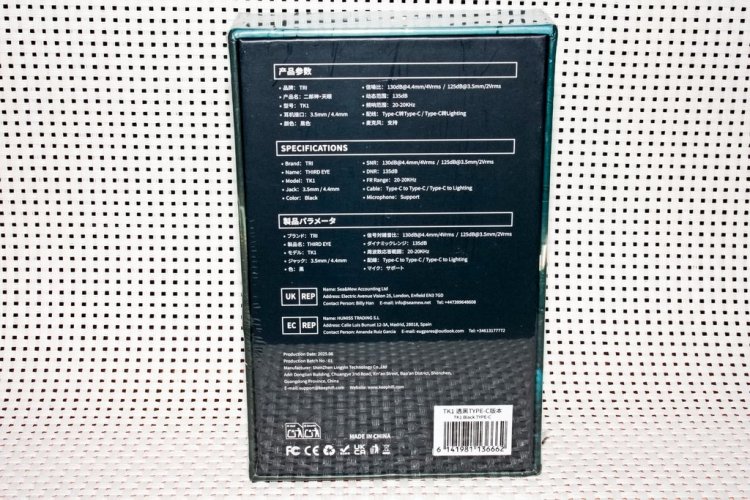
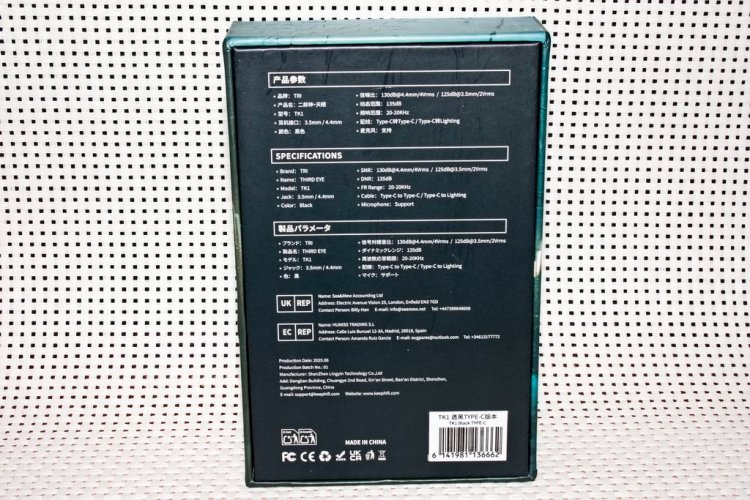
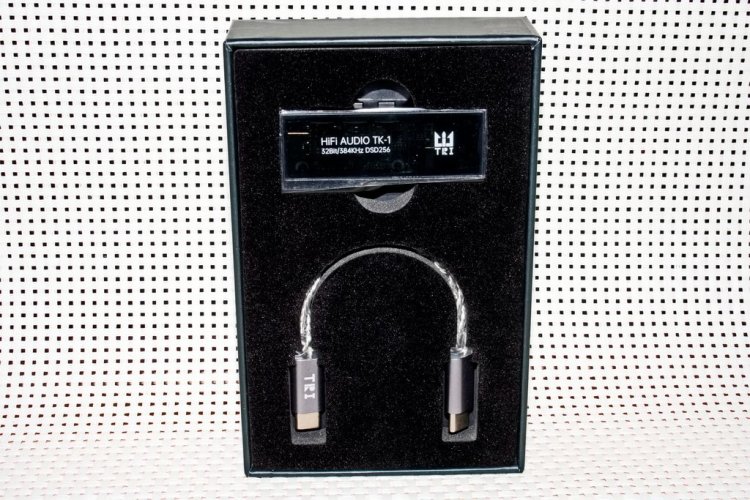
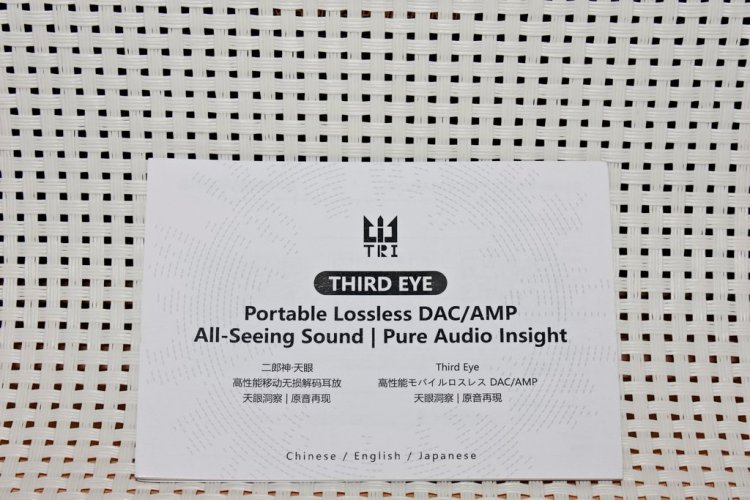
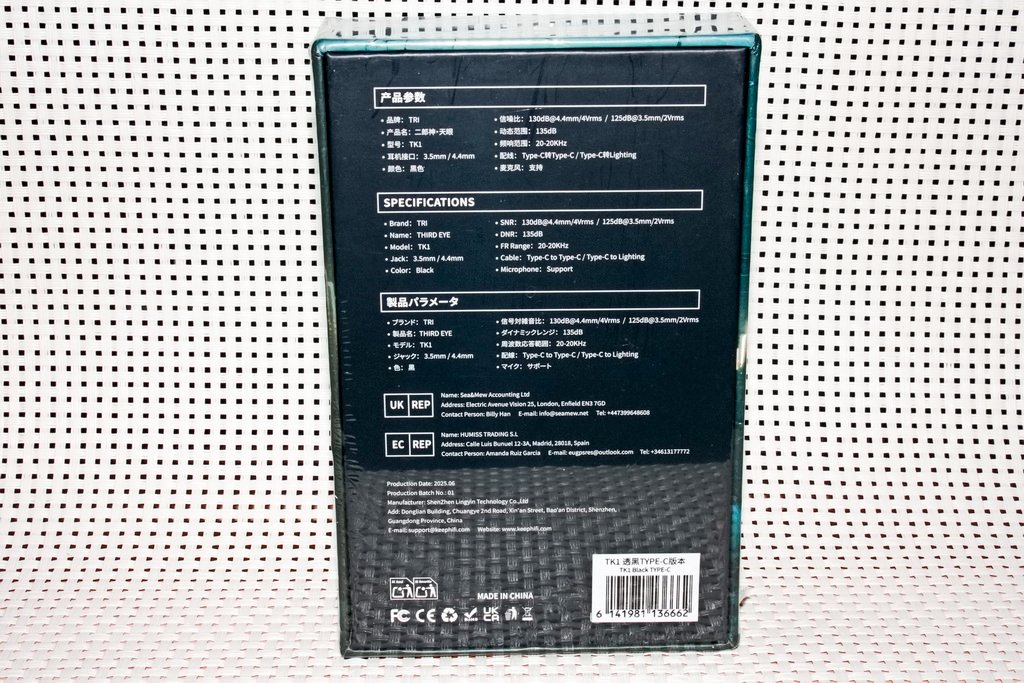
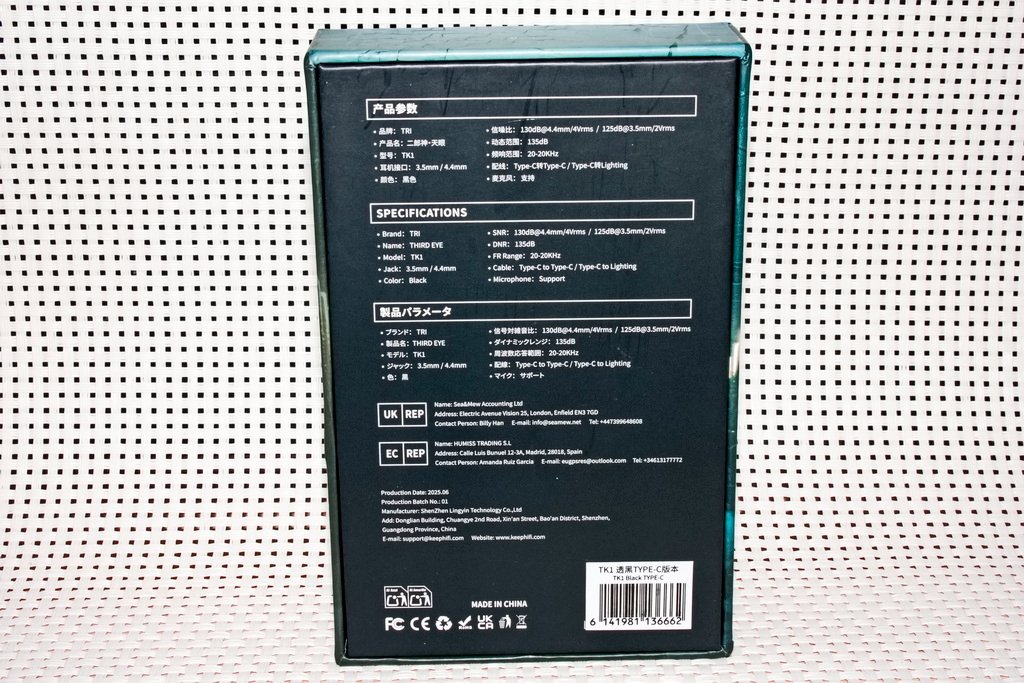
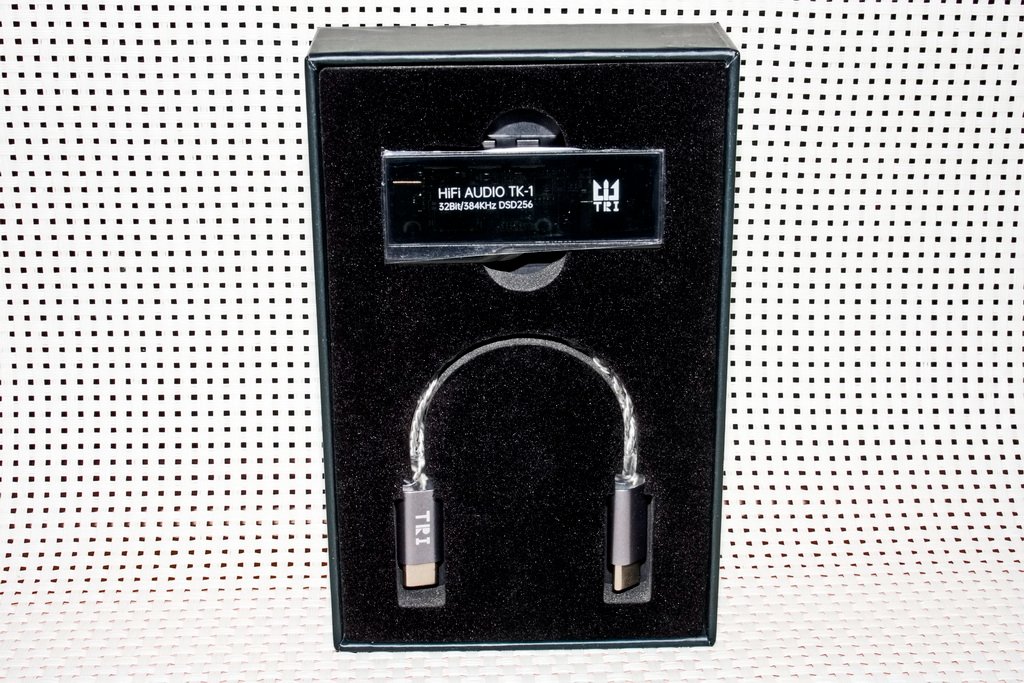
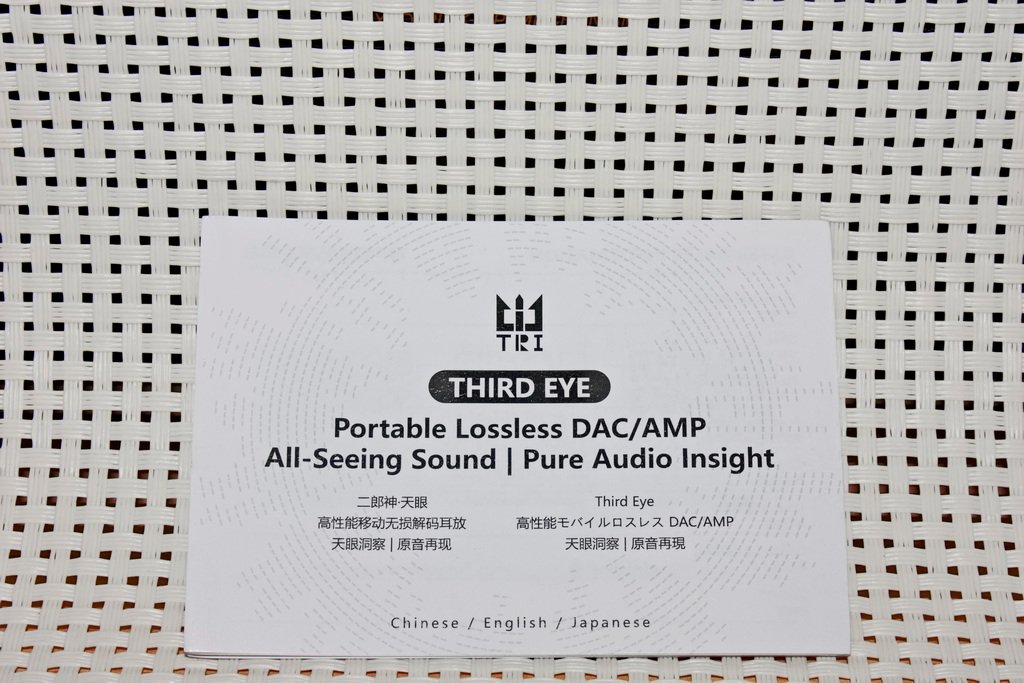
The TRI Third Eye TK1 comes in a green box measuring 91x141x31mm. On the front, you can see a kind of technological warrior, similar to Iron Man but with touches of an anime deity. The brand logo is in the upper left corner, the model name is on the right, and the product name and description are at the bottom. On the back are the specifications in several languages (Chinese, Japanese, and English), the importers' and brand's details. At the bottom are the logos of the certifications it has. Opening the box, you can see the dongle at the top and the USB cable of the chosen option below. Both items are inside a thick black foam mould. At the bottom, under the foam mould, there is a zip bag with the Type-C to Type-A USB adapter and a user manual. Nothing else.
The dongle is protected on both sides by a plastic sheet that protects the two glass surfaces. The connection cable is of good quality and the USB Type-A adapter is a welcome addition.
The sleeve-style presentation is eye-catching, but little else. The box is small and unassuming.
Construction and Design
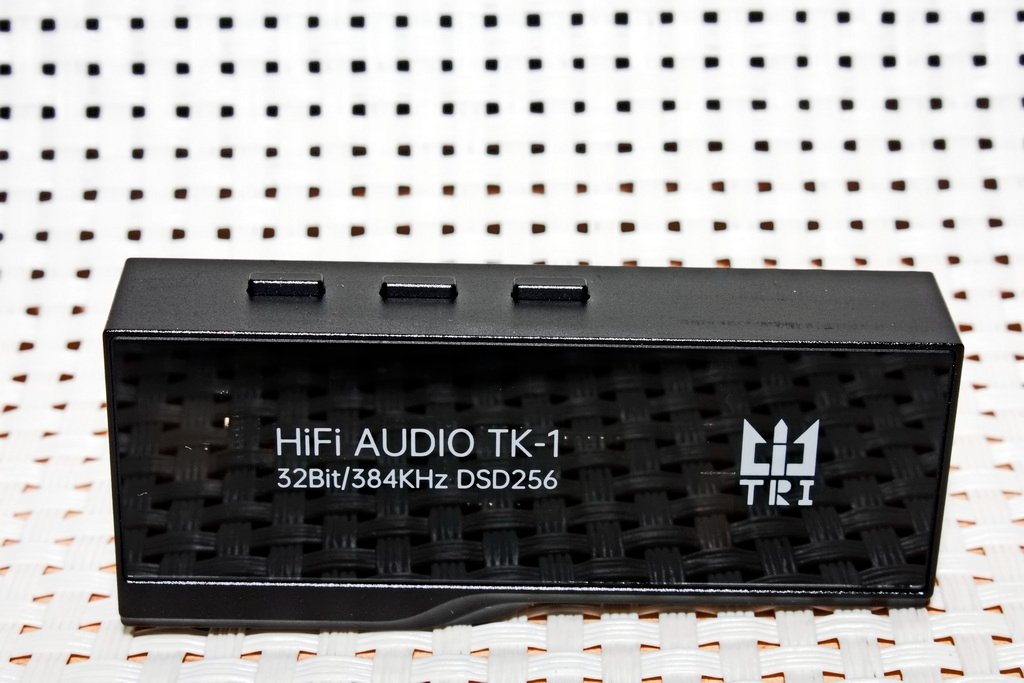
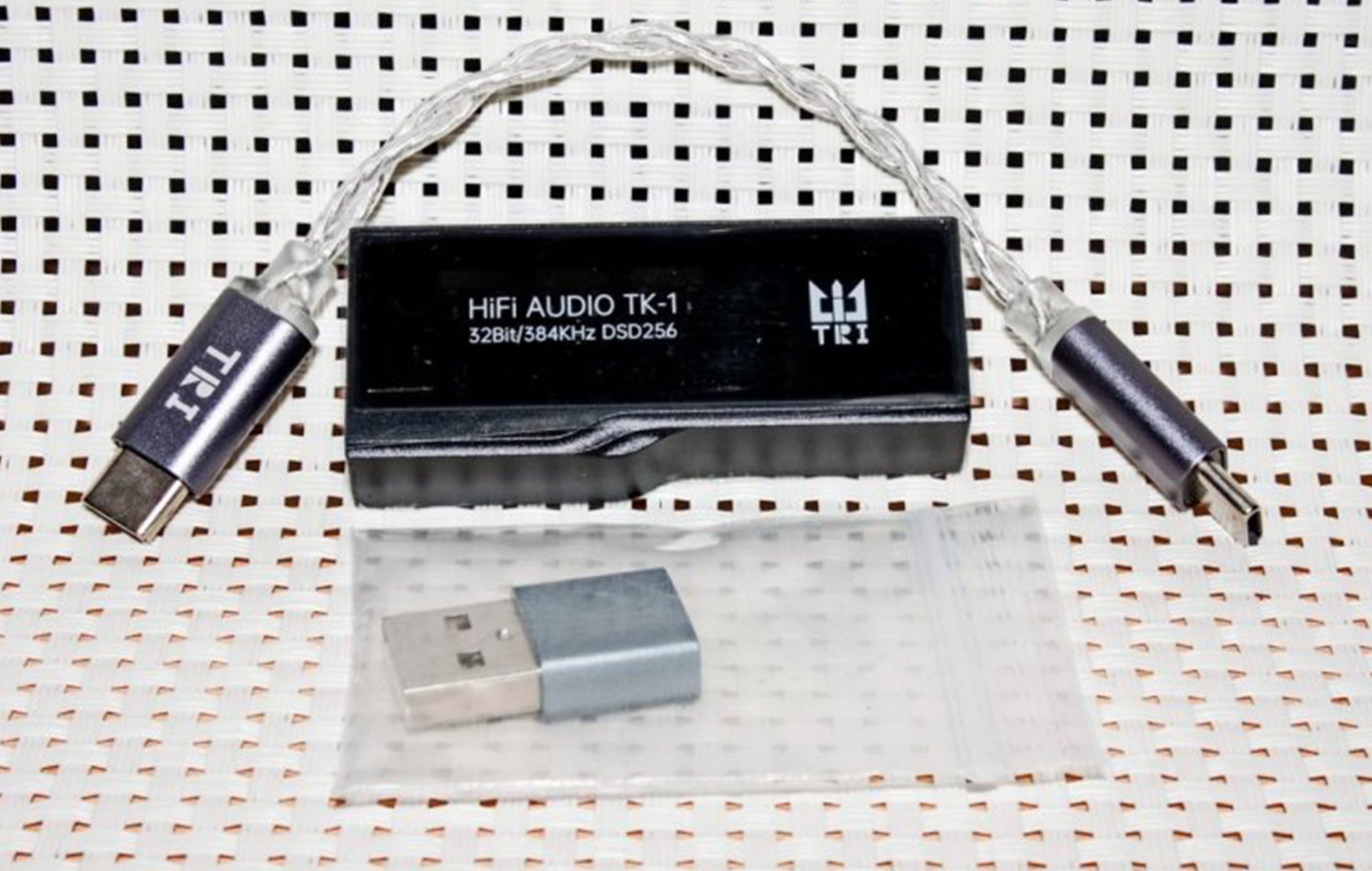
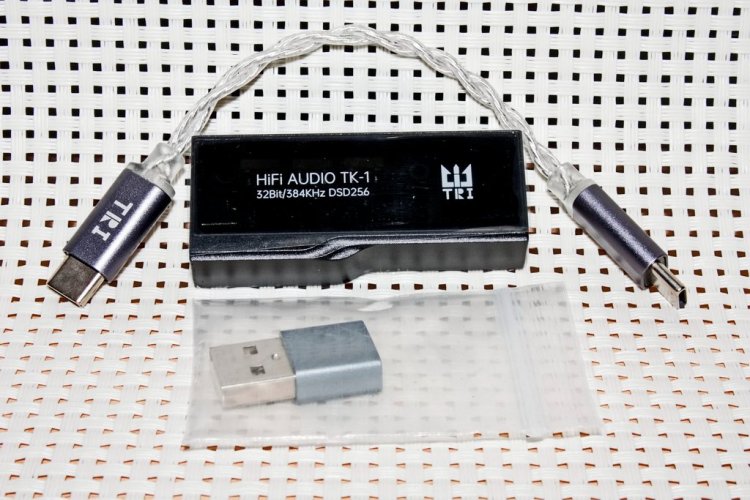
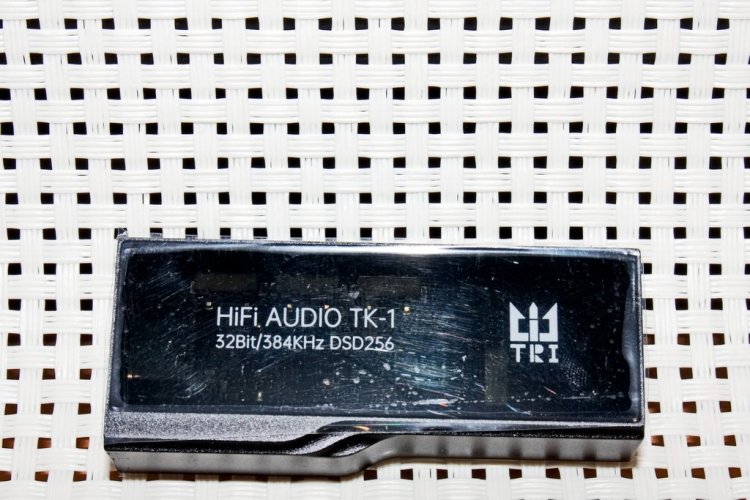
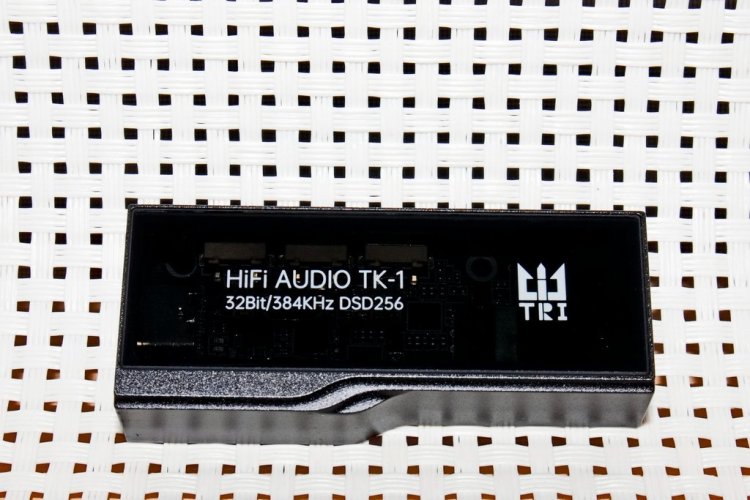
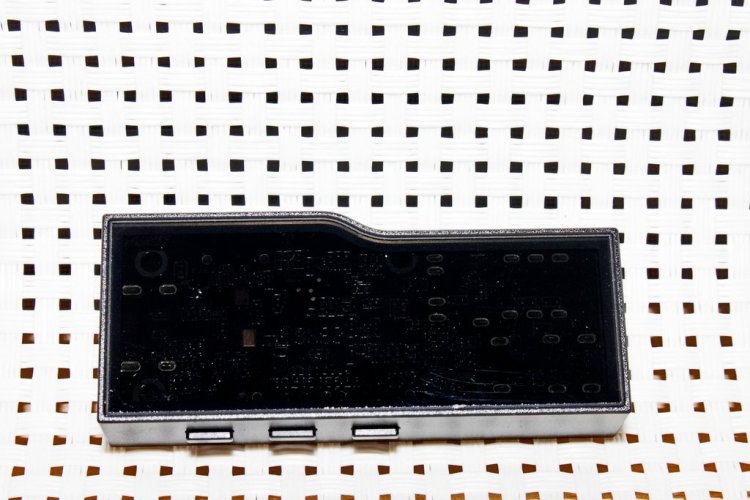
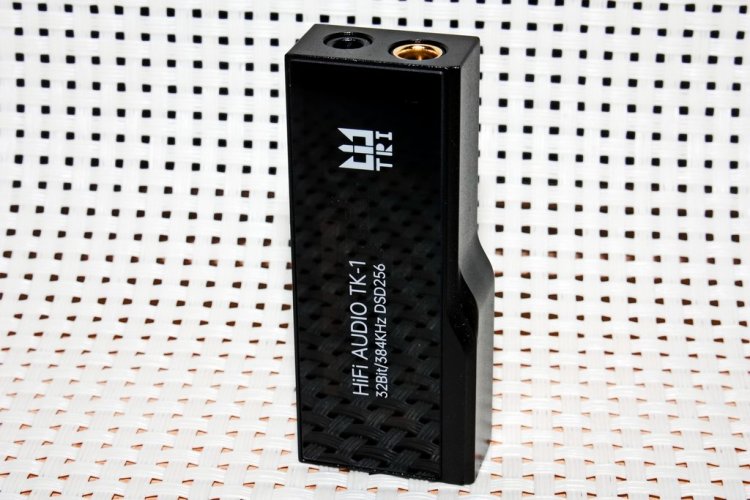
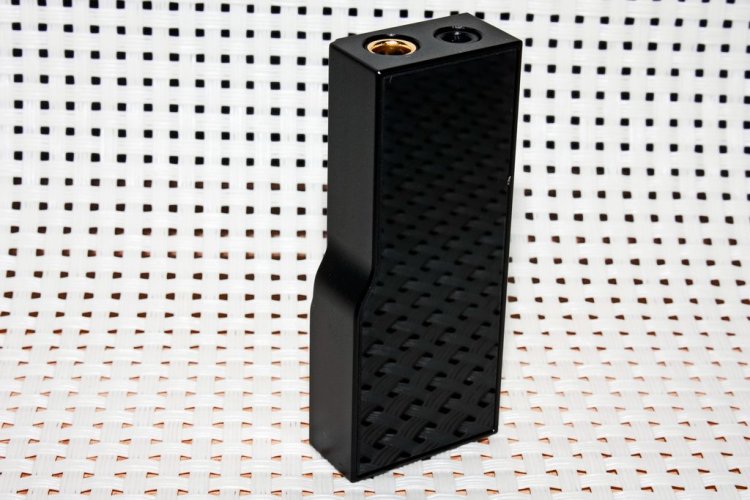
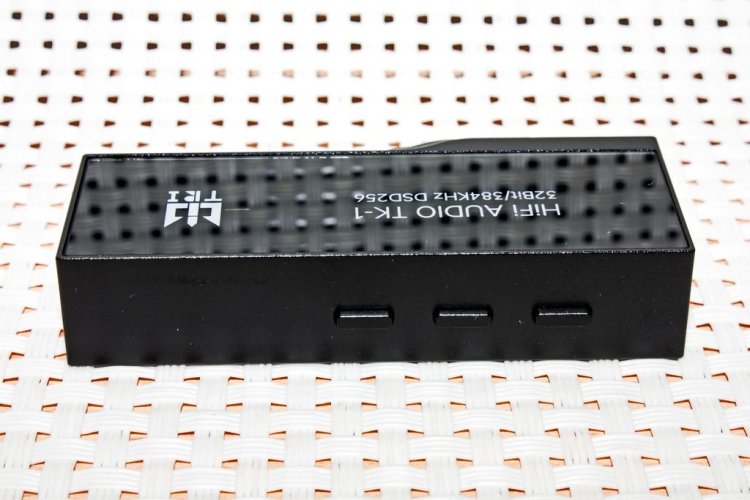
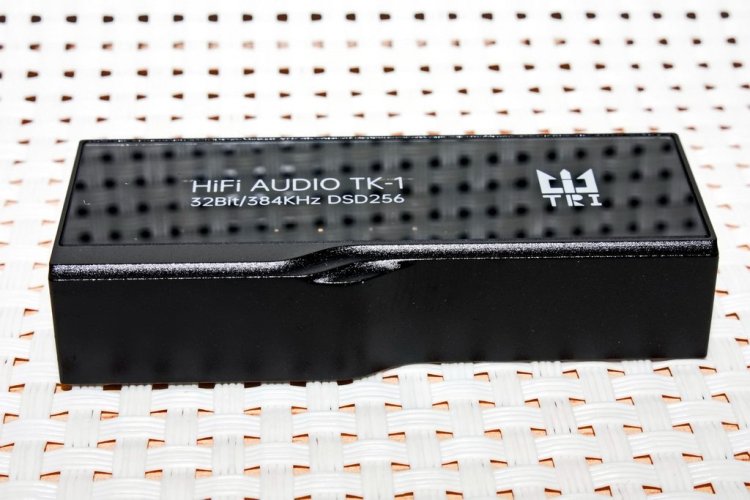
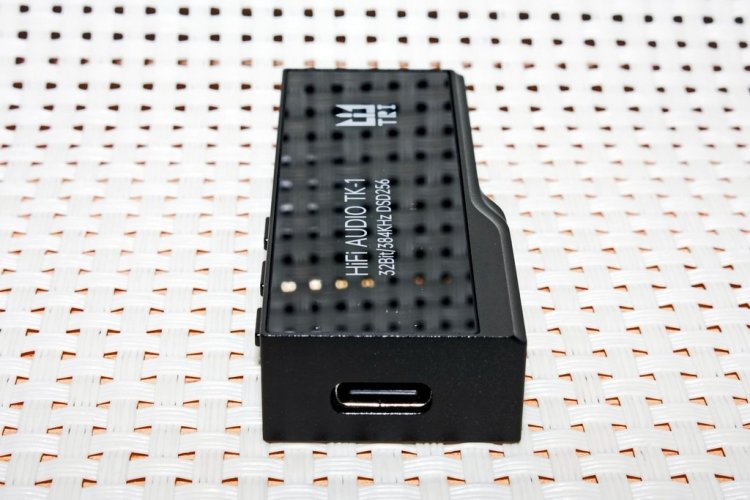
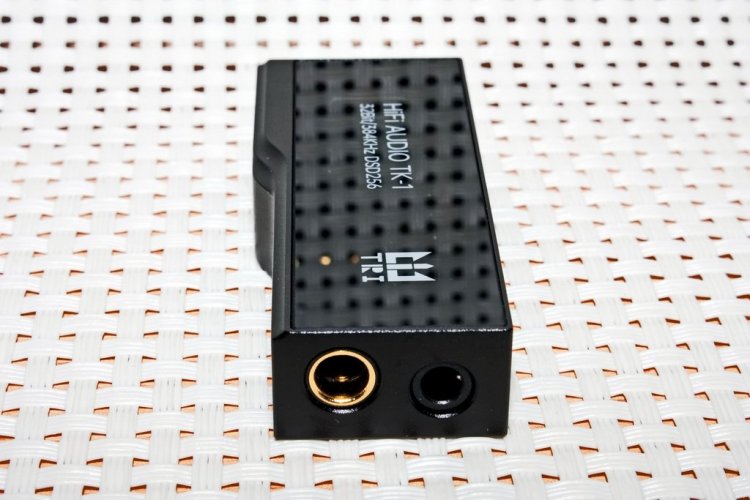
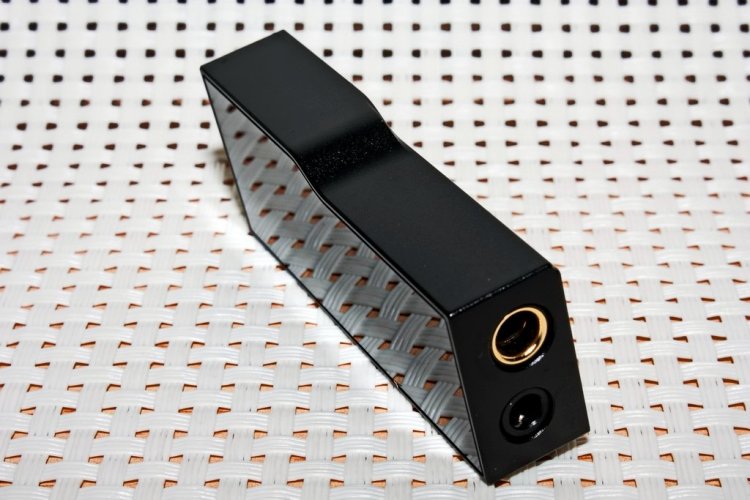
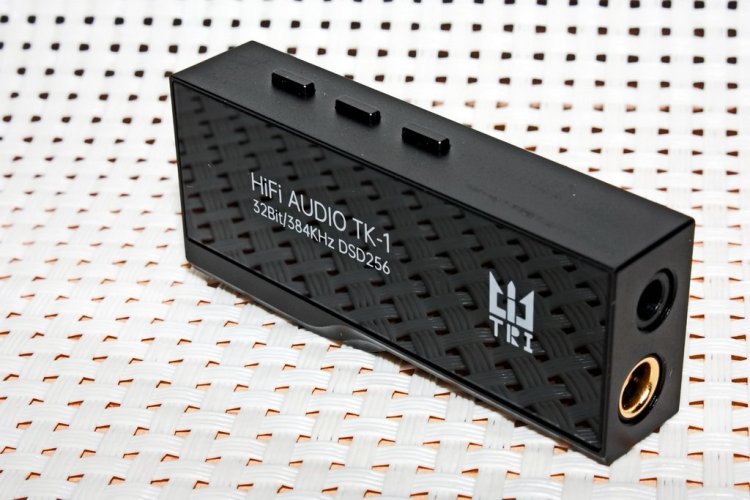
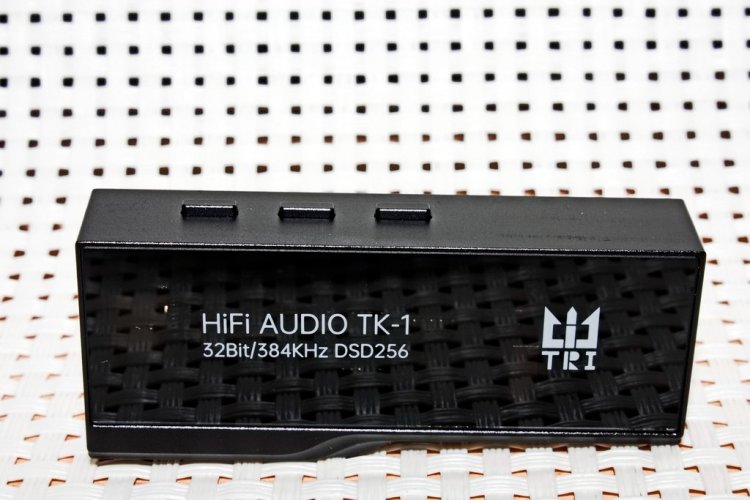
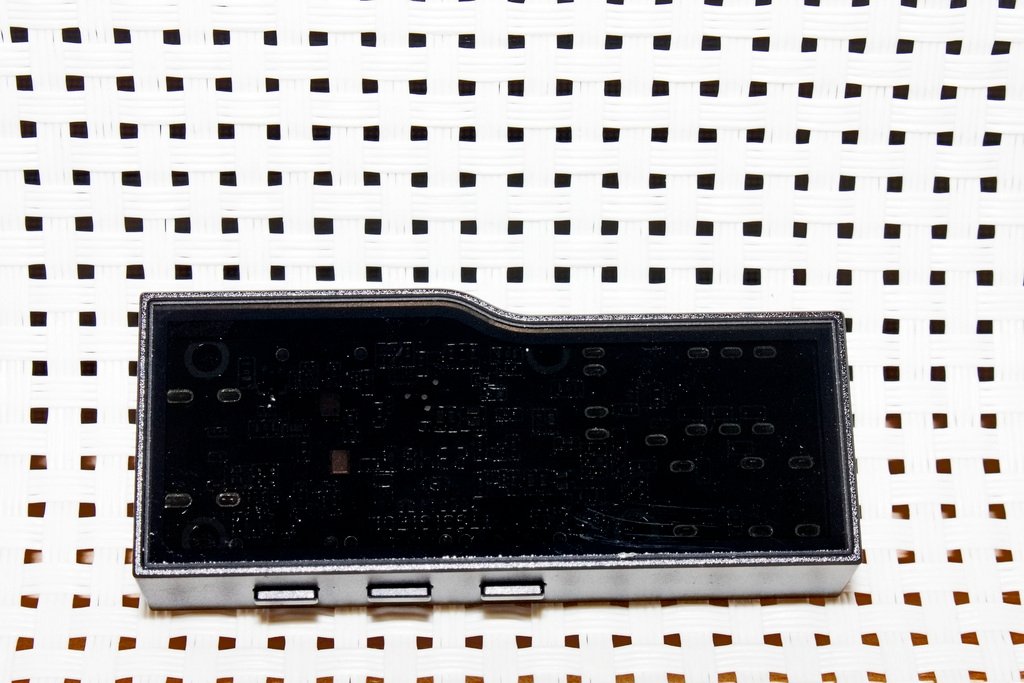
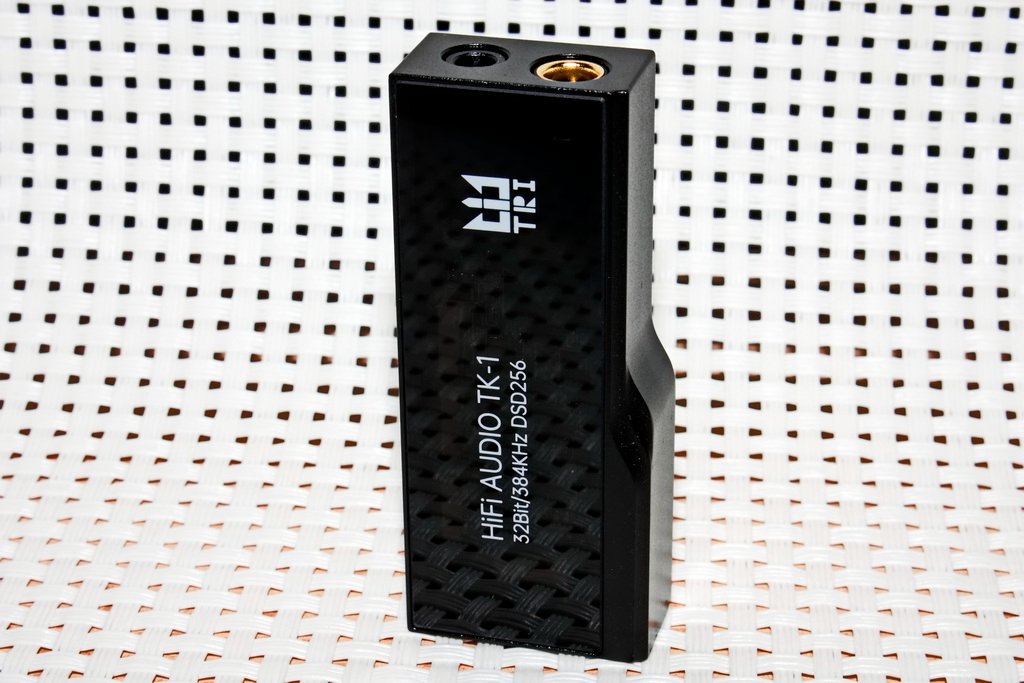
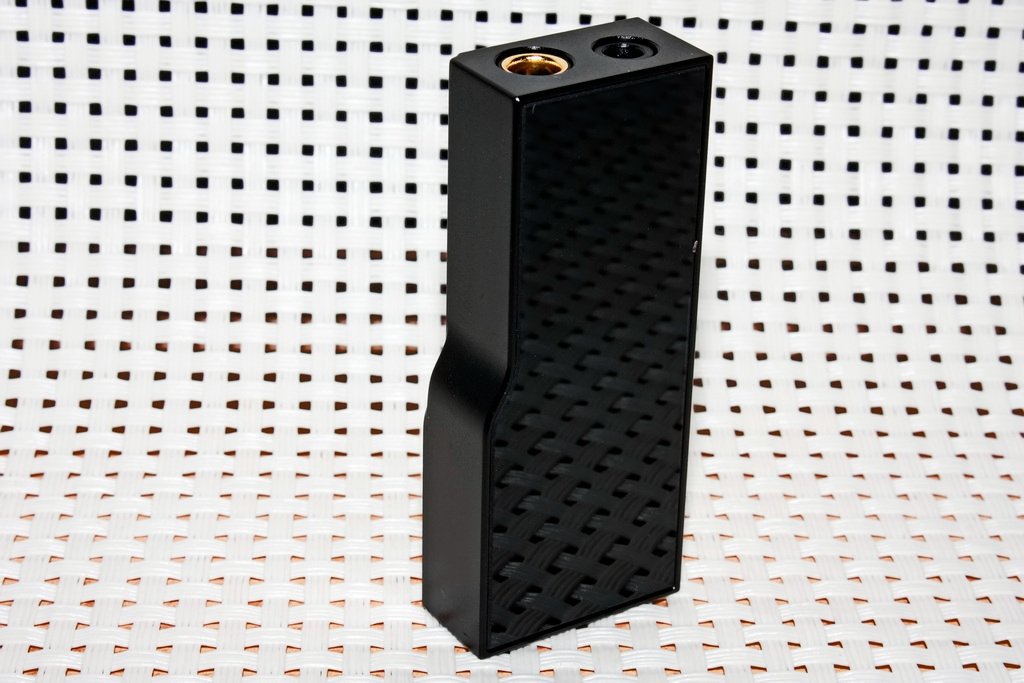
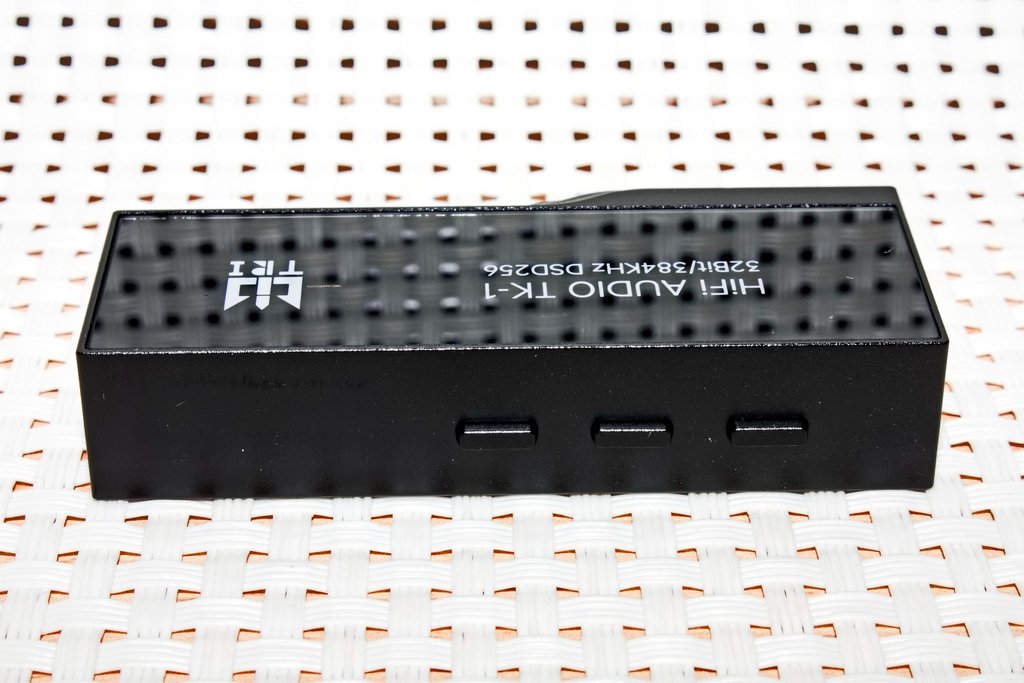
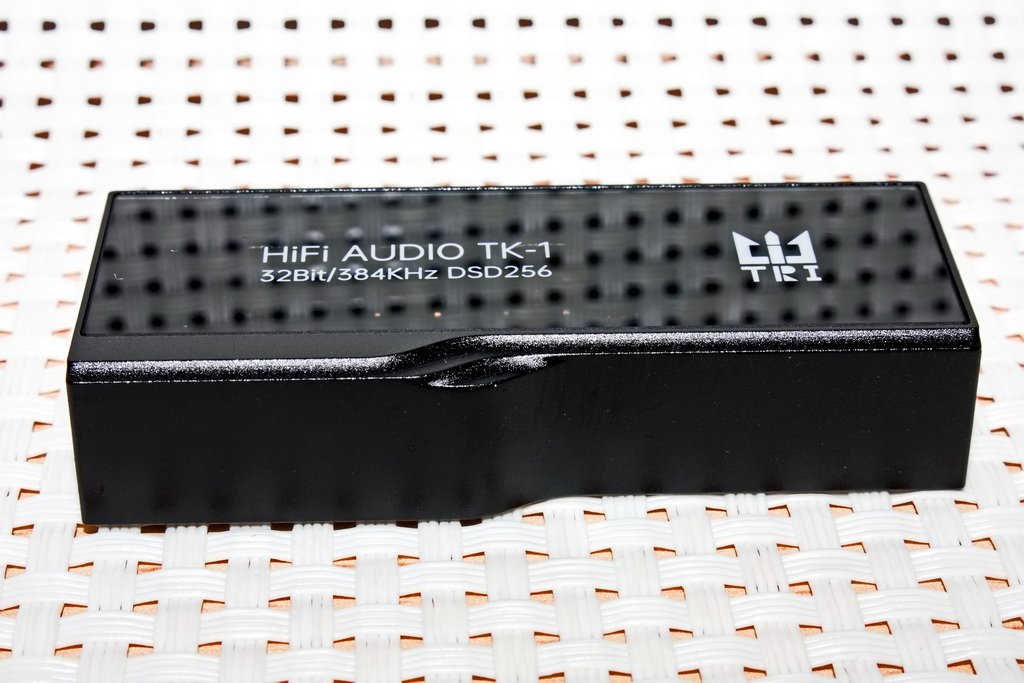
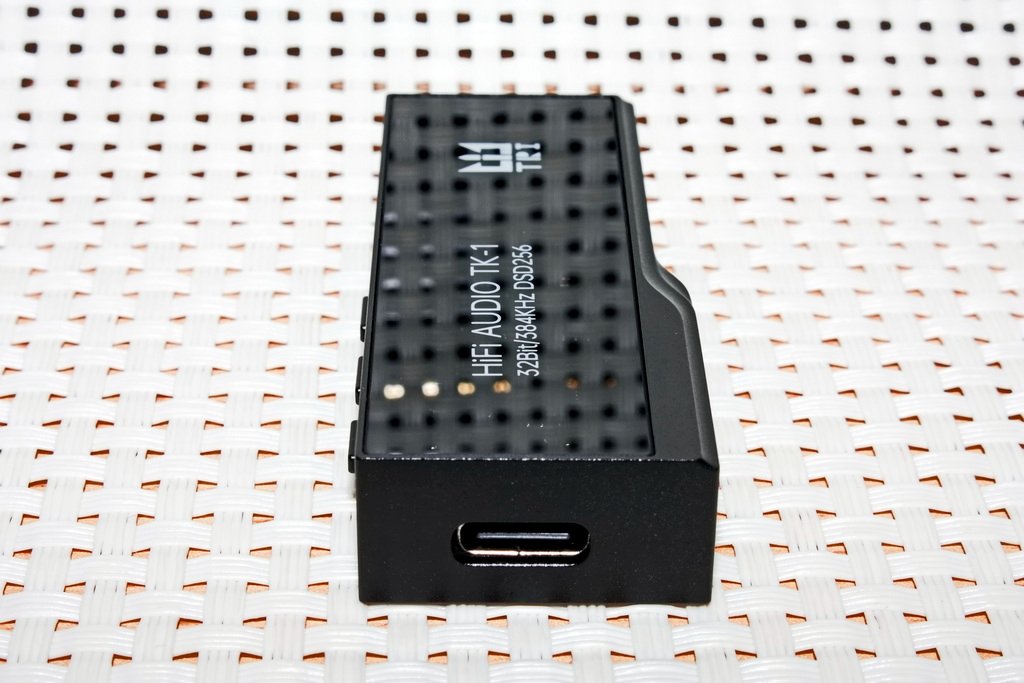
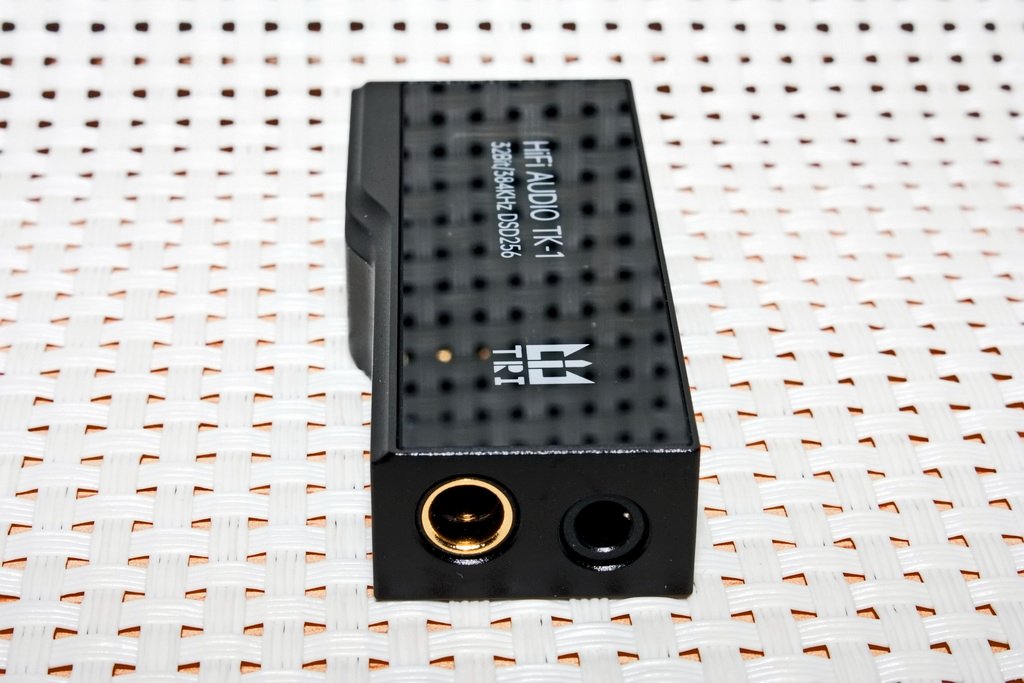
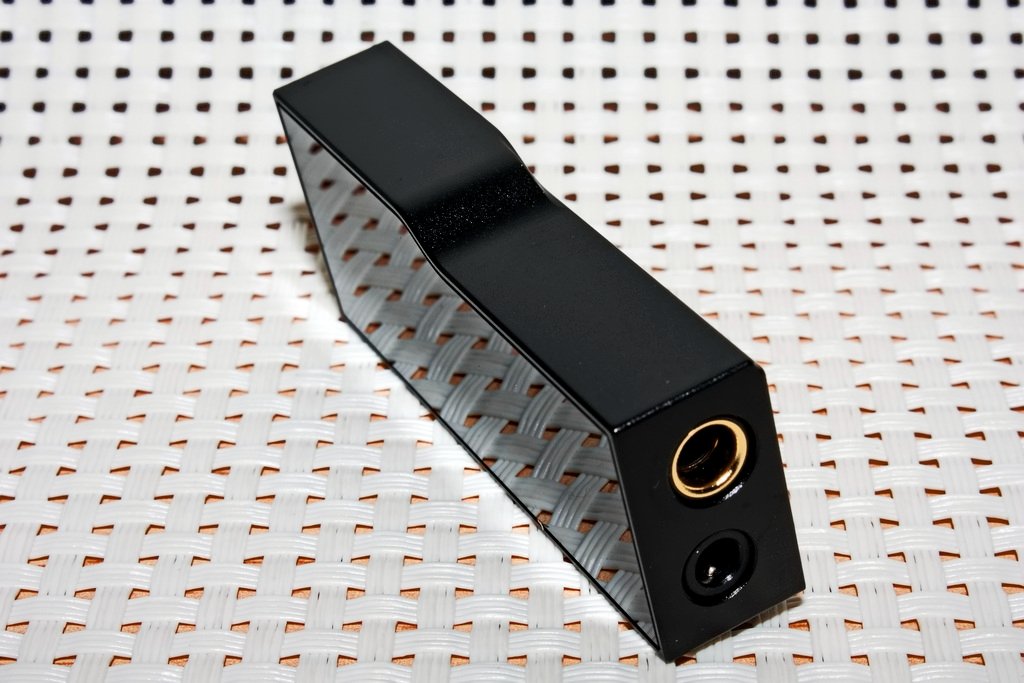
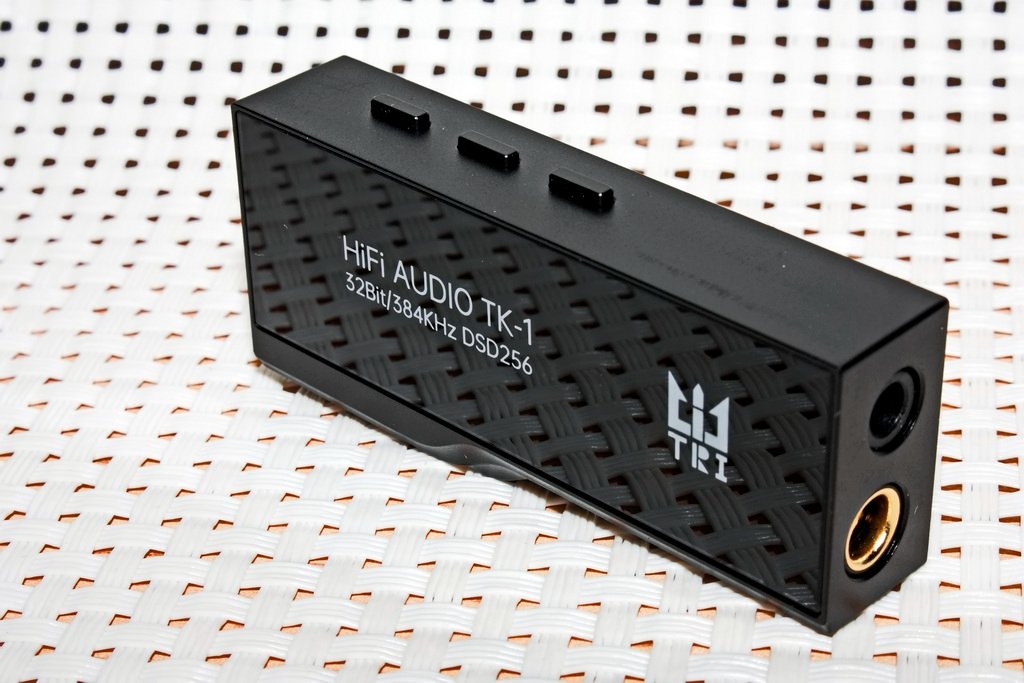
The TRI Third Eye TK1 measures 57x23.7x12.1mm. It has a black aluminium alloy body along its entire side, while both the top and bottom are glass. The side containing the three rectangular buttons located at the top of the pad is flat and has no inscription on it. The opposite side is not flat, but has a slight curve that sets it apart from the flat design of the other side. There is little else, as the small ends only have the USB Type-C connection on one side and the 3.5mm SE and 4.4mm BAL headphone outputs, which are gold-plated. On the top side, you can read ‘HiFi AUDIO TK-1’ on one line and ‘32Bit/384kHz DSD256’ below it. Closer to the headphone output is the brand logo, all in white letters. This top side is translucent despite being dark, and thanks to the internal LED, you can see the printed circuit board. The back is also glass but opaque and black.
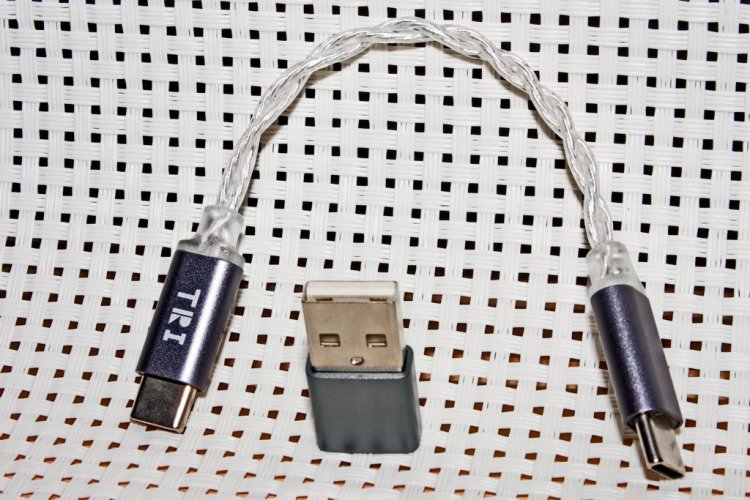
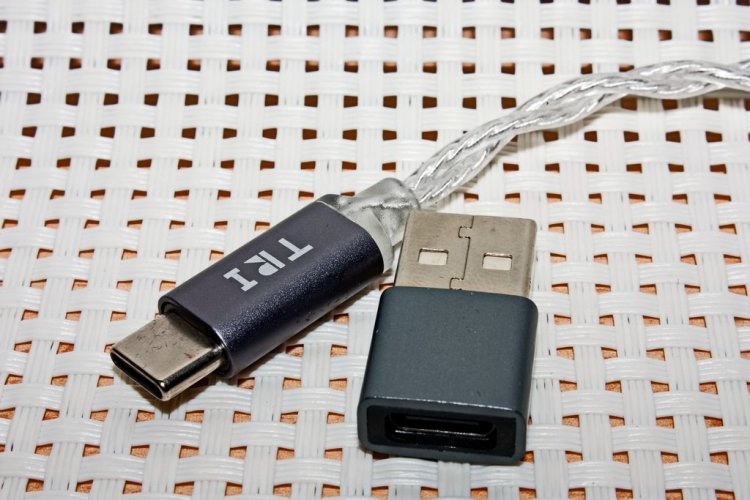
The cable has two intertwined silver-plated copper strands covered in transparent PVC. The USB Type-C connector housings are metal, rounded, and have a micro-sandblasted surface. One of the connectors has the brand name in white letters. The USB Type-A adapter is not the same colour and breaks with the rounded shape of the cable somewhat, as its protective cover is more rectangular.
The design is relatively simple, with a curved touch on one side, as well as glass plates that give it a more striking look, but also make it less durable than if it had been completely metallic.
Connectivity
It's compatible with iOS, Android, MAC, and Windows. Interestingly, my Windows 10 PC recognises it as the ‘Hidizs XO DAC&Amp’ device. It does not have ASIO drivers but can operate in exclusive mode in WASAPI.
For it to work, headphones must be connected to one of the outputs; when the headphones are disconnected, it turns off.
Operativity
Very simple. As I mentioned in the previous section: For it to work, headphones must be connected to one of the outputs; when the headphones are disconnected, it turns off. There is a USB Type-C connector on one end for connection to the source and two 3.5mm SE and 4.4mm BAL outputs on the other.
It has three buttons: two for volume up/down and one in the middle for play/pause. They are not labelled.
It has a two-colour LED on the internal circuit board that lights up green to indicate PCM file playback and red when DSD files are being played.
Measures
It does not appear to have gain selection. There are also no power specifications. This is unusual.
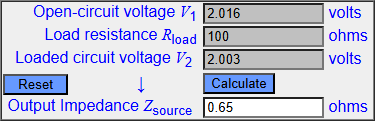
The output impedance per SE is less than 1Ω.
SE No load
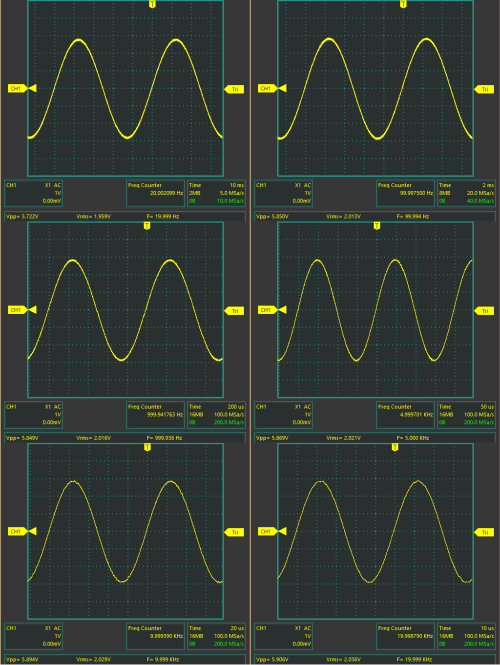
Without load, it reaches 2V RMS.
SE 15Ω
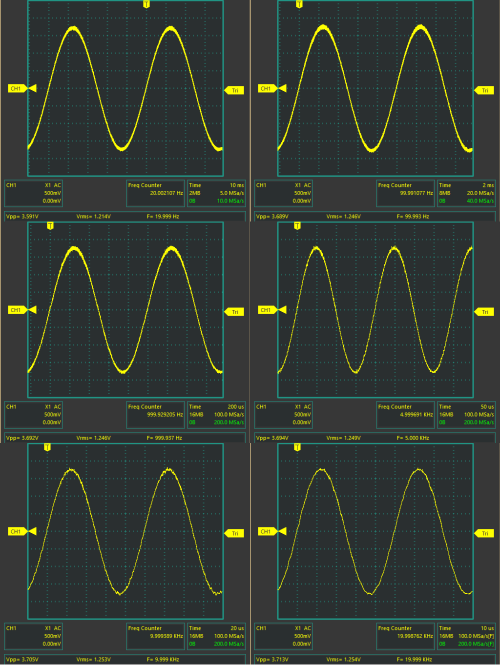
For SE 15Ω, the maximum voltage without distortion across the entire frequency range is 1.246V, which equates to a power of 100mW and 83mA. Pretty good.
SE 33Ω
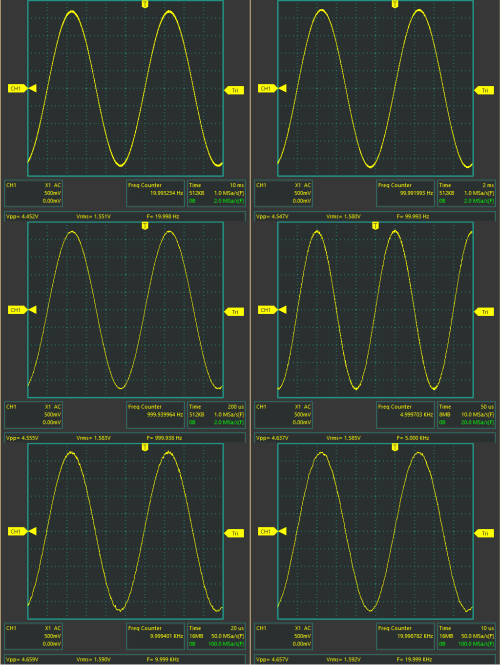
For SE 33Ω, the maximum voltage without distortion across the entire frequency range is 1.583V, which equates to a power output of 76mW and 48mA. This power output is even slightly lower than that of its most direct competitors.
SE 100Ω
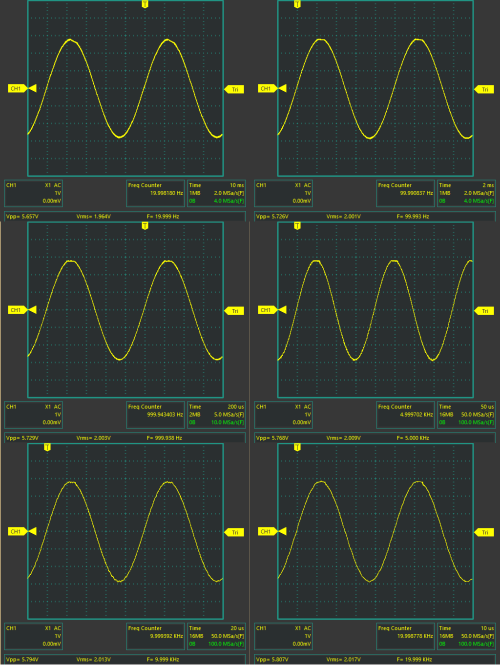
For SE 100Ω, the maximum voltage with subtle distortion across the entire frequency range is 2.003V, which equates to a power output of 40mW and 20mA. This power output is even slightly lower than that of its most direct competitors.
BAL No Load
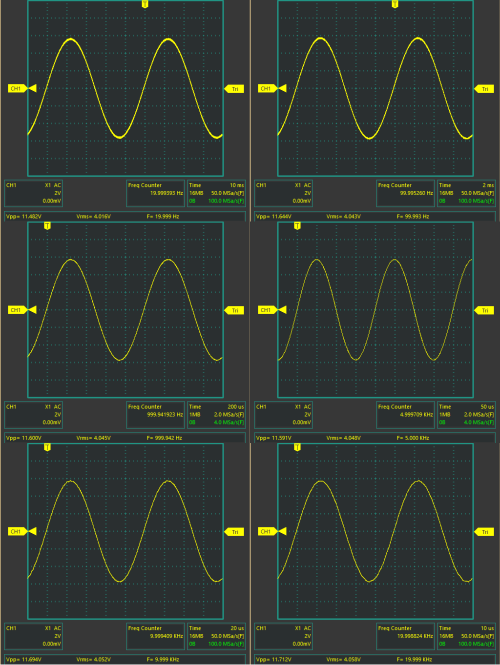
Without load, it reaches 4V RMS.
BAL 15Ω
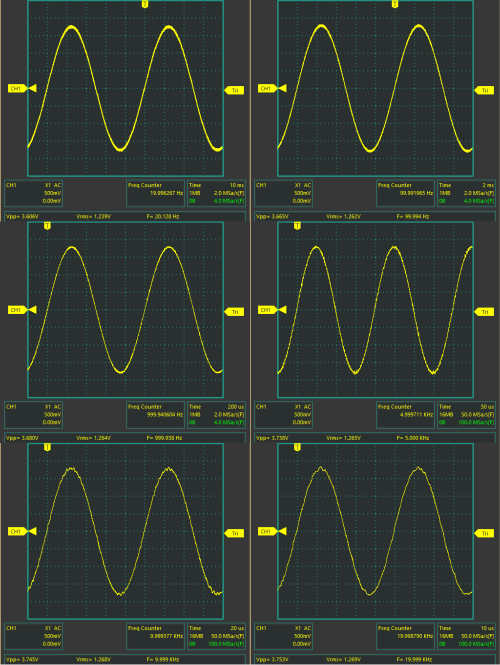
For BAL 15Ω, the maximum voltage without distortion across the entire frequency range is 1.264V, which equates to a power of 110mW and 54mA. Pretty good.
BAL 33Ω
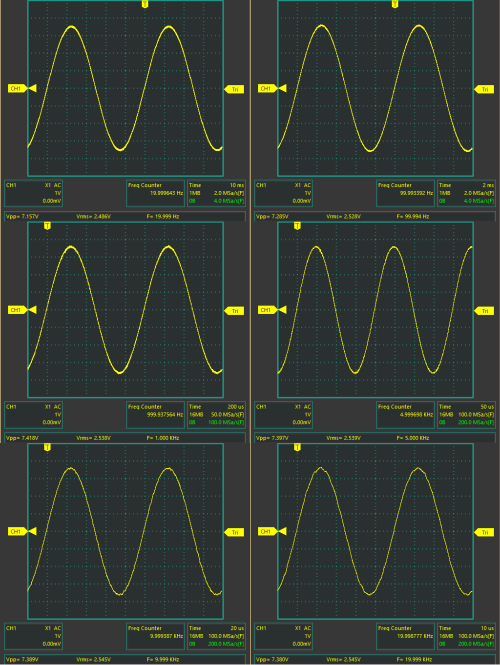
For SE 33Ω, the maximum voltage without distortion across the entire frequency range is 2.538V, which equates to a power of 200mW and 77mA. An excellent value.
BAL 100Ω
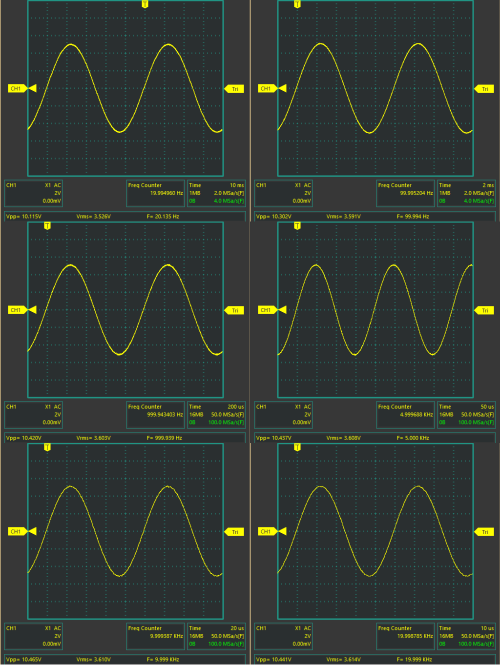
For SE 100Ω, the maximum voltage without distortion across the entire frequency range is 3.603V, which equates to a power of 130mW and 36mA. It does not reach 4V, which means that it is not the best dongle for medium impedances, but it does deliver a good amount of juice.
Frequency Response
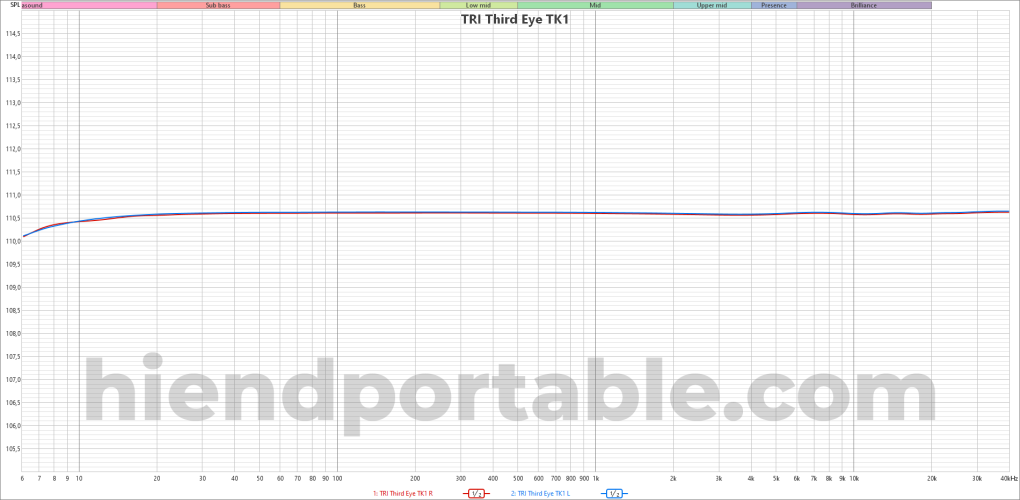
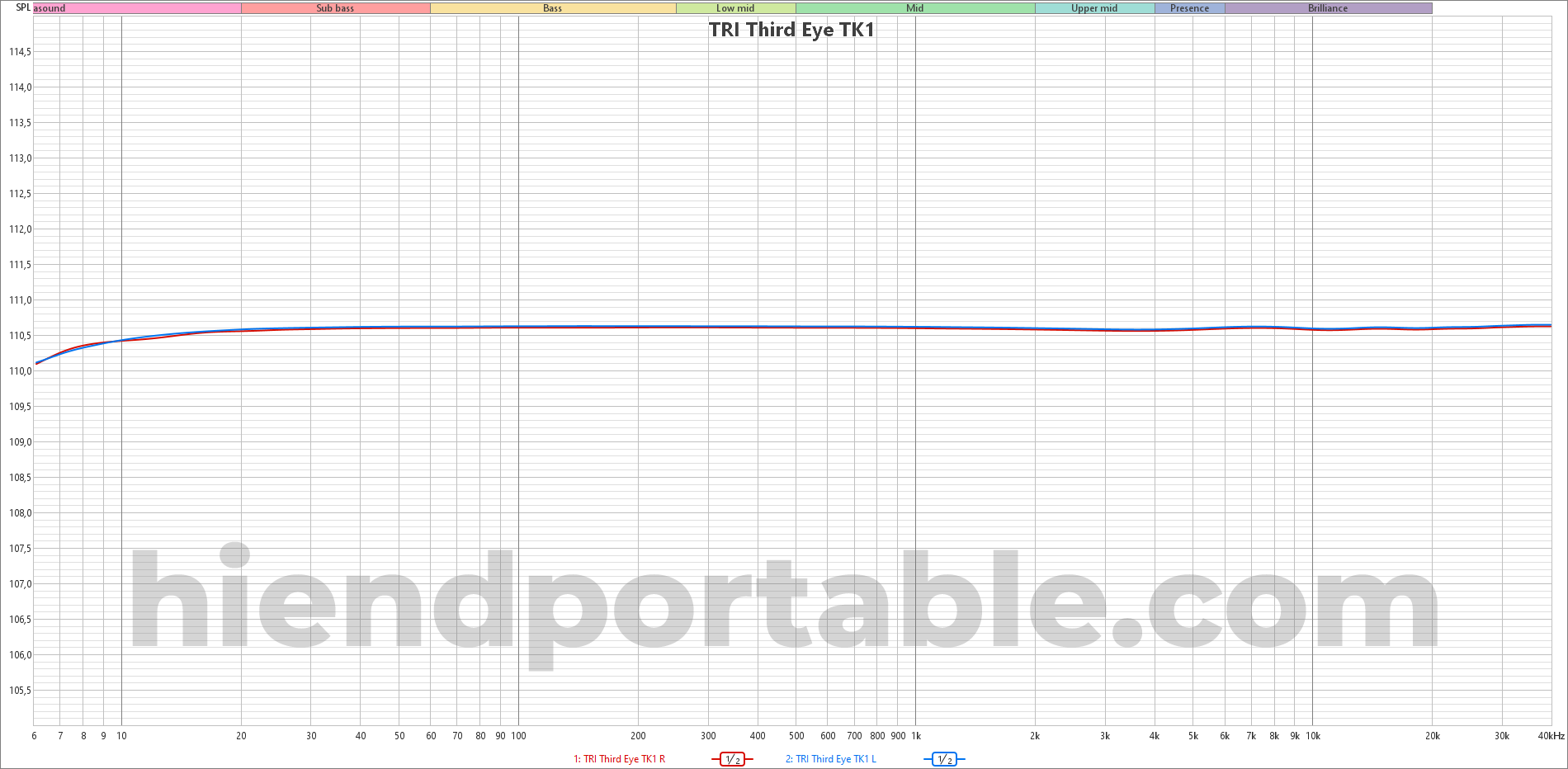
The frequency response is completely flat across the audible range, extending from 10Hz to 40kHz with this flatness. Furthermore, there is no discernible difference between channels. Very good.
Sound
As I mentioned, my Windows 10 PC recognises the TRI Third Eye TK1 as the ‘Hidizs XO DAC&Amp’ device. I suppose they must share the same USB chip and driver. On the other hand, the DACs used are not like those in the XO (ESS SABRE DUAL ES9219C), but rather two Cirrus CS43131s. That said, there are no other similarities between the two.
The TK1's profile is, as the description says, neutral-warm; there is not much more to say in this regard. I would only add that this warmth is not at odds with a good level of transparency and precision.
The bass is impetuous, full, wide, deep and with a good realistic, natural tone, with power, punch and forcefulness. The level of cleanliness and clarity of the bass is striking.
The very low frequency pure tone test is performed realistically, naturally, with very low colouration, providing physicality and a good dose of sensory component. The sensation of depth and volume is very noticeable. Overall, the best bass headphones will shine with this dongle.
In the dirty, complex, unfiltered bass test, the TK1 delivers the level of precision, definition, and clarity I mentioned earlier. It feels quite neat, with well-defined edges, clean, very controlled, and without losing any punch.
In the midrange, I feel a mixture of warmth and precision that is striking in a DUAL CS43131. I feel it is a little more analytical and thin, slightly enhancing the edges of the notes, but maintaining that warm character, although not as sweet as other smooth Cirrus implementations. I also note a certain brightness, a little more air, clarity and transparency, generating a little more amplitude, volume and space, as well as more separation in the midrange.
TRI claims that the TK1 is a dongle for relaxed, fatigue-free listening. But that doesn't mean it doesn't offer full highs, even with a slightly more daring edge. It does not lose the naturalness and organic character conferred by its DACs, but it does stretch a little further, adding a touch of extra brightness aided by that higher level of definition and precision.
The impression of greater clarity, thinness of notes and that more analytical touch, combined with very precise, physical bass with body and volume, helps to create a wide, expansive soundstage with a good level of three-dimensionality and a certain volatile and gaseous character, but without going overboard. The sound is transparent, clear, clean and well separated. The elements are very well placed in the environment and feel precise and recognisable in their presentation.
Comparisons
Tempotec Sonata BHD Pro
The Tempotec Sonata BHD Pro is a dongle that has the same CS43131 Dual DAC, features an FPGA and three femtosecond oscillators, supports MQA x8, has an RGB LED, two buttons for volume control and, of course, a USB Type-C input and 3.5mm SE and 4.4mm BAL audio outputs. Its body is made of aluminium, slightly smaller than the TK1, and also features a smaller glass window to see inside the circuitry. Although it is more robust than the TK1, I prefer the design of the TRI. It is currently available for around 60$.
It's clear that the features of both dongles are very similar, as are their parameters, including power. However, the TRI stands out for its peak power for 32Ω per BAL. The sound is very similar in both dongles, but the BHD Pro has the ability to change the sound slightly thanks to two different firmwares.
The bass on both models is very similar, but I think the BHD Pro is a little muddier, slightly darker, less precise, and not as clean as the TK1.
The very low frequency pure tone test is very similar, but I find the TK1 subtly cleaner and more accurate. Meanwhile, in the dirty, complex, unfiltered bass test, I find the TK1 performs better, offering a little more power, sharper edges, a less diffuse response, with more resolution and definition. The BHD Pro continues to sound a little murkier, wider, even dirtier, but darker.
In the midrange, the TK1 remains somewhat more analytical. I find that the TRI offers more transparency, clarity, separation and a sense of air than the BHD Pro, which sounds sweeter, perhaps more melodious, but not as transparent, open and clear as the TK1.
The high end of both dongles is very similar, with favourable performance for long listening sessions. But I find that the BHD Pro is still smoother, while the TK1 is more polished, with slightly more energy and thinner notes.
The cleaner, more analytical and transparent character of the TK1 wins the game in terms of soundstage. The BHD Pro is a little more muted, with less expansive capacity, more attached and with that subtle murkiness and roundness of the bass defining the edges in a more rounded and wider way. The micro detail is not very different in both dongles, but the TK1 is cleaner and generates it in a way that can be more defined and visible. All this means that the feeling of separation, neatness and dark background favours the TK1.
Conclusion
I must confess that I was very reluctant to analyse another dongle with the classic Dual DAC CS43131, especially since the new CS43198 has become one of my favourite DACs for portable devices. But it seems that each brand is still able to add some extra subtlety to these chips. In this case, the new TRI Third Eye TK1 comes as a simple and elegant black dongle which, thanks to its glass top surface, allows you to see inside and view the circuitry, as well as the LED that indicates when it is in operation. However, this double glass surface, which covers all the longest sides of the dongle, is also its weak point, as it gives the impression of being more fragile.
It has three buttons for volume control and play/pause, no gain control, two headphone outputs (SE 3.5mm and BAL 4.4mm) and a USB Type-C input port. It has a good amount of power, especially for the balanced output for 32Ω. Its low output impedance and absolute linearity across the entire frequency range make it very suitable for all types of low and medium impedance headphones.
In terms of sound, the extra feature is the addition of a more analytical aspect to the classic neutral-warm sound offered by the Dual DAC CS43131 chips. It is not a cold or clinical sound, but there is certainly a little more brightness, transparency, precision, resolution and definition than other classic dongles that use these circuits. And this feature can be appreciated across the entire frequency range, from bass to treble, helping to create a more expansive and volatile soundstage than the competition, as well as a cleaner and more separated sound. A pleasant surprise.
Earphones and Sources Used During Analysis
Purchase Link
You can read the full review in Spanish here
TRI, something like KBEAR's luxury brand, has launched a new dongle with a starting price of $69. Its full name is TRI Third Eye TK1. Inside, it uses the now classic and somewhat outdated Cirrus Logic CS43131 DAC in dual-channel mode. It uses femtosecond-grade crystal oscillators and ultra-low noise LDOs. It also adopts a low-power circuit design and supports PCM decoding up to 384kHz/32bit and DSD256 hardware decoding. Its tonal balance is neutral-warm for relaxed, fatigue-free listening. It has an internal multicolour LED that can be seen through its translucent panels, indicating the audio format being played (green for PCM, red for DSD). It also features three buttons for volume up/down and play/pause. It has a USB Type-C input port and two headphone outputs: 3.5mm SE and 4.4mm BAL. There are two accessory options to choose from: one with a USB Type-C to Type-C cable (plus USB Type-A adapter), and the other with a Type-C to Lightning cable. It measures 57x23.7x12.1mm and is compatible with headphones with a microphone.
This is all the information provided by the brand. Now we will see my impressions of this product and, as always, its measurements and sound.

Specifications
- Brand: TRI.
- Product name: Third Eye.
- Model: TK1.
- Supplier: KBEAR.
- Type: DAC/AMP.
- Version: Type C to Lighting, Type C to Type C.
- SKU: TRI81202Bla-TK1-L.
- DAC: Dual DAC CS43131.
- SNR: 130dB@4.4mm/4Vrms; 125dB@3.5mm/2Vrms.
- Headphone connector: SE 3.5mm and BAL 4.4mm.
- Version: Type C to Type C; Type C to Lighting.
- Frequency response: 20-20 kHz.
- DNR: 135 dB.
- Colour: black.
- Dimensions: 57x23.7x12.1mm.
- Microphone: available.
- Starting price: $69.

Packaging
The TRI Third Eye TK1 comes in a green box measuring 91x141x31mm. On the front, you can see a kind of technological warrior, similar to Iron Man but with touches of an anime deity. The brand logo is in the upper left corner, the model name is on the right, and the product name and description are at the bottom. On the back are the specifications in several languages (Chinese, Japanese, and English), the importers' and brand's details. At the bottom are the logos of the certifications it has. Opening the box, you can see the dongle at the top and the USB cable of the chosen option below. Both items are inside a thick black foam mould. At the bottom, under the foam mould, there is a zip bag with the Type-C to Type-A USB adapter and a user manual. Nothing else.
The dongle is protected on both sides by a plastic sheet that protects the two glass surfaces. The connection cable is of good quality and the USB Type-A adapter is a welcome addition.
The sleeve-style presentation is eye-catching, but little else. The box is small and unassuming.
Construction and Design
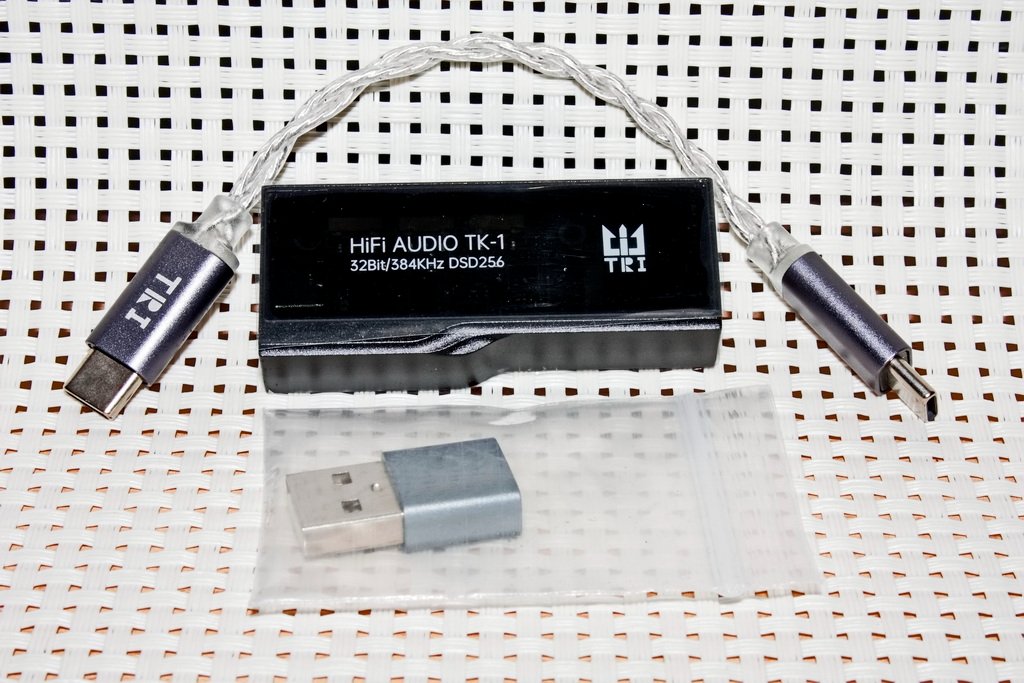
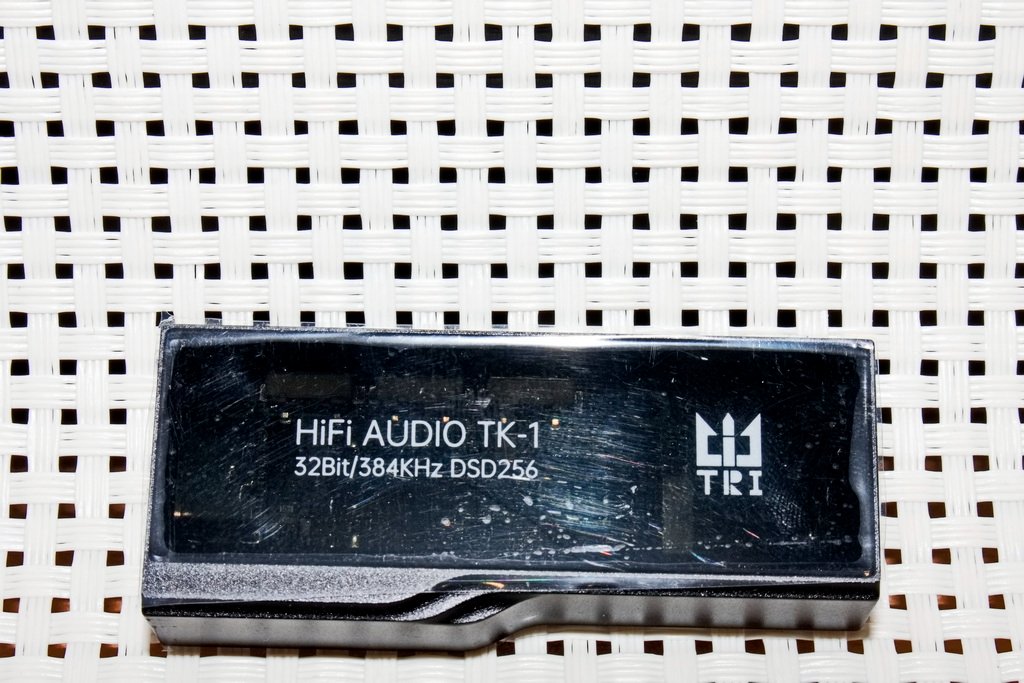
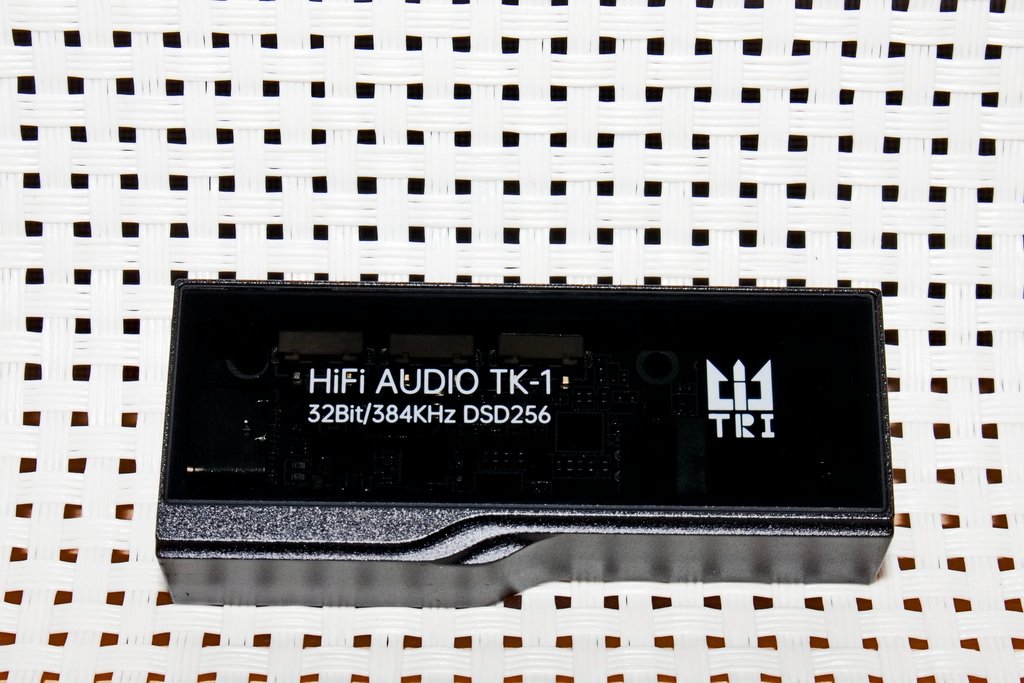
The TRI Third Eye TK1 measures 57x23.7x12.1mm. It has a black aluminium alloy body along its entire side, while both the top and bottom are glass. The side containing the three rectangular buttons located at the top of the pad is flat and has no inscription on it. The opposite side is not flat, but has a slight curve that sets it apart from the flat design of the other side. There is little else, as the small ends only have the USB Type-C connection on one side and the 3.5mm SE and 4.4mm BAL headphone outputs, which are gold-plated. On the top side, you can read ‘HiFi AUDIO TK-1’ on one line and ‘32Bit/384kHz DSD256’ below it. Closer to the headphone output is the brand logo, all in white letters. This top side is translucent despite being dark, and thanks to the internal LED, you can see the printed circuit board. The back is also glass but opaque and black.
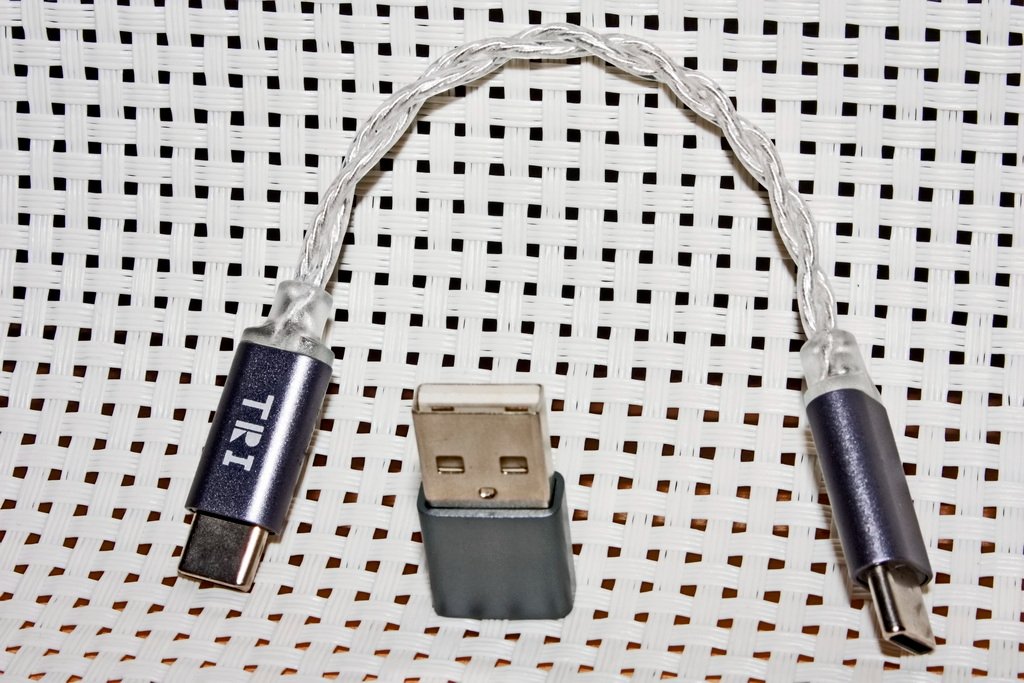
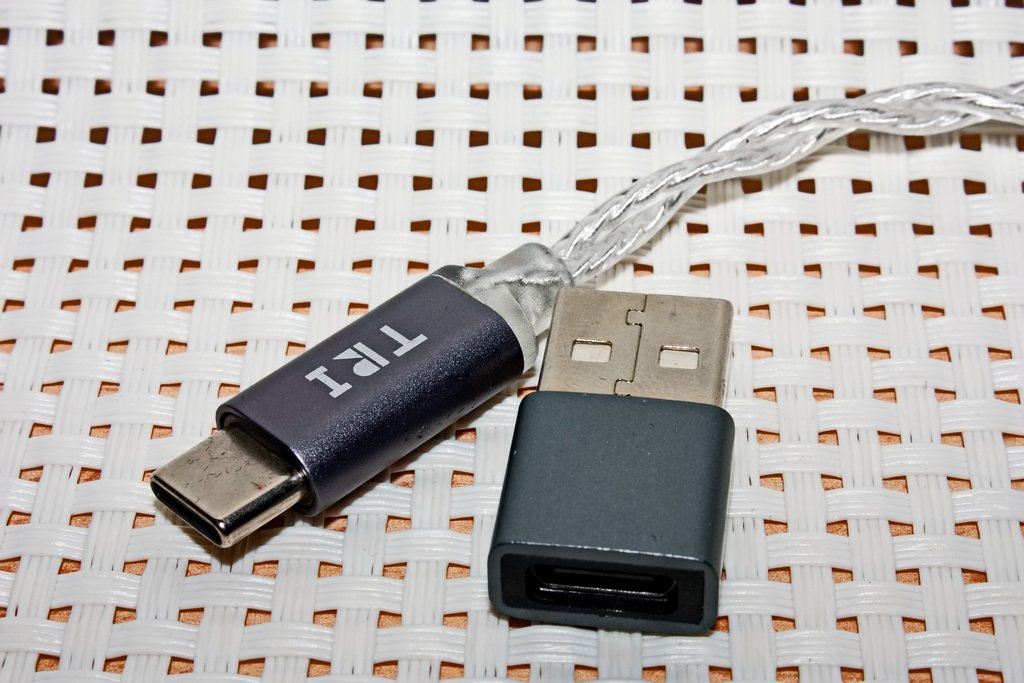
The cable has two intertwined silver-plated copper strands covered in transparent PVC. The USB Type-C connector housings are metal, rounded, and have a micro-sandblasted surface. One of the connectors has the brand name in white letters. The USB Type-A adapter is not the same colour and breaks with the rounded shape of the cable somewhat, as its protective cover is more rectangular.
The design is relatively simple, with a curved touch on one side, as well as glass plates that give it a more striking look, but also make it less durable than if it had been completely metallic.
Connectivity
It's compatible with iOS, Android, MAC, and Windows. Interestingly, my Windows 10 PC recognises it as the ‘Hidizs XO DAC&Amp’ device. It does not have ASIO drivers but can operate in exclusive mode in WASAPI.
For it to work, headphones must be connected to one of the outputs; when the headphones are disconnected, it turns off.
Operativity
Very simple. As I mentioned in the previous section: For it to work, headphones must be connected to one of the outputs; when the headphones are disconnected, it turns off. There is a USB Type-C connector on one end for connection to the source and two 3.5mm SE and 4.4mm BAL outputs on the other.
It has three buttons: two for volume up/down and one in the middle for play/pause. They are not labelled.
It has a two-colour LED on the internal circuit board that lights up green to indicate PCM file playback and red when DSD files are being played.
Measures
It does not appear to have gain selection. There are also no power specifications. This is unusual.
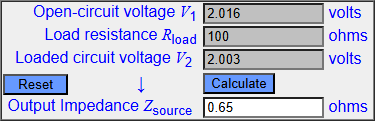
The output impedance per SE is less than 1Ω.
SE No load
Without load, it reaches 2V RMS.
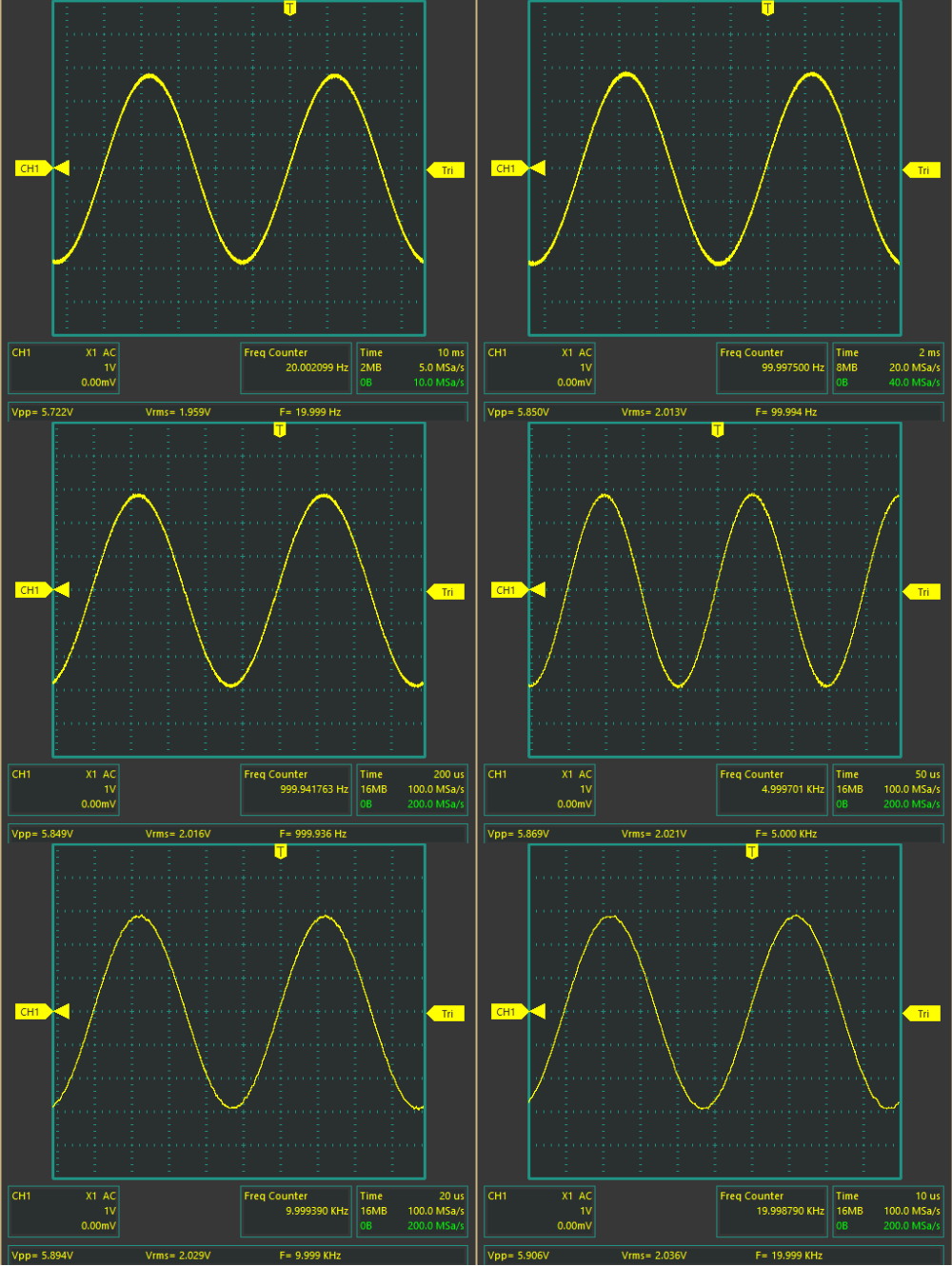
SE 15Ω
For SE 15Ω, the maximum voltage without distortion across the entire frequency range is 1.246V, which equates to a power of 100mW and 83mA. Pretty good.
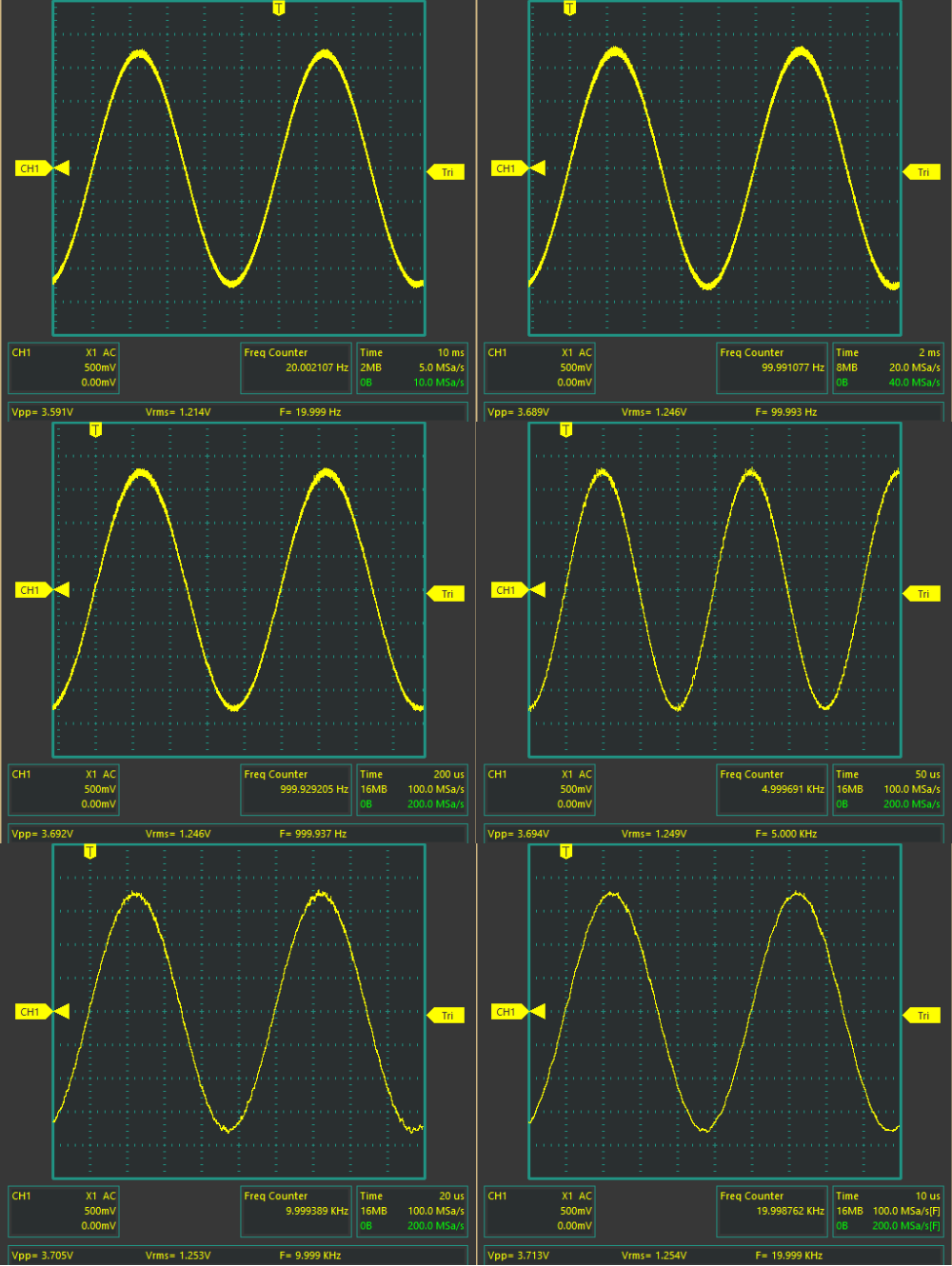
SE 33Ω
For SE 33Ω, the maximum voltage without distortion across the entire frequency range is 1.583V, which equates to a power output of 76mW and 48mA. This power output is even slightly lower than that of its most direct competitors.
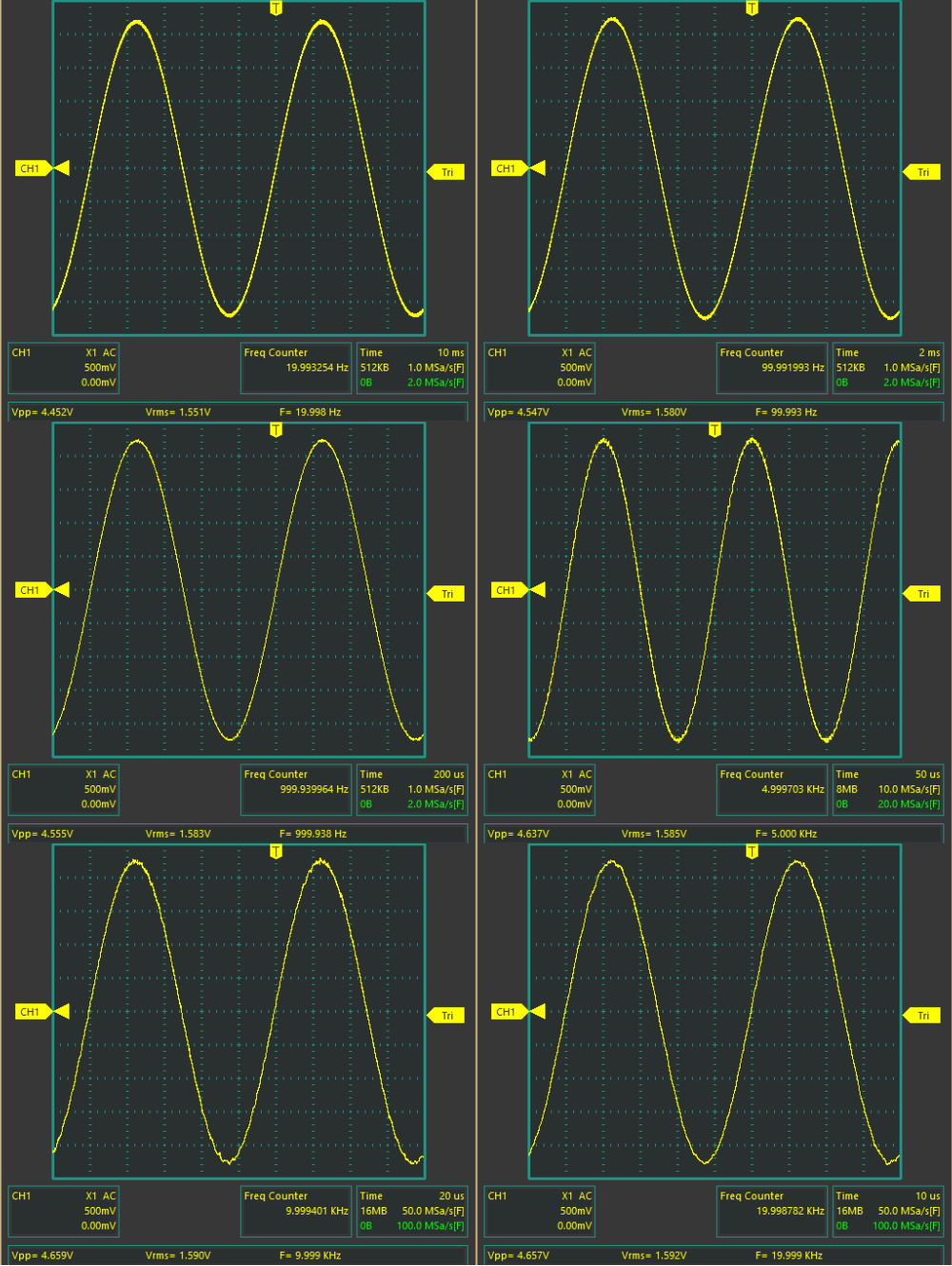
SE 100Ω
For SE 100Ω, the maximum voltage with subtle distortion across the entire frequency range is 2.003V, which equates to a power output of 40mW and 20mA. This power output is even slightly lower than that of its most direct competitors.
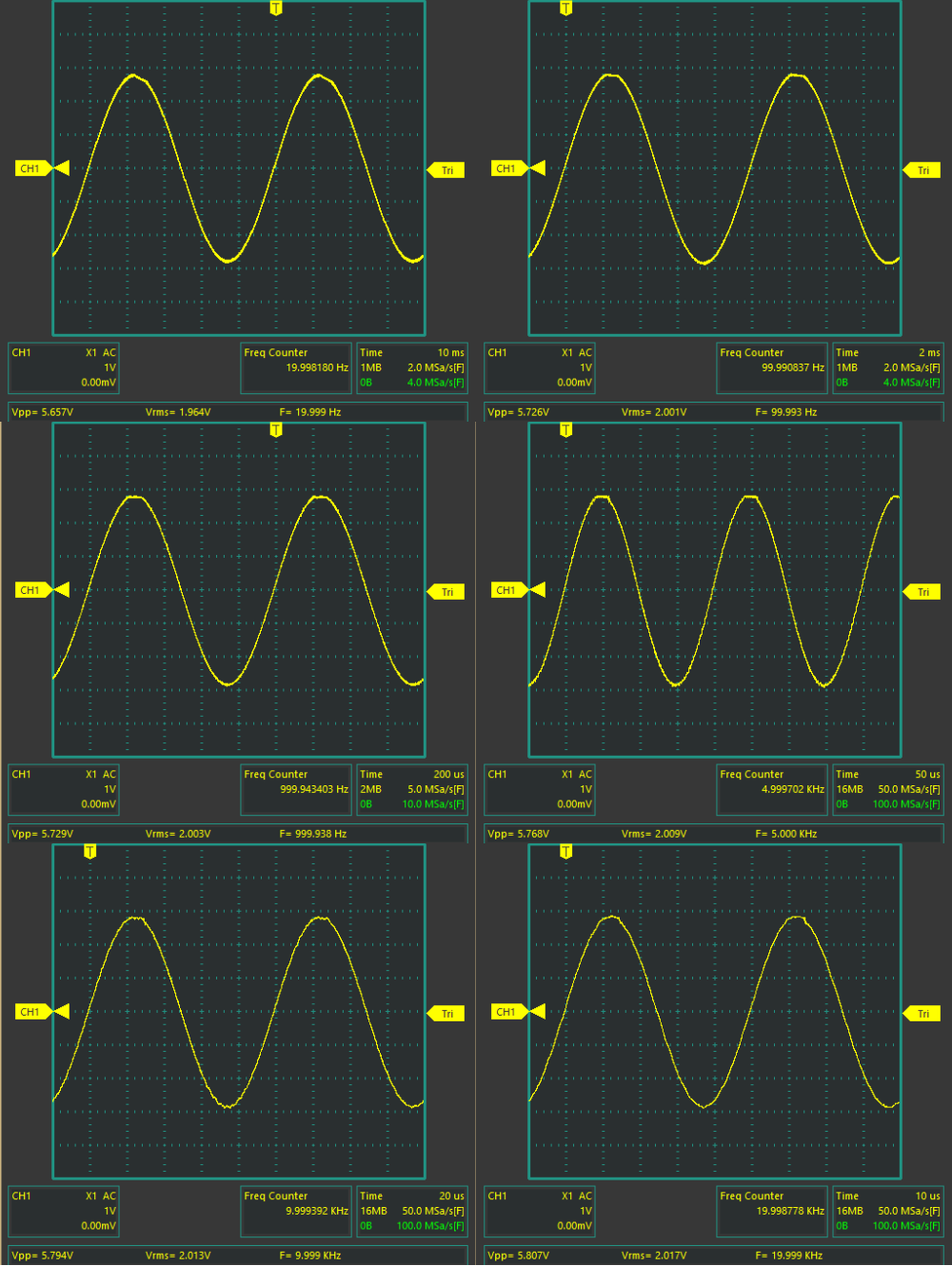
BAL No Load
Without load, it reaches 4V RMS.
BAL 15Ω
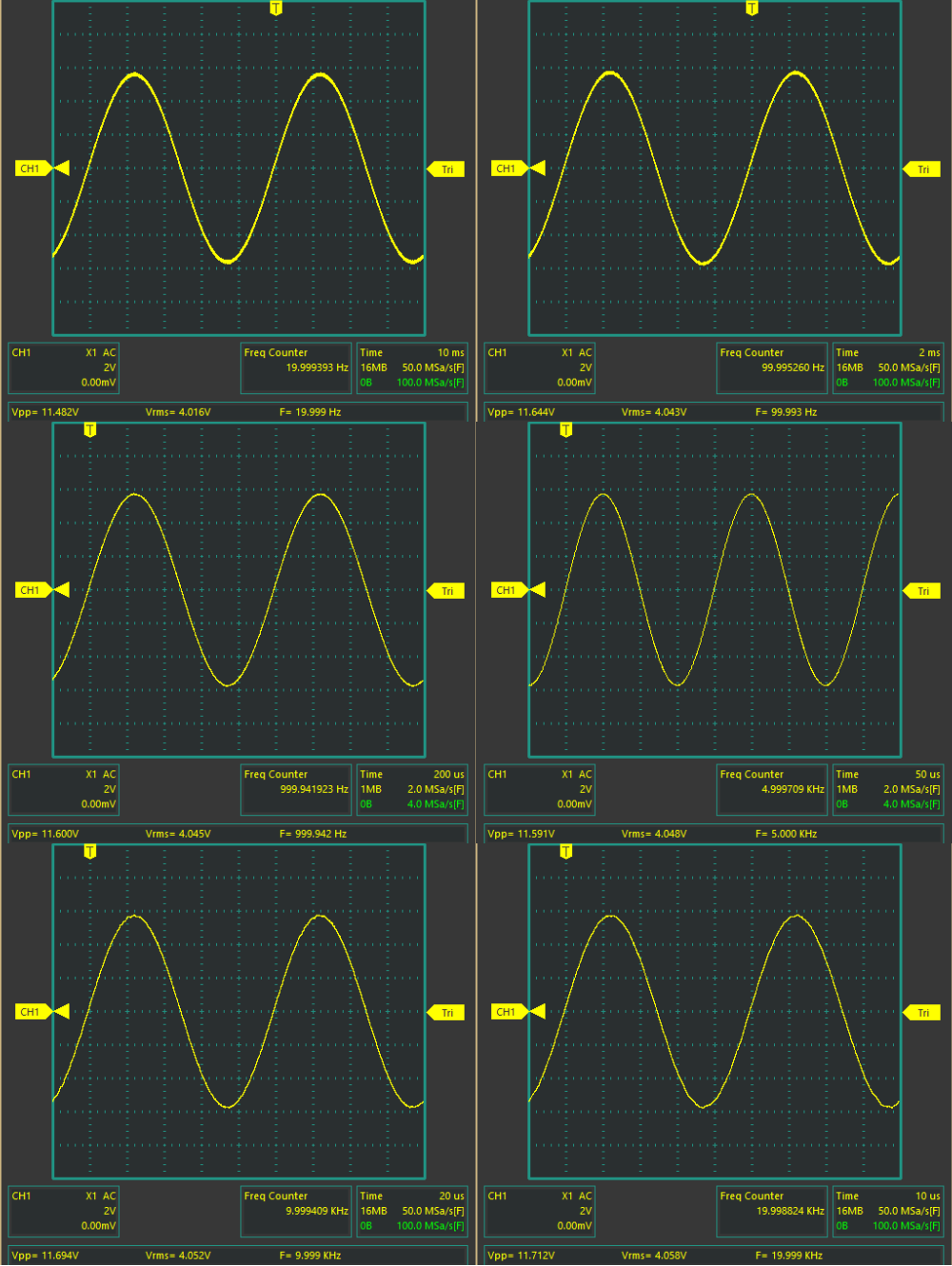
For BAL 15Ω, the maximum voltage without distortion across the entire frequency range is 1.264V, which equates to a power of 110mW and 54mA. Pretty good.
BAL 33Ω
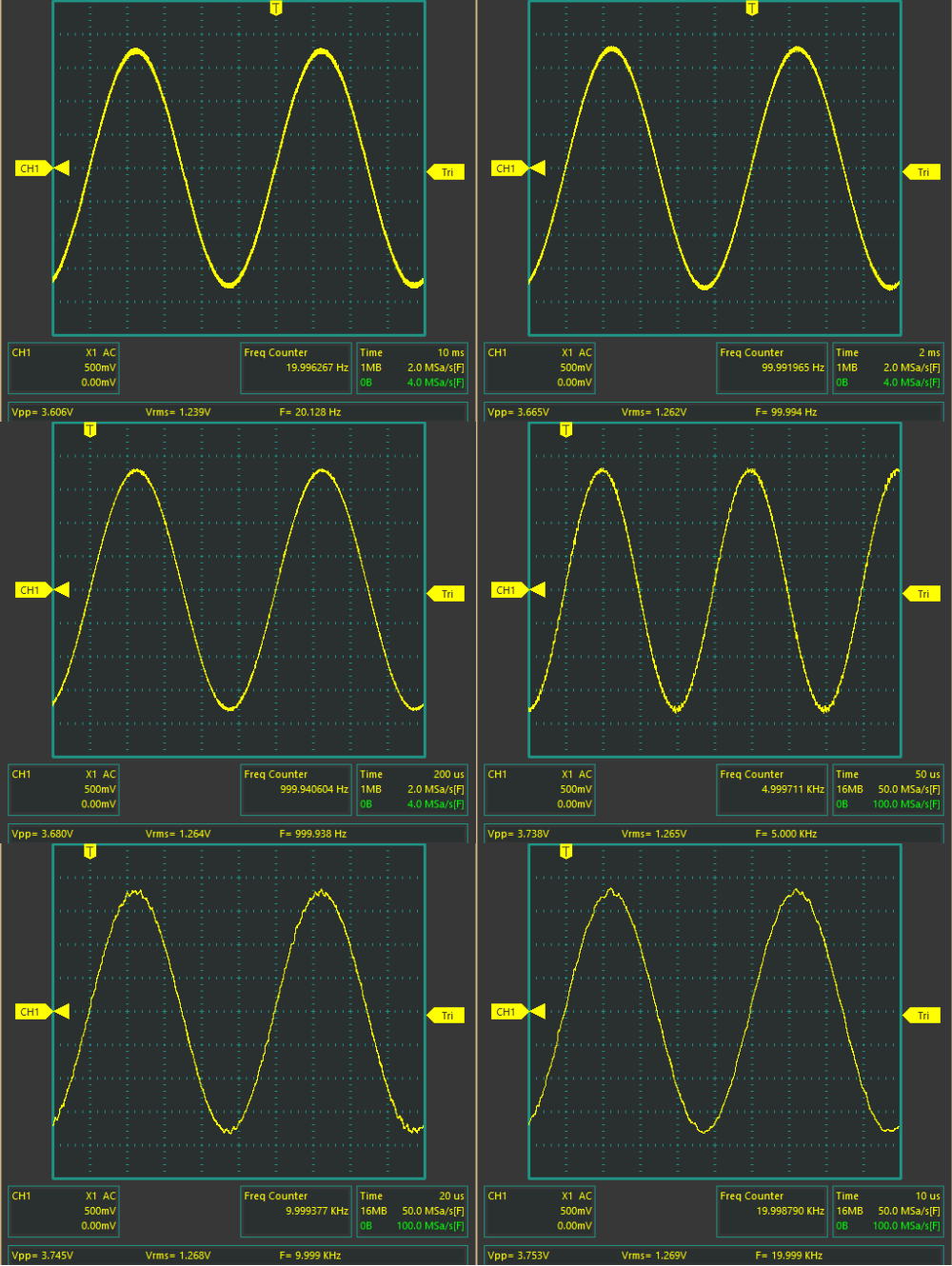
For SE 33Ω, the maximum voltage without distortion across the entire frequency range is 2.538V, which equates to a power of 200mW and 77mA. An excellent value.
BAL 100Ω
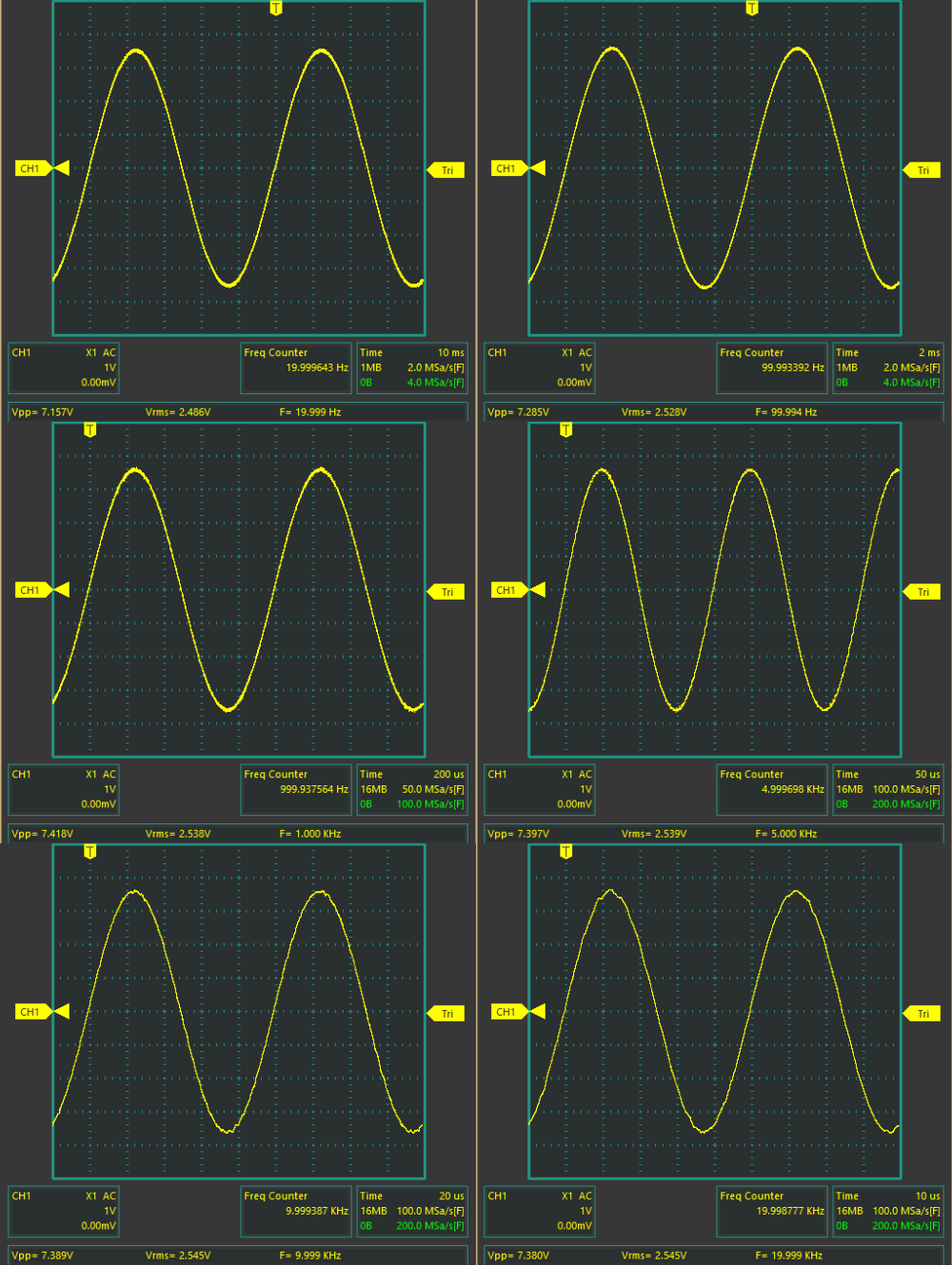
For SE 100Ω, the maximum voltage without distortion across the entire frequency range is 3.603V, which equates to a power of 130mW and 36mA. It does not reach 4V, which means that it is not the best dongle for medium impedances, but it does deliver a good amount of juice.
Frequency Response
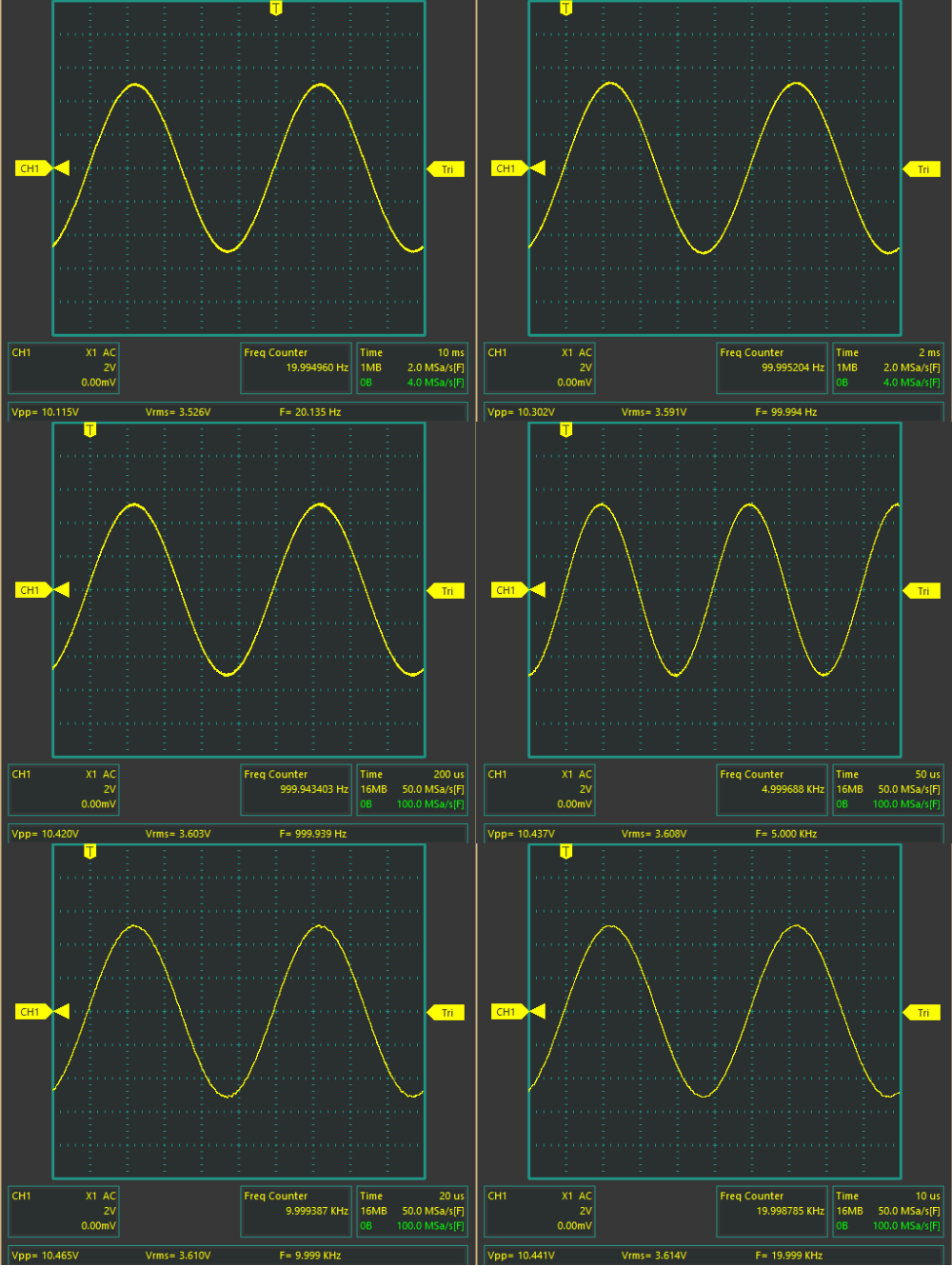
The frequency response is completely flat across the audible range, extending from 10Hz to 40kHz with this flatness. Furthermore, there is no discernible difference between channels. Very good.
Sound
As I mentioned, my Windows 10 PC recognises the TRI Third Eye TK1 as the ‘Hidizs XO DAC&Amp’ device. I suppose they must share the same USB chip and driver. On the other hand, the DACs used are not like those in the XO (ESS SABRE DUAL ES9219C), but rather two Cirrus CS43131s. That said, there are no other similarities between the two.
The TK1's profile is, as the description says, neutral-warm; there is not much more to say in this regard. I would only add that this warmth is not at odds with a good level of transparency and precision.
The bass is impetuous, full, wide, deep and with a good realistic, natural tone, with power, punch and forcefulness. The level of cleanliness and clarity of the bass is striking.
The very low frequency pure tone test is performed realistically, naturally, with very low colouration, providing physicality and a good dose of sensory component. The sensation of depth and volume is very noticeable. Overall, the best bass headphones will shine with this dongle.
In the dirty, complex, unfiltered bass test, the TK1 delivers the level of precision, definition, and clarity I mentioned earlier. It feels quite neat, with well-defined edges, clean, very controlled, and without losing any punch.
In the midrange, I feel a mixture of warmth and precision that is striking in a DUAL CS43131. I feel it is a little more analytical and thin, slightly enhancing the edges of the notes, but maintaining that warm character, although not as sweet as other smooth Cirrus implementations. I also note a certain brightness, a little more air, clarity and transparency, generating a little more amplitude, volume and space, as well as more separation in the midrange.
TRI claims that the TK1 is a dongle for relaxed, fatigue-free listening. But that doesn't mean it doesn't offer full highs, even with a slightly more daring edge. It does not lose the naturalness and organic character conferred by its DACs, but it does stretch a little further, adding a touch of extra brightness aided by that higher level of definition and precision.
The impression of greater clarity, thinness of notes and that more analytical touch, combined with very precise, physical bass with body and volume, helps to create a wide, expansive soundstage with a good level of three-dimensionality and a certain volatile and gaseous character, but without going overboard. The sound is transparent, clear, clean and well separated. The elements are very well placed in the environment and feel precise and recognisable in their presentation.
Comparisons
Tempotec Sonata BHD Pro
The Tempotec Sonata BHD Pro is a dongle that has the same CS43131 Dual DAC, features an FPGA and three femtosecond oscillators, supports MQA x8, has an RGB LED, two buttons for volume control and, of course, a USB Type-C input and 3.5mm SE and 4.4mm BAL audio outputs. Its body is made of aluminium, slightly smaller than the TK1, and also features a smaller glass window to see inside the circuitry. Although it is more robust than the TK1, I prefer the design of the TRI. It is currently available for around 60$.
It's clear that the features of both dongles are very similar, as are their parameters, including power. However, the TRI stands out for its peak power for 32Ω per BAL. The sound is very similar in both dongles, but the BHD Pro has the ability to change the sound slightly thanks to two different firmwares.
The bass on both models is very similar, but I think the BHD Pro is a little muddier, slightly darker, less precise, and not as clean as the TK1.
The very low frequency pure tone test is very similar, but I find the TK1 subtly cleaner and more accurate. Meanwhile, in the dirty, complex, unfiltered bass test, I find the TK1 performs better, offering a little more power, sharper edges, a less diffuse response, with more resolution and definition. The BHD Pro continues to sound a little murkier, wider, even dirtier, but darker.
In the midrange, the TK1 remains somewhat more analytical. I find that the TRI offers more transparency, clarity, separation and a sense of air than the BHD Pro, which sounds sweeter, perhaps more melodious, but not as transparent, open and clear as the TK1.
The high end of both dongles is very similar, with favourable performance for long listening sessions. But I find that the BHD Pro is still smoother, while the TK1 is more polished, with slightly more energy and thinner notes.
The cleaner, more analytical and transparent character of the TK1 wins the game in terms of soundstage. The BHD Pro is a little more muted, with less expansive capacity, more attached and with that subtle murkiness and roundness of the bass defining the edges in a more rounded and wider way. The micro detail is not very different in both dongles, but the TK1 is cleaner and generates it in a way that can be more defined and visible. All this means that the feeling of separation, neatness and dark background favours the TK1.
Conclusion
I must confess that I was very reluctant to analyse another dongle with the classic Dual DAC CS43131, especially since the new CS43198 has become one of my favourite DACs for portable devices. But it seems that each brand is still able to add some extra subtlety to these chips. In this case, the new TRI Third Eye TK1 comes as a simple and elegant black dongle which, thanks to its glass top surface, allows you to see inside and view the circuitry, as well as the LED that indicates when it is in operation. However, this double glass surface, which covers all the longest sides of the dongle, is also its weak point, as it gives the impression of being more fragile.
It has three buttons for volume control and play/pause, no gain control, two headphone outputs (SE 3.5mm and BAL 4.4mm) and a USB Type-C input port. It has a good amount of power, especially for the balanced output for 32Ω. Its low output impedance and absolute linearity across the entire frequency range make it very suitable for all types of low and medium impedance headphones.
In terms of sound, the extra feature is the addition of a more analytical aspect to the classic neutral-warm sound offered by the Dual DAC CS43131 chips. It is not a cold or clinical sound, but there is certainly a little more brightness, transparency, precision, resolution and definition than other classic dongles that use these circuits. And this feature can be appreciated across the entire frequency range, from bass to treble, helping to create a more expansive and volatile soundstage than the competition, as well as a cleaner and more separated sound. A pleasant surprise.
Earphones and Sources Used During Analysis
- NF ACOUS NM25
- LetShuoer S12 Ultra
- BQEYZ Winter II
- ZiiGaat Horizon
- ZiiGaat Odyssey 2
- NiceHCK Rockies
- NiceHCK EBX25Ti
- Hidizs Mk12
- Kiwi Ears Astral
- Kiwi Ears Aether
Purchase Link
You can read the full review in Spanish here