2026 KeepHiFi NEW LOOK Sale
UP to 50% Off
Giveaway Now Live
Shipping Globally
2026 KeepHiFi NEW LOOK Sale
UP to 50% Off
Giveaway Now Live
Shipping Globally





"Can KBEAR reclaim their former glory?" That was the question on my mind after trying several of their recent lineups. While some models like the KB02 were solid, others felt a bit underwhelming and lacked the competitive edge needed for their price point.

However, my perspective completely shifted after visiting the Keephifi booth at CanJam. It turns out they’ve been cooking up two highly promising products that genuinely deserve the hype—one of them being the KBEAR Kalideer. Why the Kalideer? What makes it so special? Let’s dive into why this IEM is positioning itself as a fierce competitor in the fiercely contested $100 price bracket.
Right off the bat, the packaging is eye-catching, featuring a colorful and artistic deer design that gives off an elegant vibe and builds instant unboxing anticipation. Inside, you get a beautiful postcard where the deer illustration cleverly faces the outer box cover when placed side-by-side.

Accessories are incredibly generous: you get 3 pairs of Clarion tips, 3 pairs of white tips, 3 pairs of grey tips, and 6 pairs of black tips. Among this extensive selection, the white tips provided the best synergy for my sound preferences.

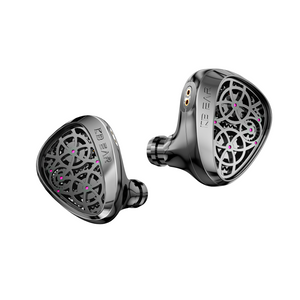
The 3D-printed resin shells look stunning—easily one of the best faceplate designs in this price range. Surprisingly, for a tribrid configuration featuring 1 Beryllium-plated DD, 1 BA, and 1 PZT (Piezoelectric) driver, the housing is remarkably small, lightweight, and offers arguably the most comfortable fit in its class (similar in size to the Cai Wenji). The cable feels decent, though it’s a shame it isn't modular and only comes with a 3.5mm jack.
On the bright side, the Kalideer is very easy to drive—even a budget dongle DAC will suffice. However, it does require about 8 hours of burn-in to fully unlock its potential.

The Kalideer features a balanced, warm U-shaped sound signature.
While the bass quantity isn't overwhelming, it favors the mid-bass with exceptional quality. The punch is satisfyingly pillowy, rich, and well-textured, making it highly addictive for K-Pop and J-Pop playlists without causing fatigue during long listening sessions.
The sub-bass extension is equally impressive, offering a deep, grand rumble with a medium decay that blends seamlessly with the mid-bass.
The bass speed is fairly quick and well-controlled, allowing the IEM to handle various genres effortlessly. So far, only bone-conduction sets like the Etude or Bijou can rival this quality, albeit with much larger bass quantities.
Despite the strong bass foundation, vocals remain forward and perfectly centered.
The vocal tuning is remarkably musical, sweet, and emotionally engaging. Male and female vocals are beautifully balanced; the warmth adds body to the notes, while a slight boost around 4kHz keeps things clean and clear.
Even when female vocalists belt out high notes, the energy is well-preserved without becoming overly aggressive. Sibilance, peaks, and shoutiness are virtually non-existent. For a tribrid set, the instrument timbre (acoustic guitars, percussion, piano) feels astonishingly natural and cohesive.
The treble is laid-back and safe.
Interestingly, the typical aggressive sizzle associated with PZT drivers is absent here. Instead, the treble feels smooth and organic. In tracks like DeadSquad's "Perangai Nadir," cymbals have a clear presence but are delivered with a relaxed, non-fatiguing presentation.
While the crash cymbals lack absolute density, the upper treble remains airy and extends reasonably well.

Much like other musical sets (such as the Truthear Pure), absolute technical performance isn't the primary focus here. That said, the soundstage is quite wide, with good height and decent depth.
Imaging is accurate, instrument separation is clean, and the transient speed is fast enough to keep up with heavy metal tracks. Dynamics are solid, backed by decent clarity. Detail retrieval, resolution, and micro-details are highly competitive for the price, sitting comfortably alongside peers like the Truthear Pure, Juzear Gamefidelity, Fudu Verse 2, and Raven Teal.

Did KBEAR succeed in tuning a competitive $100 tribrid? Absolutely. The Kalideer is a highly versatile, warm, and musical IEM boasting exceptional driver coherence and natural timbre. Combined with a premium unboxing experience, rich accessories (including Clarion tips, a hard case, and a cleaning cloth), and an incredibly comfortable small housing, it offers immense value.
It’s an easy recommendation for anyone looking for an all-around, relaxed, and musical signature. My only minor gripes are the non-modular cable and the slightly shallow soundstage depth.
Article reprinted from:https://www.facebook.com/share/p/197CFVAh8e/

Discover Better Sound