

Have you ever fallen into the "five-minute trap" with mid-tier IEMs? You buy a spec-heavy, multi-driver hybrid earphone based on hype, and for the first few minutes, the piercingly bright, hyper-detailed highs leave you amazed. But pass the thirty-minute mark, and your ears are ringing, fatiguing you to the point where you put them back in the box to collect dust.

In the brutally competitive $100 to $200 sweet spot, why is it so incredibly hard to find an all-rounder that just lets you sit back and enjoy a full album without headache-inducing bloat or harshness?
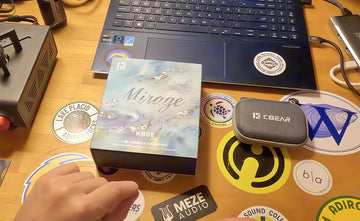
To be honest, my past experiences with KBEAR’s models (like the KB02, Wukong, and Turbion Pro) were quite mediocre. So, when the $169 - $170 KBEAR KB08 Mirage landed on my desk, my expectations were comfortably low. Yet, after living with them as my daily driver for a few days, this turned out to be the exact release that completely shattered my preconceptions.
The primary engineering challenge in multi-driver hybrid IEMs invariably revolves around coherence—different driver types fighting for dominance, causing harsh frequency cut-offs and unnatural texturing.
The Mirage bypasses this flaw entirely through a brilliantly segregated tribrid matrix that resolves phase issues right at the physical level:
· 10mm Beryllium-Coated Dynamic Driver (DD): The ultra-rigid beryllium diaphragm is tightly restricted below 250Hz. It handles nothing but the lowest low-end foundations, cutting off the muddy mid-bass bleed common in lesser hybrids right at the source.
· Custom Balanced Armature (BA): Meticulously positioned to anchor the vital midrange, rendering full-bodied, organic vocals free of dry, analytical coldness.
· Dual Micro-Planar Magnetic Drivers: Purpose-built to handle transient agility and fine upper-frequency textures with effortless resolution.
By completely stripping the low-frequency load away and offloading it to a specialized beryllium driver, every driver operates flawlessly within its optimal linear range.
The transition across the spectrum is so fluid that it mimics the organic cohesion of a single dynamic driver. Achieving this level of cohesion across a tribrid setup is nothing short of an acoustic work of art.


With an impedance of 11Ω and a sensitivity of 102dB, this set is exceptionally easy to drive from any modest portable source or dongle.
However, its controlled, mature tuning philosophy is what truly won me over and convinced me to keep it in my permanent rotation.
Verified on professional IEC 711 standard measurement rigs, the Mirage showcases a textbook acoustic equilibrium: the low-end and the upper-mids/treble peak almost symmetrically.
In real-world listening, this translates into zero bloat and absolute full-frequency harmony.
· Satisfaction-Guaranteed Bass: The mid-bass strikes with punchy control, backed by an elastic, deep sub-bass rumble. It tames boomy rumble, translating raw power into a highly textured, engaging sense of rhythm.
· Organic Mids & Airy Treble: Midrange vocals maintain pristine contours and never feel pushed back, staying beautifully distinct even in busy mixes. While a minor 8kHz energy peak is visible on graphs, real-world listening confirms it introduces zero real-world sibilance. Instead, it serves to inject a beautiful sense of top-end airiness and natural harmonic decay.
Equally impressive is its spatial presentation.
Thanks to elite separation technicalities, the Mirage projects an expansive 3D soundstage with great horizontal width and vertical depth.
When handling complex arrangements like 《A Love Supreme》, the imaging localization remains flawless—keeping the saxophone left, the bass center, and the drums right.
Every instrument retains its stable position with zero congestion, delivering a studio-grade realism that punches far above its price bracket.

During my testing, I experienced a highly authentic psychological transition that completely separates real-world evaluation from simple spec-reading. Immediately prior to unboxing the Mirage, I had been evaluating a significantly brighter, highly aggressive monitor (the Earsonics Hu Ao Shu).
Due to the phenomenon of perceptual adaptation inherent to human hearing, switching directly to the Mirage left me in brief disorientation, initially asking myself: "Where did all the treble details go?"
Yet, this exact reaction sparked a deeper realization of the fundamental difference between professional tuning and sensory bombardment.
Once I permitted my hearing to reset and spent continuous hours with the Mirage, I realized that the previous IEM forced artificial detail through exhausting top-end bombardment. The Mirage, by contrast, delivers an impeccably measured, natural musical totality.
Its ability to effortlessly handle everything from laid-back jazz to heavy metal without breaking a sweat is the ultimate hallmark of mature engineering over amateur driver-stacking.
The exceptional completeness of the Mirage extends far beyond its sonic performance; it reflects a thorough understanding of the product experience lifecycle.

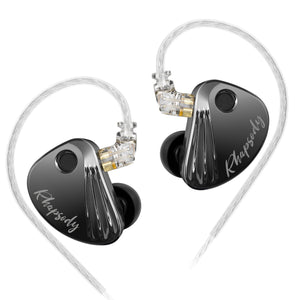
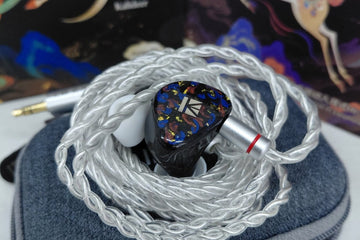
Visually, the Blue variant utilizes a sky-blue housing adorned with mica shimmer and a pearlescent white gradient that shifts elegantly under changing light conditions—earning high marks for its premium visual aesthetic even from my spouse, who maintains highly stringent design standards.
Furthermore, the unboxing rewards users with 3 distinct sets of 12 silicone ear tip pairs, including the highly sought-after Tri-Clarion wide-bore tips.

Recognizing that human ear canals vary drastically, it preemptively solves fitment and acoustic sealing issues out of the box.
Paired with a heavy-duty carrying case and an ergonomic, premium 3.5mm stock cable that matches the shells perfectly, the ecosystem delivers a complete listening solution rather than just a pair of earphones.
In the comparative spectrum, I define the KB08 Mirage as the natural progression for listeners ready to transition from entry-level gear to a more sophisticated audio tier.
Compared to the iFi Explorer—which is safely balanced but can sound dry and uninspiring—the Mirage injects a wealth of polish, superior detail density, engaging dynamics, and complete refinement without a hint of high-frequency fatigue.
While it honestly does not claim to unseat thousand-dollar absolute flagships (such as my personal favorite, the Twilight DS), its overall value proposition in the $170 price bracket remains genuinely untouchable.
For rational music lovers seeking an investment that promises long-term companionship, versatility across all musical genres, and absolute tonal faithfulness, the KBEAR KB08 Mirage rejects short-term sensory gimmicks to deliver the definitive daily driver for acoustic balance.
This article is adapted from and compiled based on a YouTube video
Click to watch the original video: https://www.youtube.com/watch?v=XfJtHWEZpMQ
More hifi audio gears at KEEPHIFI

Spend Less Enjoy HIFI