
Source: https://www.head-fi.org/showcase/kbear-kb02.27834/reviews#review-37106

KB Ear reached out to me requesting that I check out their product, the KB02. So I willingly accepted, with the caveat that I get to share my honest thoughts, positive and/or negative.
It’s always fascinating when technologies from top of the line products start to trickle down and manifest in more affordable options. I was curious how the KB02 would handle the bone conduction aspect. BCDs seem to be a more recent craze, but I have to admit, I typically like BCD drivers in the IEMs I try. Forté Ears Macbeth, Canpur CP622B, Empire Ears Raven, Astell&Kern x Empire Ears Novus, Unique Melody Multiverse Mentor, Cayin Amber Pearl, each have increase in performance with the usage of the BCDs, at least to my ears. Each of those are multi-kilobuck IEMs, though. Now, when a $39 USD IEM touts having BCD in it, I was both eager and skeptical. I will talk more about its implementation in a little bit.
Let me start by saying, any comparisons that I possibly could compare the KB02 against are not equal or possibly fair comparisons. I may include thoughts and references to some mentioned above because it’s what I have on hand or what I have experience with, but by and large I will avoid doing much comparison and base thoughts and impressions off its own merits.

Build and Aesthetics
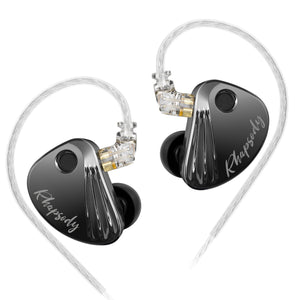
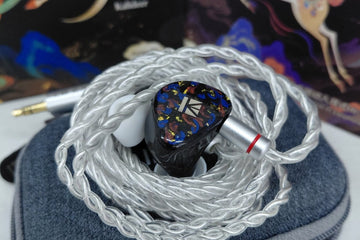
Starting with the driver make up, I already talked about the bone conduction driver, which is actually an elastic-type, and a beryllium dynamic driver. This is housed in a lightweight resin shell. The nozzles themselves are metal. The faceplates come in three different options, a blue-style, an orange-style, and a purple-style design faceplate. KB Ears sent me the purple and I quite like the overall look of the faceplate. Simple, yet elegant.
The build of the IEM itself isn’t anything to write home about. When you hold it in your hand or tap it, it feels a bit hollow. That said, it feels sturdy enough to not feel fragile. It is well shaped, too. It’s a medium-sized shell that fits very well in my ear and doesn’t create hotspots or put pressure on my ears at all. It’s also important to note that in order for the bone conduction to work, the more shell to skin/ear contact you get, the better. So wearing these deeper certainly helps maximize the bone conduction.

What’s Included
The cable provided inside the package is a standard affair cable, terminated in 2-pin for the IEMs and 3.5mm to the amp/dac/source. It’s relatively thin and provides relatively minimal microphonics. This is actually important to me because I daily use my IEMs on my morning walks before I start my work. If there are microphonics, or rather excessive microphonics, it is a big mark against the IEM and cable. A recent example of that is the FatFreq x HBB Deuce’s blood cable… horrible microphonics. I can barely use it walking, I can barely use it for my zoom meetings because I can hear the cable rubbing on my shirt, rubbing on my desk, swinging freely… I hear it all.
Additionally in the package, KB Ears provides not one, not two, but THREE sets of different ear tips to use. Really nice. Options are nice, especially at the entry level. I tried a few of them and I think they are fine overall, however for the majority of the review I ended up just using my favorite and go-to eartips, the HifiGo Divinus Velvet eartips. They provide me the best fit and seal.

Also for reference, I listened to the KB02 on a number of different sources just to throughly put it through its paces. Here’s the different configurations:
It’s interesting trying such an affordable IEM off of gear that really doesn’t make sense to pair with, but it was fun to see the maximum capabilities were for the IEM. So, while I tried it on all of those configurations, the obvious question comes to mind, “do the KB02 scale with higher quality sources or chains?” My quick answer… yes, to a degree, though it’s not infinitely scaling. Now onto how these sound.

Sound
I didn’t know what to expect and I also let this set burn-in for a week before I started really evaluating it. I did give it a try a little bit when I first opened it just out of sheer curiosity. I’d say it’s relatively neutrally warm tuned, with a bit of bass lift. It’s touted as a bassy set, but I’ll curb that expectation a bit simply because I’ve listened to some bass-heavy or bass-monster sets and this isn’t quite there. However, neutral with a bass emphasis does better describe it. Timbrally though, I think there’s a bit of metallic sheen to the sound and that’s more noticeable in the treble. I’ll elaborate a bit more on this in the treble section next. It’s not quite natural sounding, unfortunately, which could be partially due to the tuning, but also partially due to the beryllium driver implementation. The bone conduction does also actually factor in the overall timbre, as well, but I’m getting a tiny bit ahead myself.
Treble
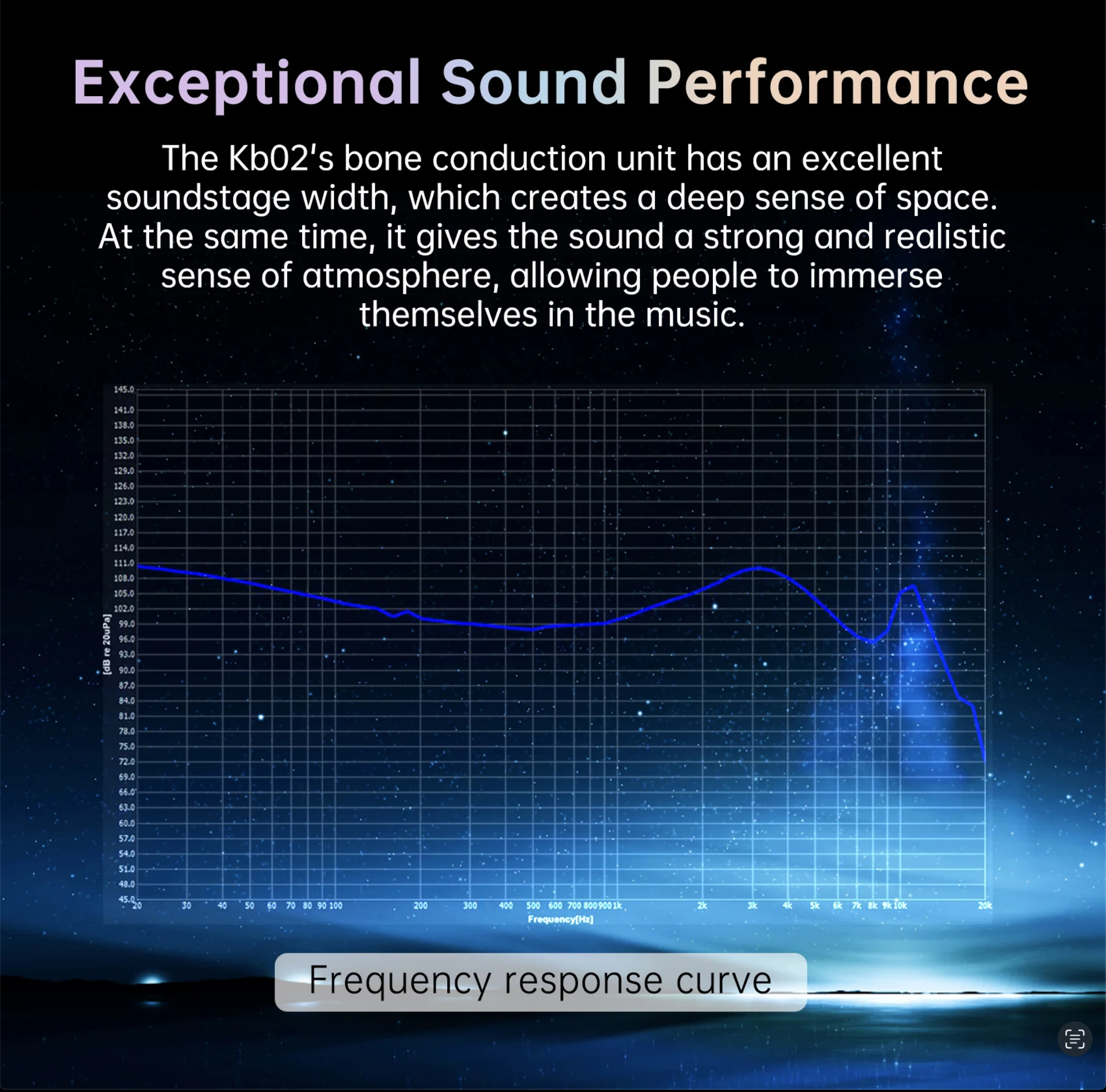
Speaking a bit more on the treble, by and large it’s pretty well balanced. It rolls off the higher treble frequencies, so you won’t get a ton of airiness. However, there is a larger peak that presents itself in the treble before the air frequencies. It’s not super spicy, but it sticks out. Where it falls is more noticeable somewhere in the upper frequencies or harmonics of sounds, like cymbal crashes. It’s not overly sharp though, thankfully, it is just more noticeable and does make it sound a little less natural. It does give the treble and overall sound a bit of that sparkle, but I think with the roll off of the air frequencies, it feels just a touch disjointed. I think that this peak/spike does lead to that metallic sheen that I hear from the treble. According to the FR graph that KB Ear shows on their webpage, it occurs around the 11-12kHz region.
Midrange
KB02’s midrange is a bit forward to my ears. It’s overly forward, but there’s a midrange emphasis that does give this set more energy than I’d prefer. The plosive sibilant areas of the vocal region that play between the upper midrange and the lower treble is kept pretty well in check, but the frequencies leading up to the 3K region are pretty emphasized making voices come off a little shouty at times. Tonality in the midrange is pretty good, voices and instruments do not sound thin or overly thick either. Vocals especially feel like they have a nice amount of body, without feeling throaty. There’s a little bit of resonant decay in the lower register of the vocals that I experience and I suspect that is due to the bone conduction. I think overall though, if the midrange was brought down just a little bit, maybe 3dB, it would actually help, one with the touch of shoutiness, but two, with the balance to the bass.

Bass
As mentioned prior, this set is touted to be a bassy set, but I think it’s not quite that. When I think of bassy sets, Nightjar Duality, FatFreq x HBB Deuce, FatFreq Scarlet Mini, FatFreq Grand Maestro all come to mind. This doesn’t compete with those bassy sets, though realistically, it shouldn’t, especially given the price. The bass is not thick and strong, but it’s just slightly more bass-emphasized. Each of those has a distinct emphasis on subbass, which I don’t quite get from this set. It’s just a little bit light on the pressurizing effect you get from the 25Hz-35Hz range that those sets above achieve. However, bass is pretty well defined and not boomy and the bass rise is quite tastefully done, in fact. Mid bass is punchy, but it is just a little bit more pillowy and lacks just a little bit of swiftness. Overall it just lacks a little bit of snap and attack, but the overall tonality of the bass is good. Upper bass is natural sounding. I think the assistance of the bone conduction helps in the bass department, though.
Bone Conduction
So, here’s where I’d like to spend a little bit more time because I think the implementation is multifaceted. The elastic bone conduction implementation is fascinating, cool, effective, if not a bit gimmicky at times. Let me elaborate a little bit on this though.
As I mentioned in the bass section, the BC assists the bass get more tactility, however, the bone conduction doesn’t seem to be isolated to the bass region as I do feel resonating effects from the BC in the midrange, especially in the lower midrange. I had said that there was a bit of resonance decay that I experienced in the lower midrange. What I hear and feel is the elastic BC still vibrating. This is easily noticeable if you pause a song, you’ll hear a very brief sound that sounds like a rubber band instantly being made taut. Kind of sounds like, “thook.” You can also feel the vibrations of the midrange sometimes in the shells themselves, too.
When I spoke about the shell feeling a bit hollow if you tap on it, you can also feel the elasticity of the BC when you do that, too. It makes sense, but you certainly can feel the shells vibrate when you have music going. This is where I think it feels a little bit gimmicky. Yes, it’s effective in the sense that the BC is supposed to vibrate your cartilage, but the amount of vibration is not subtle. If you’ve ever dealt with tactile transducers in theaters or home theaters, the same concept applies. There are implementations that are done tastefully that truly heighten the experience, effectively disappear, and there are transducers that are novel, but ultimately gimmicky and ever-present. Some seemingly just shake and one intensity. The BC in relation to that, isn’t the latter example, thankfully. The elastic BC teeters somewhere in the middle of the transducer range, though. It’s cool and a cost effective way to experience BC to a large degree, but it’s pretty noticeable it’s there and working.
So, is it ultimately a bad thing? No. After spending a few weeks going back and forth between this and other sets, I will say that it’s BC, while noticeably there pretty often, didn’t detract from my listening experience. Your mileage may vary on that, but the elastic bone conduction does its job.

Soundstage
The KB02 soundstage has got more lateral width than forward depth. Bone conduction can also heighten the experience of soundstage and here’s where I find it a bit of a double edged sword. Yes, it does actually help the expansiveness of the soundstage sometimes, but then other times it doesn’t and the overall sound is a bit closed in. That’s probably partially due to the tuning, more specifically in the midrange. However, there isn’t a large amount of depth and holography, though it’s sufficient and likely better than you might expect.
Detail and Resolution
This set is not going to wow anyone with its ability to resolve. The usage of beryllium for the driver I think helps take it a long way, but it’s still a bit smoothed over, partially due to the single dynamic driver and possibly additionally by the elastic bone conductor. There are times you can almost feel/hear the BC after the articulated notes should have dissipated.
Conclusion
I refrained making a whole lot of comparisons to other IEMs, but as I conclude my review I want to make this direct comparative statement — tonally/timbrally, I prefer the KB02 to the FFxHBB Deuce. Subbass and bass overall is still done better qualitatively and quantitatively by the Deuce, but midrange and treble, I feel the KB02 better suits my taste. Now, it’s not perfect as I’ve outlined above with the treble and the midrange, but by and large, it is pretty easy to listen to this IEM.
What does it do right? Makes bone conduction accessible and in a very affordable package. Vocals for the most part sound good. The amount of tips included is quite impressive. The price itself is highly appealing. Now, at the time of writing this review, you can even find these on Amazon for $35 with an $8 coupon. That makes these IEMs $27 dollars! Is it worth it? YES. That’s just silly.
What can be improved? Timbre could be better. Honestly, one might say, what more can you ask for in a $40 (or presently $27) IEM? I find myself thinking that, but then I also look at the landscape of IEMs. Competition is overwhelming, even in this price bracket. So maybe it’s not too much to ask for a little less metallic timbre. It’s an area of improvement, though It’s not a make or break situation here because it’s an affordable option. A slight complaint, though understandable sacrifice, is the lack of 4.4mm terminated cable. The only one is a 3.5mm single-ended cable, which is fine, but something worth noting.
So why did I give it 3.5 stars. All in all, though, I think this is a praiseworthy set. It’s fascinating and despite some of the things I pointed out, doesn’t do anything egregiously wrong, rather I think it does a lot of things right, including the price. What sets the set apart is the ability to experience bone conduction in a different way. Truth be told, I’ve already encouraged a few of my friends to give this set a try.


Spend Less Enjoy HIFI