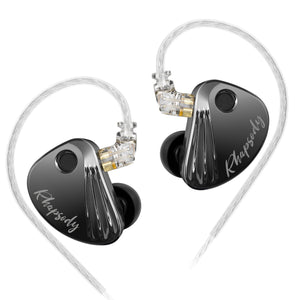



The moment you unbox the KBEAR Venus, one thing becomes instantly clear: this is not your typical audiophile IEM.
With its integrated Type-C plug, onboard DSP digital engine, and bold ring-shaped RGB aesthetics, the Venus firmly signals that it was engineered primarily for the gaming crowd, while keeping casual music listeners in its periphery.

After weeks of intensive testing across competitive multiplayer stages and general music playlists, the results are a fascinating mix of strategic tuning and structural trade-offs. Let's break down the real performance under the hood.

As a dedicated USB-C in-ear monitor, the Venus integrates its own internal DAC and amplifier circuit. However, the driver behavior is heavily dictated by its core processor—the Smart Link M20200 DSP chip.

In practice, the digital signal processing acts as a dominant force shaping the overall audio output. You can clearly feel that the audio is highly optimized prior to the analog conversion stage.
This gives the signature a slightly "processed" tone—not in a detrimental way, but in a highly tailored manner. If your daily workflow rotates around competitive FPS games and casual, background music, this highly functional digital optimization works perfectly.


The visual design of the Venus is undoubtedly a standout feature. It brings a premium-looking metal faceplate treated with a clean matte texture. Embedded neatly along the edge of the faceplate is a smooth RGB gradient ring.
The lighting gracefully transitions through a spectrum of colors automatically. It does not synchronize to the beat of the music, acting instead as a constant ambient visual flare. While it has zero impact on sonic reproduction, it is an incredibly fun addition that instantly matches the visual energy of a modern gaming station.
Ergonomically, the shell dimensions are exceptionally well-proportioned, securing an effortless fit in the ear canal. However, the acoustic nozzle is made of lightweight plastic.
For a product competing at the ₹2499 bracket, I would have loved to see a robust metal or brass nozzle to add structural strength and a premium tactile finish.
The attached cable is heavy-duty, entirely black, and ditches the standard transparent look common in traditional Hi-Fi gear. It relies on a non-detachable, fixed cable architecture.
While a detachable 2-pin interface would have offered nice customization options, this fixed setup ensures long-term ruggedness.

Tethered to this cable is the inline control module, which is easily the largest physical controller I have ever handled on an IEM. Fortunately, its oversized footprint makes it incredibly ergonomic. Without looking down, you can instantly click to play/pause tracks, adjust volume levels, or step through your queue on the go.

Analyzing the frequency response reveals a deeply considered, fatigue-free audio profile aimed at long-duration use:
· The Bass: Low-end punch is present, but it steers completely clear of loose, rumbling, or overwhelming sub-bass bloom. It leans toward a flatter, tighter response. Hardcore bassheads chasing a dramatic physical impact for cinematic scores or heavy electronic drops might find it too lean. However, this tight bass control is an incredible asset for gaming, ensuring the lower frequencies never mud up or drown out the mid-range.
· The Mid-range: The mids are transparent, clean, and nicely balanced. Vocals are not artificially pushed forward into your face; they sit in a natural, organic timber. This relaxed vocal presence allows you to sit through long sessions without experiencing listening exhaustion.
· The Treble: The top-end is remarkably forgiving. It completely eliminates harshness or piercing spikes. On the flip side, listeners who prefer a bright, analytical presentation might feel that the upper registers miss out on a bit of micro-detail sparkle.

When testing music tracks, covering western folk like Allan Taylor or Indian vocal hits like Mohit Chauhan and Arijit Singh (Tum Hi Ho), the instrument layering and separation score a reliable average-to-good.
However, everything changes the moment you load into competitive shooter arenas like Call of Duty or Ready or Not. Driven by the DSP spatial tuning and the clean low-end, the positional cues and environmental spatial awareness become incredibly sharp.
Pinpointing the exact vector of incoming fire or tracking moving footsteps through structures becomes effortless.

To unlock the true potential of this budget IEM, consider these user adjustments:
· Roll with Memory Foam Tips: I highly recommend swapping out the stock silicone tips for aftermarket memory foam tips. This maximizes passive noise isolation, silencing room ambiance and creating a darker background to hear fragile audio details.
· Watch the Volume Slider: Always stick to low-to-moderate listening volumes. Pushing the output too high not only accelerates hearing damage but also skews your frequency perception, artificially exaggerating bass bloom while burying the mid-range detail.
· Leverage Software EQ: Since the sound is entirely shaped in the digital domain, you can easily use third-party tools like Wavelet to boost the upper-airiness or dial in a touch more bass elasticity based on your casual music taste.

If you are hunting for an analytical detail monster with massive, bone-shaking bass rumble for pure music appreciation, the KBEAR Venus isn't the choice for you.
However, if you are working within a ₹2499 budget and want a hassle-free, plug-and-play USB-C audio weapon that completely bypasses the need for external DAC stacks, provides professional-grade spatial tracking in FPS games, and handles casual background tracks comfortably without fatiguing your ears—the KBEAR Venus, with its striking RGB flair and practical physical controls, is a highly solid, value-driven recommendation.
This article is adapted from and compiled based on a YouTube video
Click to watch the original video:
https://www.youtube.com/watch?v=cHHtoREAo6c
More hifi audio gears at KEEPHIFI

Spend Less Enjoy HIFI