






Introduction
CCA has always been “the handsome sister brand” of KZ, famous for bringing products g more balanced and better sounding tunings with respect to their strongly V-Shaped counterparts.
The CCA Rhapsody are among the latest releases from the brand, featuring 6 drivers per side (2 DD + 4 BA) and tuning switches, and has already received some good reviews online. Thanks to Jenny from KZ, I can hear these and also took some notes to share.

Technical Specifications
- Driver Configuration → Hybrid (2 DD + 4 x BA)
- Impedance → 8 Ω
- Sensitivity → 108dB
- Effective Frequency Response Range → 20Hz-20kHz
- Cable → 1,20m 5N copper silver plated cable with 0.78mm 2-PIN connectors
- Plug Type → straight gold plated 3.5mm jack connector
Packaging
Nothing new under the sunlight as the Rhapsody come with the same packaging as older KZ and CCA products:
- The CCA Rhapsody
- One set of starline eartips (S, M, L)
- The detachable 3.5mm cable with 0.78mm 2-PIN QDC connectors
- A SIM Card removal needle (needed to move the switches)
- User manuals and instructions


Design and Build Quality
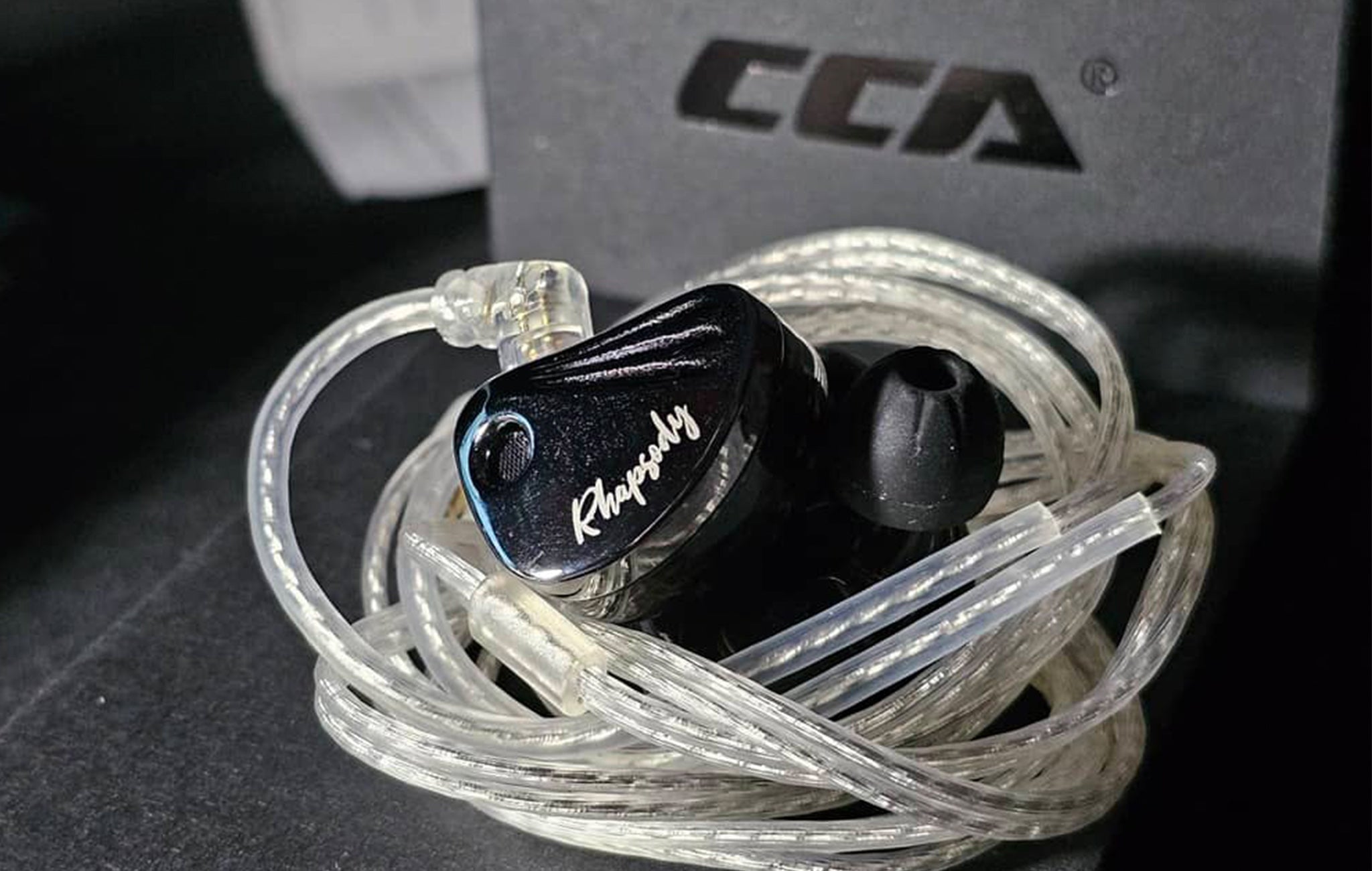
The CCA Rhapsody are larger and taller than average, with a thick shell that hides a multi-driver setup and tuning switches. The dark-silver faceplate is glossy and elegant, and the “Rhapsody” name isn’t ugly to see (which is good news) and there’s a hole on the faceplate with a visible grill, even though I’m not sure if it’s an open vent or if it’s just a decorative part of the shell.
The switches are located on one side of the IEM, but the reason why the switch panel is not symmetrical between the two IEMs is unknown to me.
The nozzle is not as wide as on other sets but it’s not a small nozzle either.
Overall, the Rhapsody are built very well with no major assembly flaws and they also feel very sturdy and well built to the touch.


Cable
The stock cable is, unfortunately, nothing to write home about. It’s the same cable that KZ and CCA have been including for ages now, and even though it’s not as bad as the one they used to provide in the past, I still think a small effort to include an even better cable could be done.

Comfort and Isolation
Comfort can be good or bad depending on the size of the ears: those who have small ears will likely have some comfort issues overtime, mostly related to the size of the shells (including their thickness), whereas others will find them sitting in a stable and comfortable way in their ears.
Isolation is more than enough for outdoor listening sessions.
Sound
GEAR USED FOR THE TEST
- DAC: Topping E30
- AMP: Topping L30
- Mobile phones: Samsung Galaxy S7 Edge, Xiaomi Mi A3, Samsung Galaxy S23 Ultra
- Moondrop May’s DSP cable with PEQ=0
- Dongle: Apple Type-C dongle, Truthear SHIO
- Portable DAPs: Benjie S8/AGPTEK M30B
- Other sources: Presonus AudioBox iONE, Elgato Wave XLR, KZ AZ10
Do they need an amplifier?
The CCA Rhapsody don’t need an amplifier, but giving them some juice is not a bad idea. I’ve noticed a bit better low-end tightness when connecting them to a proper amp.
Sound signature
The sound signature depends on the switches’ positions. The first two switches have impact on the bass, the other two twitches have impact on mid&high frequencies. Basically, setting the first bass switch in the UP position increases the low end, but if the second bass switch is also switched in the UP position, then the bass increases even more. Same applies for the mid&highs switches.
There are many possibilities and one can really try playing with them, but this review will be based on the DDUU combination, which basically avoids too much bass emphasis or a subdued upper range by following the Harman target more or less.
Moving the switches in different ways by starting from this position helped me understanding the various effects of the switches, but your mileage may vary of course.
Lows
The low-end is solid with average extension, a pleasant yet limited rumble and a very punchy bass that is more forward than the sub-bass. The bass is not the tightest or the fastest around, and the textures are only average, but it sounds very impactful in a pleasant way. I think these will be perfect for bassheads since there’s already a good amount of bass in the DDUU config and the switches really make the bass even more powerful, deeper and punchier.
For sure these are not for those seeking for neutrality, especially because they already have emphasized bass even in the switches’ combination with the least amount of low-end.
Mids
The lower midrange is slightly compressed between the emphasized bass and the upper midrange, and even though this happens, it still has some pleasant warmth that brings some character to male vocals (even though they don’t really “stand out”). The upper midrange is forward, just like on most Harman-ish sets, and although some instances of sibilance are still a thing, they don’t occur very often and aren’t unbearable, also thanks to the fact that the treble is gently roll-off providing more smoothness.
Highs
As said some lines above, the treble is rolled-off but still has enough energy to make good contrast with the low-end, providing a very engaging and dynamic sound. And good news, BA timbre is not a thing in most cases (even though it can pop-up at very high volumes and while listening to genres that require more treble such as metal).
The detail retrieval and resolution are below average for the price but the overall sound is very smooth and cohesive also thanks to the treble tuning. In addition, if we put the switches into the equation, then it’s easy to understand that everyone, including those who are sensitive to treble, has a chance to like these.
Soundstage is average and so is the imaging.
My favorite combination of the various switches: UUUU.
The UUUU combination has a more controlled midbass, more sub-bass extension and rumble, a bit less subdued lower mids and slightly better timbre overall. The other frequencies remain basically the same, so it’s more of a personal preference than anything else.
Some comparisons: