






DISCLAIMER
I would like to thank Linsoul for providing this review unit.
The BLON X HBB Z300 can be gotten here:
Other purchasing link:

SPECIFICATIONS
- Driver configuration: 10 mm silicone diaphragm dynamic driver
- Impedance: 28 Ohms
- Sensitivity: 115dB
- Cable: 2-pin, 0.78 mm, 4-core high-purity copper cable
- Tested at $39.99 USD
ACCESSORIES
Other than the IEM, these are included:
- 3 pairs of wide-bore silicone eartips (S, M, L)
- 3 pairs of narrow-bore silicone eartips (S, M, L)
- Sackcloth pouch
- Cable

The accessories are par for the course for a budget pair of IEMs. The packaging has a dragon motif with BLON's self-professed Oppoty and Driams tag line, which hasn't changed all these years from when the BLON BL-03 first came out! Some good old catch phrases are worth keeping it seems!
There are no foam tips provided. The white (wide-bore) eartips boost soundstage and the higher frequencies, whereas the black (narrow-bore) ones compress soundstage but increase bass. Do tip roll to see what suits you in terms of fit, isolation and sonics.
The stock cable is a 4-core high-purity copper cable, and is one of the best stock cables I've tried for a budget pair of IEMs. This cable is well-braided, thick, and tangle-free, with no microphonics. There's also a chin cinch for added grip. If a shop sold this cable separately for $30 USD, I think there would even be buyers! Considering that some $30ish USD IEMs in this day and age do not have detachable cables, it is really nice to see that BLON didn't skimp on this part.
Additionally, with the cable terminating in a 2-pin connector, it should be more robust than budget MMCX cables in terms of longevity, especially if you swap cables often.
There's also BLON's usual sackcloth pouch included in the packaging, which is quite superfluous and will probably not be used by most consumers.
The rest of this review was done with the stock cable and stock wide-bore tips. No aftermarket accessories were used, so as not to add any confounders to the sound.
There are no foam tips provided. The white (wide-bore) eartips boost soundstage and the higher frequencies, whereas the black (narrow-bore) ones compress soundstage but increase bass. Do tip roll to see what suits you in terms of fit, isolation and sonics.
The stock cable is a 4-core high-purity copper cable, and is one of the best stock cables I've tried for a budget pair of IEMs. This cable is well-braided, thick, and tangle-free, with no microphonics. There's also a chin cinch for added grip. If a shop sold this cable separately for $30 USD, I think there would even be buyers! Considering that some $30ish USD IEMs in this day and age do not have detachable cables, it is really nice to see that BLON didn't skimp on this part.
Additionally, with the cable terminating in a 2-pin connector, it should be more robust than budget MMCX cables in terms of longevity, especially if you swap cables often.
There's also BLON's usual sackcloth pouch included in the packaging, which is quite superfluous and will probably not be used by most consumers.
The rest of this review was done with the stock cable and stock wide-bore tips. No aftermarket accessories were used, so as not to add any confounders to the sound.
BUILD/COMFORT

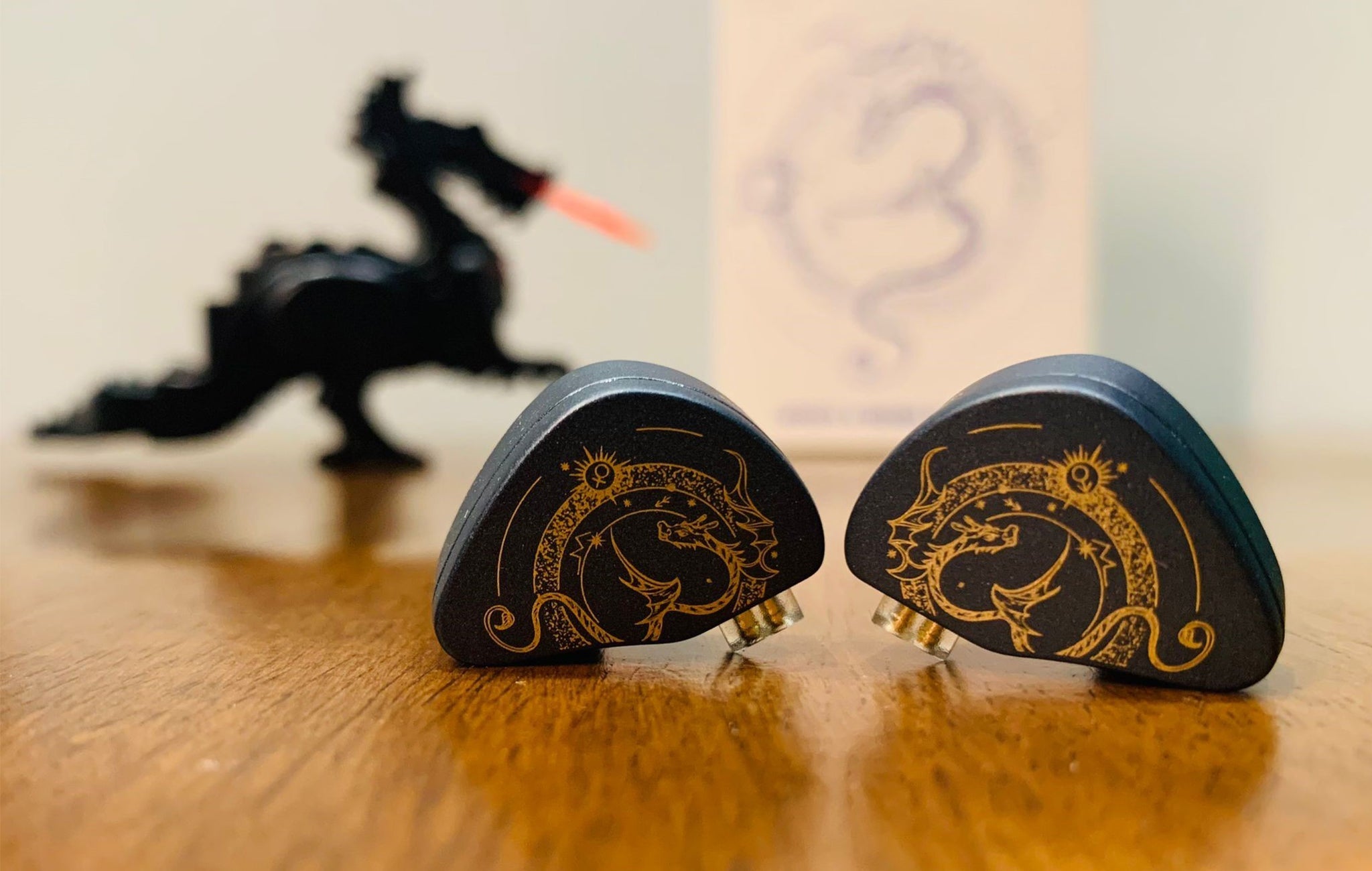
During ordering, one can opt for a gold or a dark blue shell. Both variants have the dragon motif emblazoned on the shells, which is really cool.
BLON advertises that the shells are fashioned from 18K gold-plated zinc alloy, and build-wise, they are absolutely solid, with the housings akin to a tank. In fact, due to these metal furnishings, the earpieces are quite heavy. Even though ergonomics are excellent, the heavy shells may unfortunately add to fatigue during longer listening sessions.
As per most vented sets, isolation is average. I did not encounter any driver flex but this is partially dependent on ear anatomy and type of eartips used, so YMMV.
BLON advertises that the shells are fashioned from 18K gold-plated zinc alloy, and build-wise, they are absolutely solid, with the housings akin to a tank. In fact, due to these metal furnishings, the earpieces are quite heavy. Even though ergonomics are excellent, the heavy shells may unfortunately add to fatigue during longer listening sessions.
As per most vented sets, isolation is average. I did not encounter any driver flex but this is partially dependent on ear anatomy and type of eartips used, so YMMV.
INTERNALS
The Z300 utilizes a 10 mm silicone diaphragm dynamic driver.
DRIVABILITY
I tested the Z300 with the following sources:
- Apple dongle
- Colorfly CDA M1 DAC/AMP dongle
- Creative Sound Blaster X5
- E1DA DAC/AMP dongle
- Hiby R3 Pro Saber 2022 DAP
- Khadas Tone Board -> Schiit Asgard 3 amp
- Khadas Tone Board -> Topping L30 amp
- Questyle M15 DAC/AMP dongle
- Sony Walkman NW A-55 DAP (Walkman One WM1Z Plus v2 Mod)
- Sony Walkman NW A-55 DAP (Walkman One Neutral Mod)
- Sony Walkman NW WM1A DAP (Walkman One WM1Z Plus v2 Mod)
- Smartphone
The Z300 is quite easy to drive, but amplification will tighten the bass and improve dynamics. As the Z300 is a warm IEM, pairing it with analytical, neutral or brighter sources would provide better synergy than using it with a warm or analoguish source. Warm + warm may give a muddy signature!
SOUND & TECHNICALITIES

Graph of the BLON HBB X Z300 using an IEC711 compliant coupler. 8 kHz area is a coupler artefact peak.
Tonally, the Z300 is a warm and bassy L-shaped set. Timbral accuracy is very organic, with the Z300 offering a thick note weight with a full and lush tone.
Sadly, technicalities are below average. The Z300 isn't very detailed, and clarity takes a hit due to the darkish tuning. Imaging is quite well done, though soundstage is intimate. The Z300 fairs well with slower or less complex tracks; however, once fast tracks with competing riffs come out to play, the Z300 struggles, and instruments may sometimes blend into a nebulous blob.
The Z300 is just one level shy of being a true basshead set. Bass is definitely north of neutral, with the bass mostly focused at the sub-bass. There's a decent rumble and extension to the lower registers, but bona fide basshead sets would give a greater jaw-rattling visceral vibration (eg 7Hz Legato). When it comes to bass quality, texturing is average, though speed is above average, with the mid-bass decently punchy. Inevitable for the copious bass amounts on tap, there's some mid-bass bleed.
The lower midrange is warmed by this mid-bass bleed, adding a lot of heft and note weight. The midrange isn't that transparent as such, with a veil and some analoguish colouring added. The upper mids are extremely restrained, and this translates to fatigue-free vocals with nary an ounce of shoutiness. However, on the flip side, vocals are pushed back, so mid and vocal lovers might want to look elsewhere.
There's a small lower treble mound, but the upper treble rolls off thereafter. The Z300 has minimal sibilance, but there's a distinct lack of air and sparkle. As such, clarity, micro-detailing and resolution are not class-leading, though the Z300 promises smooth and pleasant upper frequencies - as such, the Z300 is a great pair for our treble-sensitive brethren.
Sadly, technicalities are below average. The Z300 isn't very detailed, and clarity takes a hit due to the darkish tuning. Imaging is quite well done, though soundstage is intimate. The Z300 fairs well with slower or less complex tracks; however, once fast tracks with competing riffs come out to play, the Z300 struggles, and instruments may sometimes blend into a nebulous blob.
The Z300 is just one level shy of being a true basshead set. Bass is definitely north of neutral, with the bass mostly focused at the sub-bass. There's a decent rumble and extension to the lower registers, but bona fide basshead sets would give a greater jaw-rattling visceral vibration (eg 7Hz Legato). When it comes to bass quality, texturing is average, though speed is above average, with the mid-bass decently punchy. Inevitable for the copious bass amounts on tap, there's some mid-bass bleed.
The lower midrange is warmed by this mid-bass bleed, adding a lot of heft and note weight. The midrange isn't that transparent as such, with a veil and some analoguish colouring added. The upper mids are extremely restrained, and this translates to fatigue-free vocals with nary an ounce of shoutiness. However, on the flip side, vocals are pushed back, so mid and vocal lovers might want to look elsewhere.
There's a small lower treble mound, but the upper treble rolls off thereafter. The Z300 has minimal sibilance, but there's a distinct lack of air and sparkle. As such, clarity, micro-detailing and resolution are not class-leading, though the Z300 promises smooth and pleasant upper frequencies - as such, the Z300 is a great pair for our treble-sensitive brethren.

COMPARISONS
Comparisons were made with other budget single DD IEMs. Planars, hybrids and pure BA types were left out of the equation as the different transducers have their pros and cons.
BLON BL-03
The venerable BLON BL-03 has more mid-bass quantity (with less sub-bass), though the bass isn't as fast and textured, with the BL-03 having a more obvious mid-bass bleed. The BL-03 has more treble and is a bit brighter and airier.
Timbre-wise, the BL-03 has a thinner note weight with a leaner tone. Surprisingly, the BL-03 is slightly better in technical chops - imaging, soundstage, micro-detailing and instrument separation are conveyed better on the Bl-03.
The BL-03 has horrendous fit due to too short nozzles, with most users needing to spend more on longer aftermarket tips or doing mods, whereas the Z300 is well-fitting OOTB.
I won't call the Z300 a sequel to the BL-03 actually, as these two dragons sound quite different, and are complementary rather than competing.
BLON Z200
It is a bloodbath when comparing the Z300 against its predecessor, the Z200. Firstly, the Z200 has non-detachable cables, which may be a deal-breaker for some.
Secondly, the Z200 is tuned to a very old school V-shaped curve, with an ultra recessed midrange. The big bass is slow and ponderous, and smears everywhere, and in contrast, there is a huge 5kHz spike in the treble to cause an ice-pick pierce to the ears.
The Z200 has a metallic timbre, and downright mediocre technicalities. When compared to the Z300, the Z200 is unrefined and forgettable, and the Z300 is a true upgrade and worthy sequel that corrects all the wrongs of its predecessor.
Secondly, the Z200 is tuned to a very old school V-shaped curve, with an ultra recessed midrange. The big bass is slow and ponderous, and smears everywhere, and in contrast, there is a huge 5kHz spike in the treble to cause an ice-pick pierce to the ears.
The Z200 has a metallic timbre, and downright mediocre technicalities. When compared to the Z300, the Z200 is unrefined and forgettable, and the Z300 is a true upgrade and worthy sequel that corrects all the wrongs of its predecessor.
Kiwi Ears Cadenza
The Kiwi Ears Cadenza is a warm Harmanish set. The Cadenza has a hair less bass, though the bass isn't as agile or tight as on the Z300, with more mid-bass bleed. The Cadenza has more upper mids - it can be shoutier for vocals - but it has less treble.
The Z300 has a bit more natural timbre. In technical aspects, imaging is about on par, but the Z300 has a tinge better soundstage, with superior instrument separation and clarity.
Truthear HOLA
The HOLA is also L-shaped, but is darker than the Z300 in the treble.
The HOLA has a slightly faster bass, but in other technicalities (imaging, instrument separation, micro-details, soundstage), the Z300 is superior.
The HOLA has a slightly thinner note weight and a less natural timbre.
The Kiwi Ears Cadenza is a warm Harmanish set. The Cadenza has a hair less bass, though the bass isn't as agile or tight as on the Z300, with more mid-bass bleed. The Cadenza has more upper mids - it can be shoutier for vocals - but it has less treble.
The Z300 has a bit more natural timbre. In technical aspects, imaging is about on par, but the Z300 has a tinge better soundstage, with superior instrument separation and clarity.
Truthear HOLA
The HOLA is also L-shaped, but is darker than the Z300 in the treble.
The HOLA has a slightly faster bass, but in other technicalities (imaging, instrument separation, micro-details, soundstage), the Z300 is superior.
The HOLA has a slightly thinner note weight and a less natural timbre.
CONCLUSIONS
In the ultra competitive budget segment, the Z300 holds its own.
Build and aesthetics are impeccable, and it has good value proposition for the coin. The stock cable is notable, and the Z300 brings a very organic and lush sound to the budget CHIFI table, with zero fatigue or harshness.

The Z300 is no technical tour de force, and it is more of an IEM to sit back to chill to music, rather than to critically analyze every minute nuance in the recording. The gentle and warm tuning of the Z300 assures a relaxing and pleasant afternoon of music, though understandably, trebleheads and detail freaks might want to consider alternatives.
I've owned most of the BLON IEMs, including some of the BL-03's predecessors like the BLON Cardinal, and BLON has been trying to capture lightning in a bottle ever since the success of the BL-03. Sadly, since the heydays of the BL-03, the company has regressed, churning out mostly mediocre and tepid sidegrades. Arguably, only the BL-05s (not the original BL-05 without an S) did okay, with the other BLONs relegated to footnotes in audio forums after their 15 minutes of hype.
In fact, BLON's last release - the Z200, was an abysmal fail, and I'm quite chuffed that the Z300 manages to not only fix the issues of its predecessor, but shine in timbre and an agreeable soundscape. Indeed, after today, I would consider the Z300, the BL-03, and the BL-05s to be the trinity of the company's success stories.
Oppoty Knocks Again, and thankfully, this Oppoty is worth getting!