







Shanling Audio
Shanling is a China-based audio manufacturer recognized for making high-quality hi-fi equipment, digital audio players (DAPs), headphones, and amplifiers. With many years in the audio business, the company has earned a name for combining thoughtful industrial design, quality materials, and advanced acoustic engineering to produce gear that blends modern functionality with audiophile-grade sound.
The Shanling EC Zero T
Portable CD players (Discmans) are experiencing a resurgence in popularity. Several brands — including FiiO, Moondrop and Dunu — are actively participating in this niche, but Shanling was among the first to revive interest with the EC Mini.
Building on the EC Mini’s success, Shanling has released a more sophisticated model: the EC Zero T. This battery-powered CD player combines two technologies Shanling often favors. It is the first portable CD transport to pair an R-2R DAC with a tube-based output stage.
The Shanling EC Zero T
Portable CD players (Discmans) are experiencing a resurgence in popularity. Several brands — including FiiO, Moondrop and Dunu — are actively participating in this niche, but Shanling was among the first to revive interest with the EC Mini.
Building on the EC Mini’s success, Shanling has released a more sophisticated model: the EC Zero T. This battery-powered CD player combines two technologies Shanling often favors. It is the first portable CD transport to pair an R-2R DAC with a tube-based output stage.
Technical stuff
Following the approach used in its recent desktop DACs, Shanling brings R-2R ladder DAC technology into a portable CD player with the EC Zero T. The player features an in-house balanced R-2R DAC built from 192 precision 0.1% resistors and offers two selectable operating modes: OS and NOS.
The analog stage uses two low-voltage JAN6418 mini tubes noted for efficient power use. Those tubes sit in a custom anti-vibration mounting to reduce microphonic artefacts. The tube stage can be fully bypassed for a purely solid-state signal path, giving listeners two clearly different tonal options.
The balanced headphone stage uses a pair of TPA6120A2 op-amps and Panasonic tantalum capacitors.
The CD mechanism employs a magnetic suspension that continually adjusts the disc’s position and the clamp pressure to stabilize rotation. That arrangement cuts down on mechanical noise and vibration for smoother playback.
The Desktop mode
The EC Zero T includes a desktop mode that allows simultaneous music playback and battery charging while also increasing the headphone amplifier’s power. With external power connected, the balanced output’s power climbs to 1220 mW ×2 into 32 Ω.
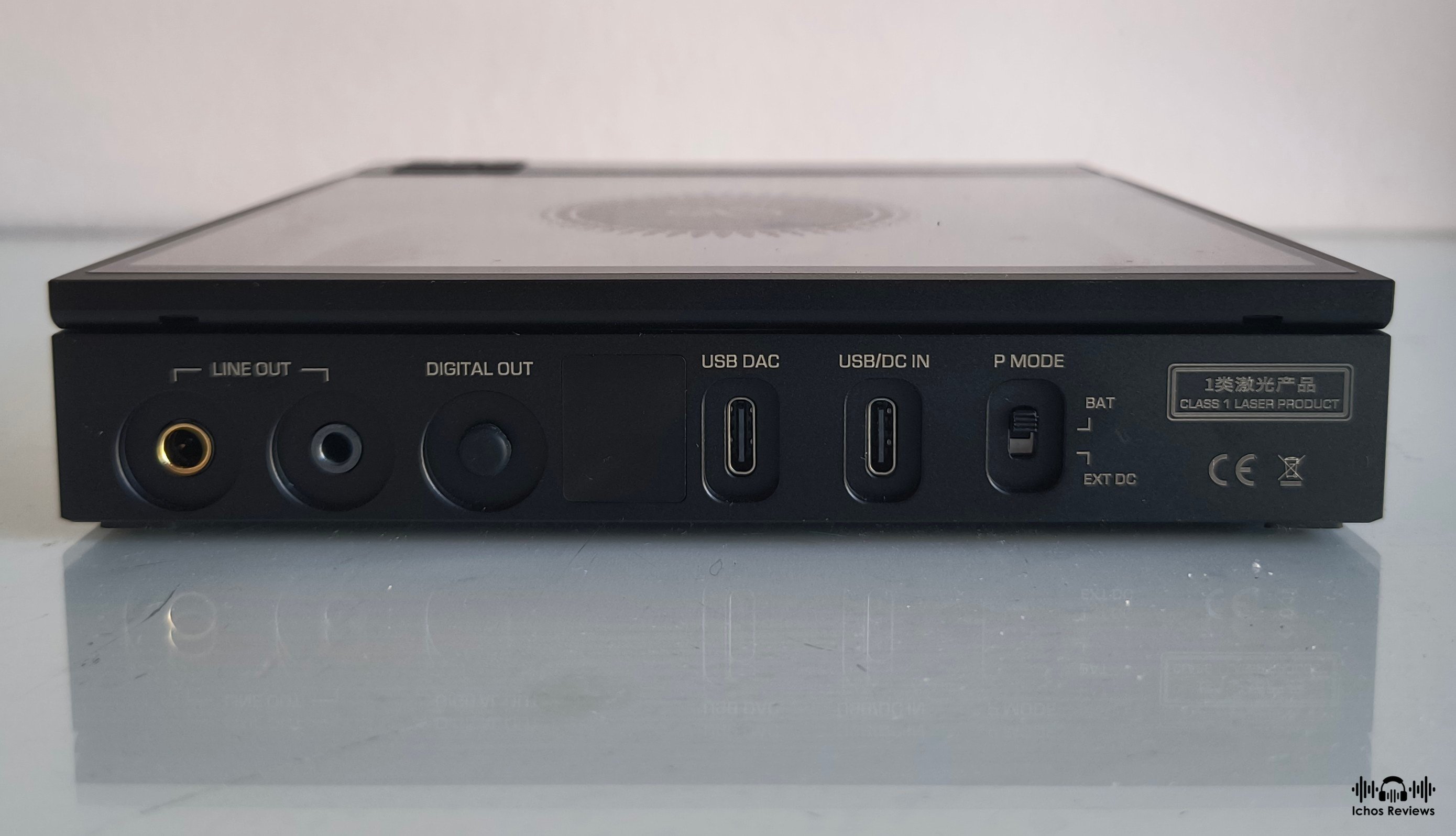
To use desktop mode, plug a 5 V (minimum 2 A) external power supply into the dedicated USB-C port and flip the EXT DC switch.
Non Audio stuff
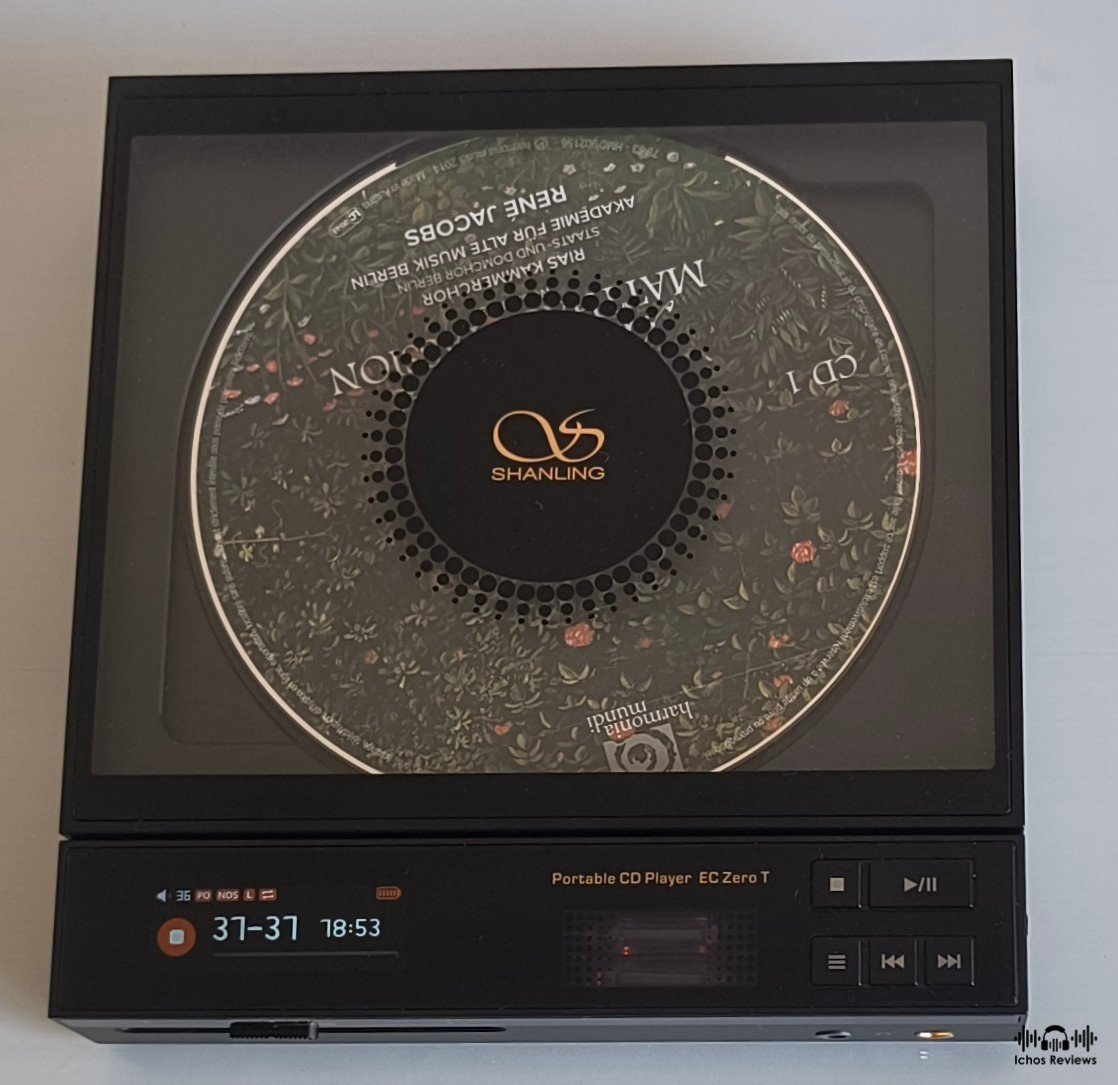
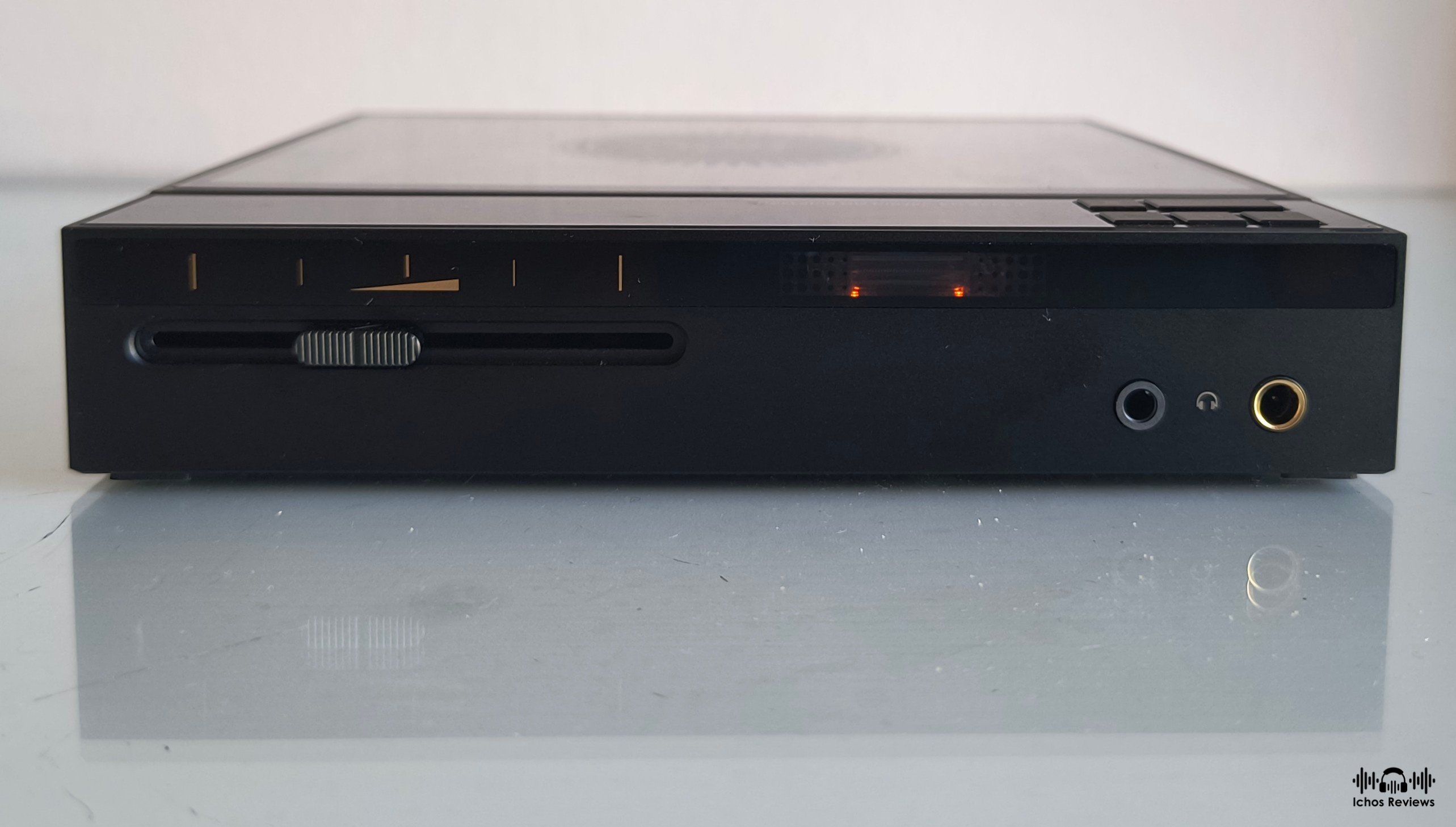
The EC Zero T’s body is milled from a single block of CNC aluminum and topped with a tempered glass lid so you can watch the disc spin. The styling is somewhat retro with a boxy silhouette and a vintage-inspired slider for volume instead of a conventional knob.
Weighing roughly 669 g and measuring 158 × 150 × 28 mm, the unit is better described as transportable rather than pocketable. It fits comfortably in a backpack and Shanling offers an official carrying case that includes a hanging lanyard.
On the upper front panel sits a 1.68″ LCD that’s a touch small and can be a little hard to read, but it displays key information and supports navigation of the settings menu. The screen is full color, though Shanling limits the palette to white and dark orange — a pleasing retro aesthetic.
Beside the display there’s a glassed section revealing the glowing tubes underneath. The front face also has five hardware buttons for control, while the power button and a lock switch are placed at the left and right edges respectively.
Following the approach used in its recent desktop DACs, Shanling brings R-2R ladder DAC technology into a portable CD player with the EC Zero T. The player features an in-house balanced R-2R DAC built from 192 precision 0.1% resistors and offers two selectable operating modes: OS and NOS.
The analog stage uses two low-voltage JAN6418 mini tubes noted for efficient power use. Those tubes sit in a custom anti-vibration mounting to reduce microphonic artefacts. The tube stage can be fully bypassed for a purely solid-state signal path, giving listeners two clearly different tonal options.
The balanced headphone stage uses a pair of TPA6120A2 op-amps and Panasonic tantalum capacitors.
The CD mechanism employs a magnetic suspension that continually adjusts the disc’s position and the clamp pressure to stabilize rotation. That arrangement cuts down on mechanical noise and vibration for smoother playback.
The Desktop mode
The EC Zero T includes a desktop mode that allows simultaneous music playback and battery charging while also increasing the headphone amplifier’s power. With external power connected, the balanced output’s power climbs to 1220 mW ×2 into 32 Ω.
To use desktop mode, plug a 5 V (minimum 2 A) external power supply into the dedicated USB-C port and flip the EXT DC switch.
Non Audio stuff
The EC Zero T’s body is milled from a single block of CNC aluminum and topped with a tempered glass lid so you can watch the disc spin. The styling is somewhat retro with a boxy silhouette and a vintage-inspired slider for volume instead of a conventional knob.
Weighing roughly 669 g and measuring 158 × 150 × 28 mm, the unit is better described as transportable rather than pocketable. It fits comfortably in a backpack and Shanling offers an official carrying case that includes a hanging lanyard.
On the upper front panel sits a 1.68″ LCD that’s a touch small and can be a little hard to read, but it displays key information and supports navigation of the settings menu. The screen is full color, though Shanling limits the palette to white and dark orange — a pleasing retro aesthetic.
Beside the display there’s a glassed section revealing the glowing tubes underneath. The front face also has five hardware buttons for control, while the power button and a lock switch are placed at the left and right edges respectively.
Connectivity stuff
The EC Zero T is more than a CD player with headphone jacks — it’s a versatile unit that can be used in multiple roles.
In addition to two front headphone outputs (4.4 mm balanced and 3.5 mm single-ended), the rear panel provides fixed-level 4.4 mm and 3.5 mm line outputs plus a 3.5 mm SPDIF jack that supports both coaxial and optical connections.
The player functions as a USB DAC with input support up to 768 kHz/32-bit and native DSD512. It can also rip CDs to WAV files directly onto a USB stick, noting that the ripping process happens in real time.
The Bluetooth transmitter
The EC Zero T includes a Bluetooth v5.3 transmitter so you can pair wireless headphones or speakers that support aptX Adaptive, aptX, or SBC. Bluetooth works for both CD playback and USB DAC input. In testing with FiiO FW5 wireless earphones, pairing was stable and free of audible noise within the same room.
Operation stiff
Four buttons control CD playback, while a mode/function switch toggles between CD and USB inputs or — when held — enters the configuration menu.
The menu lets you change gain, pick between NOS and OS filters, enable or bypass the tube stage, set screen brightness and the auto-off timer, choose output mode, adjust channel balance, and enable a “smart volume” feature that alters how sensitively the volume slider responds to movement.
Smart volume addresses a practical issue with the slider: because the slider has low friction, fine volume adjustments can be difficult. Smart volume reduces that problem effectively.
Everything works as intended, though it would be convenient if gain and tube on/off could be assigned to shortcut buttons.
The CD transport mechanism
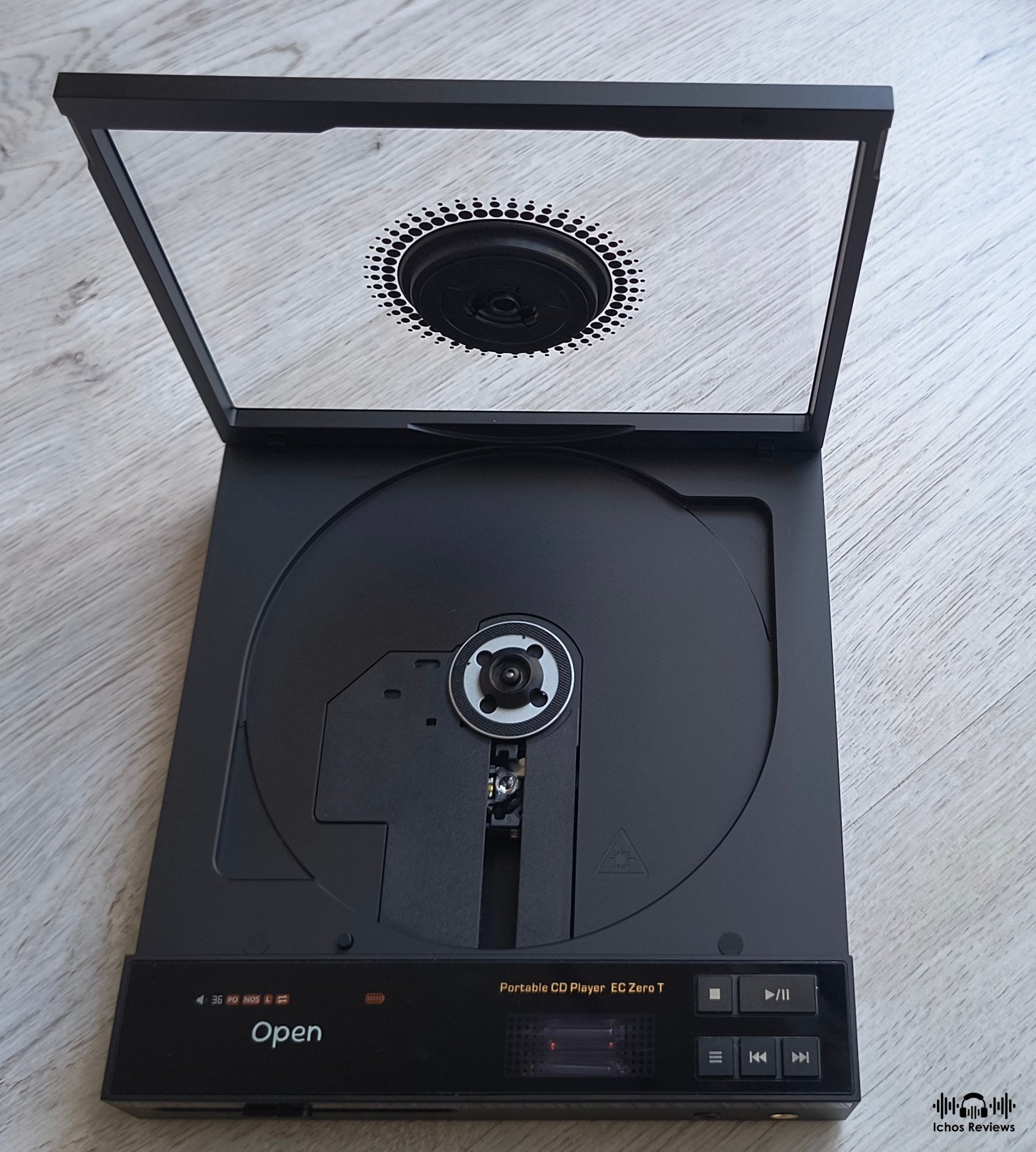
The EC Zero T’s drive performed excellently across many commercial discs. Playback is truly gapless, it reliably starts the first track without losing the opening seconds, and it resists skipping when jostled or used at non-horizontal angles.
The spindle runs quietly and the laser assembly seeks quickly when you change tracks. You get normal and shuffle playback modes and options for repeating a single track or the entire disc.
One note on controls: to register actions such as skipping tracks you generally need to press the corresponding button twice — once to wake the screen and a second time to trigger the function — unless you’ve configured the display to remain on.
Battery related stuff
Inside is a 5500 mAh battery that delivers about six hours of CD playback from the balanced output with tube mode engaged. Using the USB DAC function typically extends runtime by roughly one hour. That’s adequate for everyday use, and you can always connect external power when needed.
Power and noise stuff
With an external DC supply connected, the EC Zero T’s balanced output is rated at 1220 mW ×2 into 32 Ω in solid-state mode and 10872 mW ×2 into 32 Ω in tube mode — more than sufficient to drive demanding planar or dynamic models such as the FiiO FT1 Pro or the Hifiman Arya.
When used without the external supply, the numbers fall to 551 mW ×3 into 32 Ω for both modes, making the unit less optimal for large full-size headphones.
Shanling has not circumvented the TPA6120A2’s relatively high output impedance — measured at 4.7 Ω single-ended and 6.6 Ω balanced — which can create impedance-matching issues with some headphones.
Solid-state mode is completely quiet, but engaging the tube stage introduces a very low level hiss that is generally masked during listening. Microphonics are not a problem during typical use unless you tap the tube housing forcefully. The unit remains fairly cool even with the tubes active.
(The unit tested was updated to firmware V1.0.13)
The EC Zero T is more than a CD player with headphone jacks — it’s a versatile unit that can be used in multiple roles.
In addition to two front headphone outputs (4.4 mm balanced and 3.5 mm single-ended), the rear panel provides fixed-level 4.4 mm and 3.5 mm line outputs plus a 3.5 mm SPDIF jack that supports both coaxial and optical connections.
The player functions as a USB DAC with input support up to 768 kHz/32-bit and native DSD512. It can also rip CDs to WAV files directly onto a USB stick, noting that the ripping process happens in real time.
The Bluetooth transmitter
The EC Zero T includes a Bluetooth v5.3 transmitter so you can pair wireless headphones or speakers that support aptX Adaptive, aptX, or SBC. Bluetooth works for both CD playback and USB DAC input. In testing with FiiO FW5 wireless earphones, pairing was stable and free of audible noise within the same room.
Operation stiff
Four buttons control CD playback, while a mode/function switch toggles between CD and USB inputs or — when held — enters the configuration menu.
The menu lets you change gain, pick between NOS and OS filters, enable or bypass the tube stage, set screen brightness and the auto-off timer, choose output mode, adjust channel balance, and enable a “smart volume” feature that alters how sensitively the volume slider responds to movement.
Smart volume addresses a practical issue with the slider: because the slider has low friction, fine volume adjustments can be difficult. Smart volume reduces that problem effectively.
Everything works as intended, though it would be convenient if gain and tube on/off could be assigned to shortcut buttons.
The CD transport mechanism
The EC Zero T’s drive performed excellently across many commercial discs. Playback is truly gapless, it reliably starts the first track without losing the opening seconds, and it resists skipping when jostled or used at non-horizontal angles.
The spindle runs quietly and the laser assembly seeks quickly when you change tracks. You get normal and shuffle playback modes and options for repeating a single track or the entire disc.
One note on controls: to register actions such as skipping tracks you generally need to press the corresponding button twice — once to wake the screen and a second time to trigger the function — unless you’ve configured the display to remain on.
Battery related stuff
Inside is a 5500 mAh battery that delivers about six hours of CD playback from the balanced output with tube mode engaged. Using the USB DAC function typically extends runtime by roughly one hour. That’s adequate for everyday use, and you can always connect external power when needed.
Power and noise stuff
With an external DC supply connected, the EC Zero T’s balanced output is rated at 1220 mW ×2 into 32 Ω in solid-state mode and 10872 mW ×2 into 32 Ω in tube mode — more than sufficient to drive demanding planar or dynamic models such as the FiiO FT1 Pro or the Hifiman Arya.
When used without the external supply, the numbers fall to 551 mW ×3 into 32 Ω for both modes, making the unit less optimal for large full-size headphones.
Shanling has not circumvented the TPA6120A2’s relatively high output impedance — measured at 4.7 Ω single-ended and 6.6 Ω balanced — which can create impedance-matching issues with some headphones.
Solid-state mode is completely quiet, but engaging the tube stage introduces a very low level hiss that is generally masked during listening. Microphonics are not a problem during typical use unless you tap the tube housing forcefully. The unit remains fairly cool even with the tubes active.
(The unit tested was updated to firmware V1.0.13)
Audio stuff
Solid-state mode
Using the solid-state path with the OS filter selected, the EC Zero T delivers a powerful example of R-2R character.
Tonal balance leans natural and organic, with rich midrange harmonics and a treble that avoids digital harshness. Bass is substantial, tactile, and layered rather than thin or lifeless.
The overall signature is mildly warm and musical without objectionable coloring. The player retains good transparency and clarity across the spectrum and is competitive in technical performance compared with many D/S chip-based rivals.
Shanling’s R-2R implementation provides an essentially flat frequency response with no obvious linearity issues. Low frequencies are fast, well-defined and timed, giving punch and control even on fast, dynamic material.
Mids are articulate and textured, resolving detail while maintaining natural articulation. Treble is open and clean with a smooth temperament — extended but never brittle — offering satisfying detail without leaning towards analytical brightness.
The balanced output supplies an impressive soundstage: wide, layered, and precise in instrument placement. When the connected headphones allow, the presentation gains a holographic depth and immersive quality that makes performances feel vivid.
The NOS filter
Switching to NOS softens the presentation slightly: things become a touch more relaxed and less incisive than in OS. Timbre grows a bit more organic, but there is a small tradeoff in refinement as some textures take on a rawer grain, particularly in the treble, which can seem sharper. Overall, OS delivers better technical performance and transparency, while NOS presents a generally smoother sonic character.
Tubes
The tube stage is implemented with restraint — it does not introduce heavy distortion or excessive coloration. Instead, the tubes enrich harmonic saturation and broaden tonal variety. The result is a more analog-like, organic presentation, but not as overtly “tubey” as classic tube amplifiers.
Engaging the tubes relaxes textures slightly, mellows the treble without overly damping it, and adds weight to the low end at the cost of a little control and speed. Tube mode also enhances the sense of space and immersion in the soundstage, though focus tightness is somewhat reduced versus solid-state.
Aside from a marginally higher noise floor, the tubes maintain solid technical capability and respectable clarity. If there is any audible tradeoff, it is a slight softening of low-end macro dynamics, which is offset by improved microdynamic nuance.
A versatile CD player
With four major tonal combinations available (solid-state OS/NOS and tube OS/NOS), the EC Zero T is exceptionally flexible — it’s easy to find a pairing that suits your earphones and listening preferences.
Add in the boosted power when on external DC and the broad connectivity suite, and the player functions as a true chameleon that adapts to desktop and portable scenarios alike.
Solid-state mode
Using the solid-state path with the OS filter selected, the EC Zero T delivers a powerful example of R-2R character.
Tonal balance leans natural and organic, with rich midrange harmonics and a treble that avoids digital harshness. Bass is substantial, tactile, and layered rather than thin or lifeless.
The overall signature is mildly warm and musical without objectionable coloring. The player retains good transparency and clarity across the spectrum and is competitive in technical performance compared with many D/S chip-based rivals.
Shanling’s R-2R implementation provides an essentially flat frequency response with no obvious linearity issues. Low frequencies are fast, well-defined and timed, giving punch and control even on fast, dynamic material.
Mids are articulate and textured, resolving detail while maintaining natural articulation. Treble is open and clean with a smooth temperament — extended but never brittle — offering satisfying detail without leaning towards analytical brightness.
The balanced output supplies an impressive soundstage: wide, layered, and precise in instrument placement. When the connected headphones allow, the presentation gains a holographic depth and immersive quality that makes performances feel vivid.
The NOS filter
Switching to NOS softens the presentation slightly: things become a touch more relaxed and less incisive than in OS. Timbre grows a bit more organic, but there is a small tradeoff in refinement as some textures take on a rawer grain, particularly in the treble, which can seem sharper. Overall, OS delivers better technical performance and transparency, while NOS presents a generally smoother sonic character.
Tubes
The tube stage is implemented with restraint — it does not introduce heavy distortion or excessive coloration. Instead, the tubes enrich harmonic saturation and broaden tonal variety. The result is a more analog-like, organic presentation, but not as overtly “tubey” as classic tube amplifiers.
Engaging the tubes relaxes textures slightly, mellows the treble without overly damping it, and adds weight to the low end at the cost of a little control and speed. Tube mode also enhances the sense of space and immersion in the soundstage, though focus tightness is somewhat reduced versus solid-state.
Aside from a marginally higher noise floor, the tubes maintain solid technical capability and respectable clarity. If there is any audible tradeoff, it is a slight softening of low-end macro dynamics, which is offset by improved microdynamic nuance.
A versatile CD player
With four major tonal combinations available (solid-state OS/NOS and tube OS/NOS), the EC Zero T is exceptionally flexible — it’s easy to find a pairing that suits your earphones and listening preferences.
Add in the boosted power when on external DC and the broad connectivity suite, and the player functions as a true chameleon that adapts to desktop and portable scenarios alike.
The excellent Line output
The onboard headphone amplifier performs well for many uses, but it also limits the EC Zero T’s ultimate sonic potential.
The player shines more when used via its balanced line outputs, where it pairs and scales with higher-end headphone or integrated amplifiers. For example, the recently released Aune N7 headphone amplifier made an excellent partner, bringing forward and accentuating many of the EC Zero T’s sonic strengths described above.
That sort of system scaling is worth considering because the EC Zero T is more than a simple portable CD player — it’s a fully featured desktop component as well.
Comparison with the FiiO DM13
The FiiO DM13 is a similar-sized portable CD player with an internal battery and support for external DC desktop operation.
The DM13 is priced significantly lower — $155 for the standard model and $185 for the version with a tempered glass lid — but it omits several features found on the Shanling. It lacks an R-2R DAC (it uses dual CS43198 chips), has no tube output stage, its desktop mode does not increase headphone power beyond 650 mW ×2 into 32 Ω, and it cannot act as a USB DAC.
Beyond tonal differences (which I won’t analyze exhaustively here — see the DM13 review for full comparison), the DM13 also has some functional shortcomings. It doesn’t support true gapless playback the way the EC Zero T does and there have been reports of missing the first seconds of the initial track. Its LCD can emit a faint high-pitched sound, and the CD transport is not as silent or smooth as Shanling’s implementation. FiiO continues to improve the DM13 with firmware updates, but in both sound and function the Shanling EC Zero T outperforms the DM13, justifying the price gap.
Conclusion
There’s very little to criticize about the EC Zero T’s sound quality and general usability.
It’s a well-sounding, reliable transport that transitions easily into desktop use, covering many user needs. As the only player in its category with a balanced R-2R DAC and a tube output stage, it offers a distinctive sound and more fine-tuning options than competing models. Highly recommended.
The onboard headphone amplifier performs well for many uses, but it also limits the EC Zero T’s ultimate sonic potential.
The player shines more when used via its balanced line outputs, where it pairs and scales with higher-end headphone or integrated amplifiers. For example, the recently released Aune N7 headphone amplifier made an excellent partner, bringing forward and accentuating many of the EC Zero T’s sonic strengths described above.
That sort of system scaling is worth considering because the EC Zero T is more than a simple portable CD player — it’s a fully featured desktop component as well.
Comparison with the FiiO DM13
The FiiO DM13 is a similar-sized portable CD player with an internal battery and support for external DC desktop operation.
The DM13 is priced significantly lower — $155 for the standard model and $185 for the version with a tempered glass lid — but it omits several features found on the Shanling. It lacks an R-2R DAC (it uses dual CS43198 chips), has no tube output stage, its desktop mode does not increase headphone power beyond 650 mW ×2 into 32 Ω, and it cannot act as a USB DAC.
Beyond tonal differences (which I won’t analyze exhaustively here — see the DM13 review for full comparison), the DM13 also has some functional shortcomings. It doesn’t support true gapless playback the way the EC Zero T does and there have been reports of missing the first seconds of the initial track. Its LCD can emit a faint high-pitched sound, and the CD transport is not as silent or smooth as Shanling’s implementation. FiiO continues to improve the DM13 with firmware updates, but in both sound and function the Shanling EC Zero T outperforms the DM13, justifying the price gap.
Conclusion
There’s very little to criticize about the EC Zero T’s sound quality and general usability.
It’s a well-sounding, reliable transport that transitions easily into desktop use, covering many user needs. As the only player in its category with a balanced R-2R DAC and a tube output stage, it offers a distinctive sound and more fine-tuning options than competing models. Highly recommended.
The review sample was kindly provided free of charge in exchange for an honest review. I don't use affiliate links.
The price of the Shanling EC Zero T is $589 and you can buy it from Amazon or AliExpress.
Disclaimer: For various Google indexing reasons, most parts of this review have been processed with an automatic paragraph rewriting tool. However it reads exactly the same as the 100% original content that is available in my website.
The price of the Shanling EC Zero T is $589 and you can buy it from Amazon or AliExpress.
Disclaimer: For various Google indexing reasons, most parts of this review have been processed with an automatic paragraph rewriting tool. However it reads exactly the same as the 100% original content that is available in my website.
SHANLING EC ZERO T