






DISCLAIMER
I would like to thank Tangzu for furnishing this unit. The Fu Du can be gotten here: TANGZU FUDU VERSE 1(no affiliate links)

INTRODUCTION
As per Tangzu's convention of naming IEMs after historical Tang Dynasty figures, Du Fu (https://en.wikipedia.org/wiki/Du_Fu) was one of the eminent poets of that era; indeed, after his death, his poetry continued to influence future writers even from outside China.
Divinus is a boutique Korean brand, and they have done a collaboration with Tangzu for this Fu Du IEM, which we will be reviewing today.
SPECIFICATIONS
- Driver configuration: 1 x 10 mm dynamic driver (DD) + 2 x custom balanced armature (BA) drivers
- Impedance: 16 ohm
- Frequency response: 20 Hz - 20 kHz
- Sensitivity: 106 dB
- Cable: 2-pin, 0.78 mm, Oxygen-free copper silver-plated cable. Choice of 4.4 mm or 3.5 mm termination
- Tested at $89 USD
ACCESSORIES

Other than the IEM, the following are included:
- 3 pairs of Tang Sancai balanced silicone tips (S/M/L)
- 3 pairs of Divinus velvet silicone tips (S/M/L)
- Cable
- Leatherette carrying pouch
The accessories are pretty decent for a sub-$100 USD set, and everything is serviceable.
- 3 pairs of Tang Sancai balanced silicone tips (S/M/L)
- 3 pairs of Divinus velvet silicone tips (S/M/L)
- Cable
- Leatherette carrying pouch
The accessories are pretty decent for a sub-$100 USD set, and everything is serviceable.

While no foam tips are included, we have 2 variants of silicone tips. The Tang Sancai balanced tips have a narrower bore and boost bass with some compression in soundstage. The Divinus ones have a wider bore and increase the upper frequencies and furnish a more expansive soundstage.

The stock oxygen-free copper silver-plated cable is quite thin, with microphonics in abundance. It is tangly too, though there is a chin cinch for added stability. Honestly, I've seen better cables included in other budget IEM packaging, but it is no biggie swapping an aftermarket cable in should you wish to do so. When placing an order, one can opt for a 4.4 mm or 3.5 mm termination, depending on your source requirements. The 4.4 mm/3.5 mm terminal is gold-plated, which is a nice touch.

Unlike the run of the mill semi-rigid cases we see in CHIFI packaging, Tangzu has decided to provide a black leatherette zipper pouch. It has a lychee skin pattern, with compartments inside this pouch, though it might not withstand compressive forces or a drop. Nevertheless, this elegant addition is quite appreciated.
The rest of this review was done with the stock cable and stock Divinus tips. No aftermarket accessories were used, so as not to add any confounders to the sound.
The rest of this review was done with the stock cable and stock Divinus tips. No aftermarket accessories were used, so as not to add any confounders to the sound.
BUILD/COMFORT

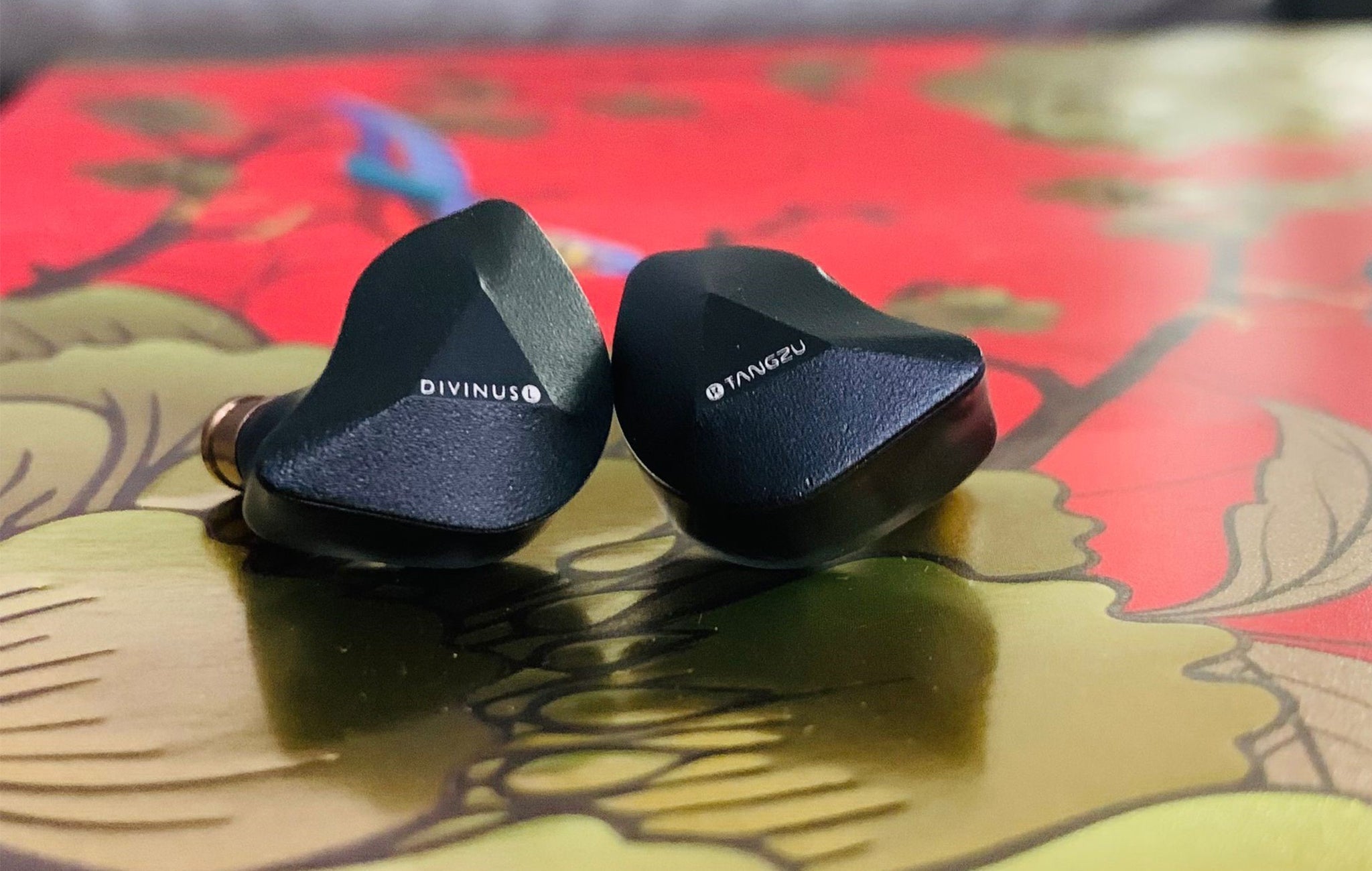
The housings are fashioned from 3D printed using resin, with a black CNC aluminum alloy panel faceplate- this has a matte frosted finish in a pyramidal design, which Tangzu says is inspired by Zen minimalism. However, they do feel a tinge cheap and not too robust.

The inner aspects are smooth with no awkward protrusions to poke the ears. The shells are ergonomic and light, with no discomfort during usage.
For budget IEMs, 2-pin connectors are always a plus in my book, as they tend to be less fragile than MMCX ones with frequent cable changes.
For budget IEMs, 2-pin connectors are always a plus in my book, as they tend to be less fragile than MMCX ones with frequent cable changes.

There is a slight driver flex during insertion, but this is partially dependent on type of eartips used and ear anatomy, so YMMV. Isolation is average in view of the dual vents on each housing.
DRIVABILITY
I tested the Fu Du with the following sources:
- Apple dongle
- Cayin RU7
- Colorfly CDA M1 DAC/AMP dongle
- Creative Sound Blaster X5
- E1DA DAC/AMP dongle
- Hiby R3 Pro Saber 2022 DAP
- Khadas Tone Board -> Schiit Asgard 3 amp
- Khadas Tone Board -> Topping L30 amp
- Questyle M15 DAC/AMP dongle
- Sony Walkman NW A-55 DAP (Walkman One WM1Z Plus v2 Mod)
- Sony Walkman NW A-55 DAP (Walkman One Neutral Mod)
- Sony Walkman NW WM1A DAP (Walkman One WM1Z Plus v2 Mod)
- Smartphone
This IEM is easily driven, amplification is not truly required.
SOUND & TECHNICALITIES

Graph of the Tangzu Fu Du via IEC711 coupler. 8 kHz is a coupler artefact peak.
Tonally, the Fu Du sports a U-shaped balanced tuning that lies on the warmer side. This tuning choice is quite pleasant and consumer-friendly, and should suit most genres out there.
This IEM is sub-bass focused, with the bass north of neutral but not at outright basshead levels. There is quite deep sub-bass extension with a husky rumble. Bass has moderate speed, though there is mid-bass bleed and poor texturing - the low-end can sound a bit one-noted at times.
The mid-bass does meld a bit into the lower midrange, adding heft and warmth, though there is some loss of transparency. This region isn't too depressed, and is quite euphonic and lush. The upper mids are safe with a 5 dB ear gain, and there is no shoutiness or fatigue here.
The lower treble peaks at about 4 kHz, adding some resolution and clarity to this frequency band. Thereafter, the treble rolls-off, and the Fu Du isn't very airy or sparkly - it is generally quite safe for treble sensitive folk. Sibilance is mild, with not much splashiness in high-hats or cymbals. Having said this, the choice of eartip will influence a lot on treble perception, in addition to volume played at (Fletcher Munson curve) and hearing health.
Tonally, the Fu Du sports a U-shaped balanced tuning that lies on the warmer side. This tuning choice is quite pleasant and consumer-friendly, and should suit most genres out there.
This IEM is sub-bass focused, with the bass north of neutral but not at outright basshead levels. There is quite deep sub-bass extension with a husky rumble. Bass has moderate speed, though there is mid-bass bleed and poor texturing - the low-end can sound a bit one-noted at times.
The mid-bass does meld a bit into the lower midrange, adding heft and warmth, though there is some loss of transparency. This region isn't too depressed, and is quite euphonic and lush. The upper mids are safe with a 5 dB ear gain, and there is no shoutiness or fatigue here.
The lower treble peaks at about 4 kHz, adding some resolution and clarity to this frequency band. Thereafter, the treble rolls-off, and the Fu Du isn't very airy or sparkly - it is generally quite safe for treble sensitive folk. Sibilance is mild, with not much splashiness in high-hats or cymbals. Having said this, the choice of eartip will influence a lot on treble perception, in addition to volume played at (Fletcher Munson curve) and hearing health.

In terms of timbral accuracy, there's a very small hint of BA timbre (which isn't unexpected for a BA containing set), but the Fu Du nevertheless has surprisingly authentic timbre for acoustic instruments, and there are way worst offenders in other BA containing hybrid rivals.
While discussing technicalities, the Fu Du is arguably bang average, and this department is nothing to write home about. Micro-details, clarity and instrument separation is middle-of-the-road for a sub-$100 USD hybrid. Soundstage width is average, though there is decent height and depth.
With the unexceptional technical chops and laid-back tonality, the Fu Du is definitely a "musical" IEM, rather than an analytical set for critical listening.
While discussing technicalities, the Fu Du is arguably bang average, and this department is nothing to write home about. Micro-details, clarity and instrument separation is middle-of-the-road for a sub-$100 USD hybrid. Soundstage width is average, though there is decent height and depth.
With the unexceptional technical chops and laid-back tonality, the Fu Du is definitely a "musical" IEM, rather than an analytical set for critical listening.
COMPARISONS
Comparisons were made with other budget hybrids. Planars, single DDs and pure BA types were left out of the equation as the different transducers have their pros and cons.

Truthear HEXA
The HEXA is a neutral hybrid with a sub-bass boost. The HEXA has less mid-bass, though the bass is tighter and cleaner. The HEXA also has a more extended treble and can be more fatiguing. It is much thinner in note weight, and sounds more anemic than the Fu Du.
The HEXA has a less natural timbre, and is harder to drive. However, in technicalities, the HEXA is ahead, with better micro-detailing, clarity, imaging and instrument separation. The HEXA has a smaller soundstage though.
Simgot EM6L

the Simgot EM6L versus Tangzu Fu Du, via IEC711 coupler. 8 kHz is a coupler artefact peak.
Tonally, both IEMs are on the smoother side, though the EM6L has a bit more upper mids, and vocals are more boosted in this region, especially at louder volumes (Fletcher Munson curve). The EM6L has a bit more upper treble and air.
In timbral accuracy, the EM6L is a step behind, and sounds more artificial for acoustic instruments.
The EM6L has a more expansive soundstage, but slightly weaker instrument separation. Micro-detailing and imaging are similar, and not class-leading.
TLDR: The Fu Du and Simgot EM6L are sidegrades.
7Hz Sonus
Tonally, both IEMs are on the smoother side, though the EM6L has a bit more upper mids, and vocals are more boosted in this region, especially at louder volumes (Fletcher Munson curve). The EM6L has a bit more upper treble and air.
In timbral accuracy, the EM6L is a step behind, and sounds more artificial for acoustic instruments.
The EM6L has a more expansive soundstage, but slightly weaker instrument separation. Micro-detailing and imaging are similar, and not class-leading.
TLDR: The Fu Du and Simgot EM6L are sidegrades.
7Hz Sonus

Graph of the 7Hz Sonus versus Tangzu Fu Du, via IEC711 coupler. 8 kHz is a coupler artefact peak.
The Sonus is a U-shaped hybrid. It has less bass, though the bass is more textured and clean. Upper treble is also more extended on the Sonus, though it is a bit more sibilant.
The Sonus has a more artificial BA timbre and thinner note weight. In technicalities, the Sonus is superior, with better soundstage, imaging, micro-detailing and instrument separation.
The Sonus is a U-shaped hybrid. It has less bass, though the bass is more textured and clean. Upper treble is also more extended on the Sonus, though it is a bit more sibilant.
The Sonus has a more artificial BA timbre and thinner note weight. In technicalities, the Sonus is superior, with better soundstage, imaging, micro-detailing and instrument separation.
CONCLUSIONS

The Fu Du is a decent entrant to the ultra-competitive budget hybrid market. It brings to the table a sedate U-shaped sonic profile that is smooth and fatigue-free, with outstanding timbre for a BA containing set.
Comfort, ergonomics and accessories are superb, and the Fu Du is easily driven, with no stringent amplification requirements.
Unfortunately, the Fu Du loses marks in my book for its middling technicalities and an untextured bass. But by-and-large, the Fu Du's organic timbre and consumer friendly tonality does vindicate the overall tuning, and not many sub-$100 USD hybrids can ace timbre. The Fu Du should be in the conversation for folks searching for a "musical" budget hybrid, but probably not if you are looking for something analytical or technical.
Comfort, ergonomics and accessories are superb, and the Fu Du is easily driven, with no stringent amplification requirements.
Unfortunately, the Fu Du loses marks in my book for its middling technicalities and an untextured bass. But by-and-large, the Fu Du's organic timbre and consumer friendly tonality does vindicate the overall tuning, and not many sub-$100 USD hybrids can ace timbre. The Fu Du should be in the conversation for folks searching for a "musical" budget hybrid, but probably not if you are looking for something analytical or technical.
40% OFF: