






The Empress of Bass

Foreword

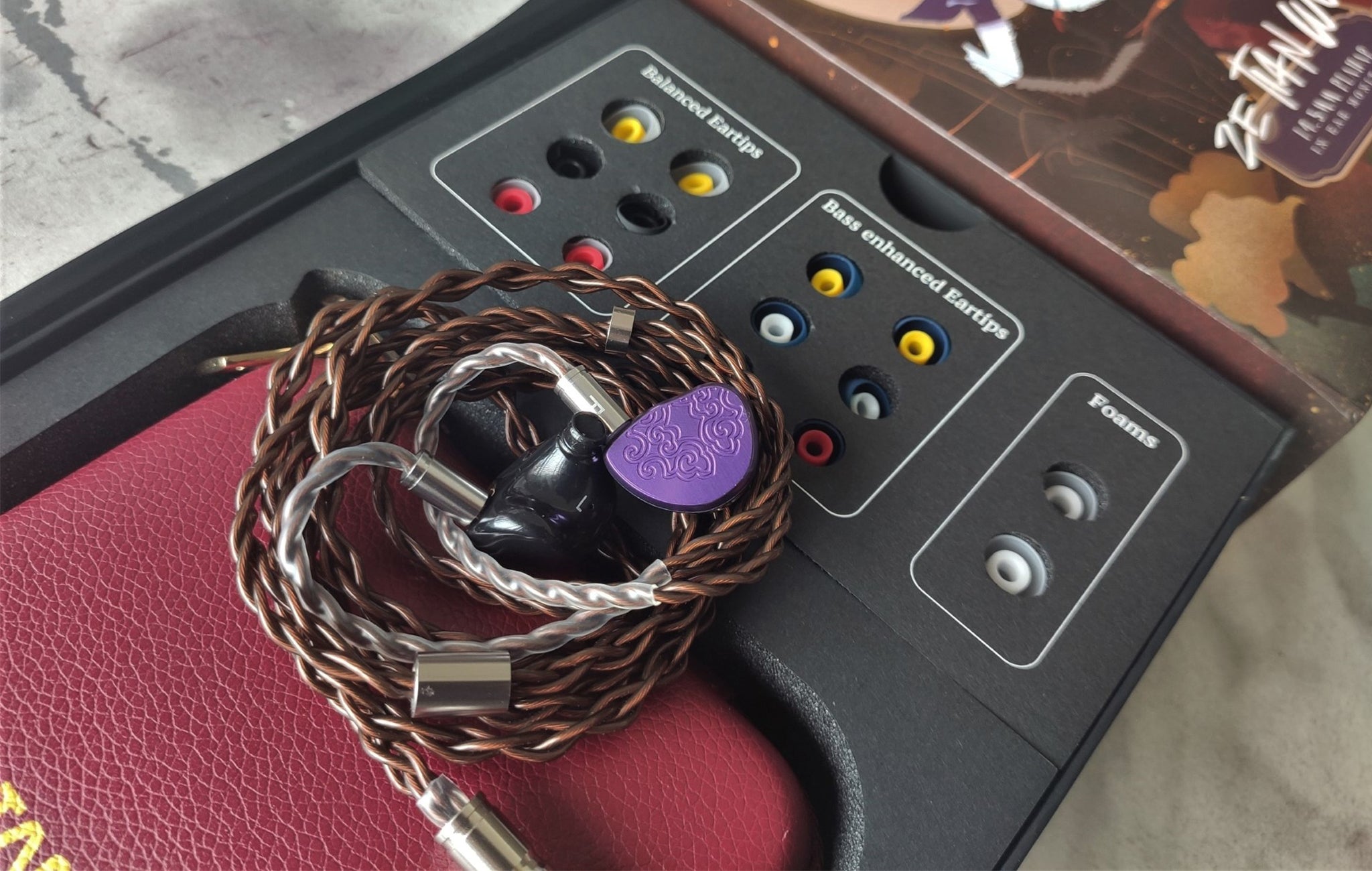
I must say I expected better build from Tangzu for Zetian Wu which is supposed to be higher tiered than the Yuan Li (an IEM that I adore very much). The shells seems to be made of acrylic plastic with aluminum faceplates - adorned only in purple. Not exactly shabby but yes after owning the metal shelled Yuan Li which oozes with refined workmanship, I was taken aback slightly - but this is subjective to my observation.
Otherwise, I am happy with the lightweight build which will allow me to wear my Zetian Wu for 3-4 hours without experiencing any ear fatigue. Yes is it very comfortable for my ears.
Housed inside, a single Magnetic Planar rated at 16 Ohm with 100db of sensitivity. That should translate into something that is meant to be driven efficiently even with low powered sources.
I will give credit to Tangzu for the inclusion of very fine cable made of 5N Oxygen Free Copper braided beautifully in intricate pattern. It is very sturdy as it is premium looking. The termination comes in 0.78mm two pins configuration.
Zetian Wu comes in premium boxed package which contains all the normal accessories expected of this price range. Quite notable, the accompanying red carrying case which is larger than most competitors. Easily capable of fitting in the IEM together with a few dongles.
Equipment Used

Timbre, Tonality & Dynamics:
Zetian Wu general sound is tuned to appease the appreciation for Harman-ish, V curved frequency. Without a doubt nowhere near being neutral as would be observed from Tangzu's debut IEM, the Yuan Li. I can clearly hear big emphasis on low frequency elevation which is quite evident especially when used with silicone tips - does not matter big bore or small bore, Bass is big regardless. Then the Mids audibly positioned a step or two back, but not recessed enough to sound distant. The highs being present and well extended.
Timbral and tonal wise, Zetian Wu offers highly organic and well rounded sound - it is natural enough to avoid the pitfalls of being digital/metallic sounding. The vibrancy of dynamic projection is admirably mature yet fun, Zetian Wu sometimes appeared almost as vibrant as some Dynamic Driver IEMs that I am familiar with, except that being a Magnetic Planar, it has better discipline with attack and decays to not sound overly euphonic.
Throughout my listening sessions with Zetian Wu, I am impressed how clean it sounds, there's good balance of cohesion between smoothness and polished edge. Even when using it for listening to more aggressive mastering, Zetian Wu retained the smoothness with deft agility.
Mids
The Mids on Zetian Wu really depends on the genre of the music played. With some Rock/Metal/Indie recordings which usually employ less emphasis on Mids, the output can appear recessed with the midrange instruments/vocals seemingly placed a step or two back. However with Bluegrass/Modern Jazz/Folk (which normally exhibit Mids centric mastering), then the Mids would appear forward enough allowing the listener to savor the vocals clearly. What does this say about Zetian Wu? I call this Mids transparency - the ability to reflect the intended tuning the way the tracks are being mastered. So I see this as a positive point for Zetian Wu.
Vocal wise, Zetian Wu is admirably natural and organic sounding. Perhaps the placement may seem to be lower than what I am familiar with. I do not observe any audible coloration to add warmth - definitely not sounding thin or dry.
Treble
Treble is well extended, that's for sure. I am hearing good micro details resolved especially with deep decays from hi hats or cymbals. The overall theme of Zetian Wu being smooth and well controlled. It has ample air and shimmer, evident enough yet never attempting to induce any unsavory shimmer or sparkle. The Mid Treble thankfully are free from any Pinna Glare that would usually translate into Treble fatigue or shouty-ness.
Dispersal of decays seems to be in favor of smoothness over prompt edge, it is polished as it is velvety - especially when the recordings and mastering are done properly (true lossless tracks).
Bass
I think, this is why Zetian Wu exists. It is Tangzu's first legitimate IEM that focuses on big Bass performances. Let's start with the Mid-Bass, it is highly impactful and commanding - yet it behaves well enough to not overshadow lower Mids or drown out the Sub-Bass. It almost felt like Dynamic Drivers Bass with the vibrancy level.
Sub-Bass on the other hand, exhibit solid presence and will emit equally strong seismic sensations. This clearly apparent when using Zetian Wu spinning Electronic, Metal, Rock and Dance music - those that contain layers of Bass attack most prominent from Drum Bass and electro percussions (drum machines).
Even when playing Alison Krauss & Union Station Bluegrass music tracks, I can hear strong bass responses from the cello, Bass guitars etc.
I am not a Basshead (I was, but not anymore), but I will admit I am impressed at how disciplined Zetian Wu is at keeping things in check - the caveat being, at least for my application I need to tone it down with the usage of Misodiko MIX460 tips (similar to Symbio Orange). Otherwise when using the stock silicone tips, I can tell it was borderline overbearing with Bass reverbs and resonances. In short I cannot tolerate using Zetian Wu with any silicone tips no matter if they are big bore or small bore. Yes this is probably unique to my situation of being sensitive to Bass.
Technicalities
Big, wide and open sounding, Zetian Wu must be commended for being technically competent. The resolution is clean and concise, despite being Bass heavy. Zetian Wu also seemingly quite good with speed, nothing less from a properly implemented Magnetic Planar, I have yet to observe any sluggishness no matter how complex or outright speedy the tracks are. Be it myriad of instruments from Modern Jazz of Sinne Eeg or breakneck speed of Slayer's Reign In Blood, Zetian Wu handled them all without breaking sweat.
Spatial positioning is also quite good, with holographic imaging making it easy to track instruments and source of sound. This also indicated Zetian Wu suitability for gaming and movie watching.
Scalability
Being highly sensitive with such low impedance rating, Zetian Wu already sounded great with my 1 Vrms Abigail 4.4. Even the old Sony Xperia X Compact at under 1 Vrms sounded proper (despite with smaller headroom). This is a huge plus for highly portable usage on the go.
However, with this characteristics, Zetian Wu seemingly does not scale much better beyond 2 Vrms. So driving it with the 4.7 Vrms of VE Megatron versus 1 Vrms Abigail 4.4 practically does not exhibit much difference aside from the loudness it capable of. Thankfully, being a magnetic planar, Zetian Wu will not end up being shouty like most highly sensitive DDs

Final Words
I reflect upon the intended audience for Zetian Wu and it is apparent to me it is aimed for those loving the Bass heavy Harman tuning. It is decidedly fun and engaging, yet polished to retain fluid harmonics. Such a feat almost unheard of 2 years ago when Magnetic Planar IEMs are not expected to be as efficient and sensitive like what we see nowadays.
In contrast, comparing Zetian Wu with TIN HiFi P1 is like comparing apple to oranges - despite both being Magnetic Planars. P1 is obviously more neutral and reserved, Zetian Wu markedly Bassy and vibrant. Compare a bit more and I would say Zetian Wu is not as bright as 7hz Timeless, yet twice as sensitive than Timeless. In fact, Zetian Wu is competing directly with LETSHUOER Z12, another similarly sized Magnetic Planar which also exhibit Bass heavy Harman tuning. it is great for the users to have choices now.

Foreword
- This unit was sent to me by Tangzu for review purposes. Check out https://keephifi.com/products/tangzu-zetian-wu-14-5mm-planar-magnetic-drivers-iem-earphones-in-ear-monitors
- At the point of this article, my Zetian Wu has undergone over 150 hours of burn in and approximately 50 hours of actual listening
- I don't do measurements, I just describe what I hear, from my own POV
- I don't use EQ
- The entirety of my impressions was done with my own hybrid Foam Tips
- Ultimately, my reviews are purely subjective and biased to my personal preference in sound
I must say I expected better build from Tangzu for Zetian Wu which is supposed to be higher tiered than the Yuan Li (an IEM that I adore very much). The shells seems to be made of acrylic plastic with aluminum faceplates - adorned only in purple. Not exactly shabby but yes after owning the metal shelled Yuan Li which oozes with refined workmanship, I was taken aback slightly - but this is subjective to my observation.
Otherwise, I am happy with the lightweight build which will allow me to wear my Zetian Wu for 3-4 hours without experiencing any ear fatigue. Yes is it very comfortable for my ears.
Housed inside, a single Magnetic Planar rated at 16 Ohm with 100db of sensitivity. That should translate into something that is meant to be driven efficiently even with low powered sources.
I will give credit to Tangzu for the inclusion of very fine cable made of 5N Oxygen Free Copper braided beautifully in intricate pattern. It is very sturdy as it is premium looking. The termination comes in 0.78mm two pins configuration.
Zetian Wu comes in premium boxed package which contains all the normal accessories expected of this price range. Quite notable, the accompanying red carrying case which is larger than most competitors. Easily capable of fitting in the IEM together with a few dongles.
Equipment Used
- Xiaomi Mi 9T (3.5mm SE and USB Port)
- Sony Xperia X Compact (3.5mm SE and USB Port)
- Windows 10 with Native USB Drivers
- HiBy Audio Player USB Exclusive Mode with FLAC files
- CEntrance DACport HD
- Cayin RU6
- Ovidius B1
- VE Abigail 4.4
- VE Megatron
- Misodiko MIX460 Foam Tips
Timbre, Tonality & Dynamics:
Zetian Wu general sound is tuned to appease the appreciation for Harman-ish, V curved frequency. Without a doubt nowhere near being neutral as would be observed from Tangzu's debut IEM, the Yuan Li. I can clearly hear big emphasis on low frequency elevation which is quite evident especially when used with silicone tips - does not matter big bore or small bore, Bass is big regardless. Then the Mids audibly positioned a step or two back, but not recessed enough to sound distant. The highs being present and well extended.
Timbral and tonal wise, Zetian Wu offers highly organic and well rounded sound - it is natural enough to avoid the pitfalls of being digital/metallic sounding. The vibrancy of dynamic projection is admirably mature yet fun, Zetian Wu sometimes appeared almost as vibrant as some Dynamic Driver IEMs that I am familiar with, except that being a Magnetic Planar, it has better discipline with attack and decays to not sound overly euphonic.
Throughout my listening sessions with Zetian Wu, I am impressed how clean it sounds, there's good balance of cohesion between smoothness and polished edge. Even when using it for listening to more aggressive mastering, Zetian Wu retained the smoothness with deft agility.
Mids
The Mids on Zetian Wu really depends on the genre of the music played. With some Rock/Metal/Indie recordings which usually employ less emphasis on Mids, the output can appear recessed with the midrange instruments/vocals seemingly placed a step or two back. However with Bluegrass/Modern Jazz/Folk (which normally exhibit Mids centric mastering), then the Mids would appear forward enough allowing the listener to savor the vocals clearly. What does this say about Zetian Wu? I call this Mids transparency - the ability to reflect the intended tuning the way the tracks are being mastered. So I see this as a positive point for Zetian Wu.
Vocal wise, Zetian Wu is admirably natural and organic sounding. Perhaps the placement may seem to be lower than what I am familiar with. I do not observe any audible coloration to add warmth - definitely not sounding thin or dry.
Treble
Treble is well extended, that's for sure. I am hearing good micro details resolved especially with deep decays from hi hats or cymbals. The overall theme of Zetian Wu being smooth and well controlled. It has ample air and shimmer, evident enough yet never attempting to induce any unsavory shimmer or sparkle. The Mid Treble thankfully are free from any Pinna Glare that would usually translate into Treble fatigue or shouty-ness.
Dispersal of decays seems to be in favor of smoothness over prompt edge, it is polished as it is velvety - especially when the recordings and mastering are done properly (true lossless tracks).
Bass
I think, this is why Zetian Wu exists. It is Tangzu's first legitimate IEM that focuses on big Bass performances. Let's start with the Mid-Bass, it is highly impactful and commanding - yet it behaves well enough to not overshadow lower Mids or drown out the Sub-Bass. It almost felt like Dynamic Drivers Bass with the vibrancy level.
Sub-Bass on the other hand, exhibit solid presence and will emit equally strong seismic sensations. This clearly apparent when using Zetian Wu spinning Electronic, Metal, Rock and Dance music - those that contain layers of Bass attack most prominent from Drum Bass and electro percussions (drum machines).
Even when playing Alison Krauss & Union Station Bluegrass music tracks, I can hear strong bass responses from the cello, Bass guitars etc.
I am not a Basshead (I was, but not anymore), but I will admit I am impressed at how disciplined Zetian Wu is at keeping things in check - the caveat being, at least for my application I need to tone it down with the usage of Misodiko MIX460 tips (similar to Symbio Orange). Otherwise when using the stock silicone tips, I can tell it was borderline overbearing with Bass reverbs and resonances. In short I cannot tolerate using Zetian Wu with any silicone tips no matter if they are big bore or small bore. Yes this is probably unique to my situation of being sensitive to Bass.
Technicalities
Big, wide and open sounding, Zetian Wu must be commended for being technically competent. The resolution is clean and concise, despite being Bass heavy. Zetian Wu also seemingly quite good with speed, nothing less from a properly implemented Magnetic Planar, I have yet to observe any sluggishness no matter how complex or outright speedy the tracks are. Be it myriad of instruments from Modern Jazz of Sinne Eeg or breakneck speed of Slayer's Reign In Blood, Zetian Wu handled them all without breaking sweat.
Spatial positioning is also quite good, with holographic imaging making it easy to track instruments and source of sound. This also indicated Zetian Wu suitability for gaming and movie watching.
Scalability
Being highly sensitive with such low impedance rating, Zetian Wu already sounded great with my 1 Vrms Abigail 4.4. Even the old Sony Xperia X Compact at under 1 Vrms sounded proper (despite with smaller headroom). This is a huge plus for highly portable usage on the go.
However, with this characteristics, Zetian Wu seemingly does not scale much better beyond 2 Vrms. So driving it with the 4.7 Vrms of VE Megatron versus 1 Vrms Abigail 4.4 practically does not exhibit much difference aside from the loudness it capable of. Thankfully, being a magnetic planar, Zetian Wu will not end up being shouty like most highly sensitive DDs
Final Words
I reflect upon the intended audience for Zetian Wu and it is apparent to me it is aimed for those loving the Bass heavy Harman tuning. It is decidedly fun and engaging, yet polished to retain fluid harmonics. Such a feat almost unheard of 2 years ago when Magnetic Planar IEMs are not expected to be as efficient and sensitive like what we see nowadays.
In contrast, comparing Zetian Wu with TIN HiFi P1 is like comparing apple to oranges - despite both being Magnetic Planars. P1 is obviously more neutral and reserved, Zetian Wu markedly Bassy and vibrant. Compare a bit more and I would say Zetian Wu is not as bright as 7hz Timeless, yet twice as sensitive than Timeless. In fact, Zetian Wu is competing directly with LETSHUOER Z12, another similarly sized Magnetic Planar which also exhibit Bass heavy Harman tuning. it is great for the users to have choices now.