
Source: Head-Fi


**For some weird reason my original pictures for this review refuse to upload properly on head-fi forums, to check out this review along with my main pics please visit my page The Audio Bloke, link provided at the end of the review, thanks**
Tips Used During Review: Mostly Fiio FH3 stock Foam Tips.
Sources Used During Review: Fiio BTR5, DDTC 35, Hiby R5 Pro Saber, Redmi K30 Pro.
Cables Used During Review: Stock Cable.
Introduction: So, I had been using the Final E3000 for a while & wanted to try out a tuning which was opposite, not smooth, not warm & definitely more detail retrieval oriented. I was pretty set on the BQEYZ Summer at first but then I read a few reviews about it online and summer was definitely not the tuning I was looking for, if anything it would have been more an extension to my Final E3000’s not something different. So, I conducted a poll on many Facebook audio enthusiast groups highlighting the tuning I was looking for & also my budget and the TRI Starsea name kept popping up. A $130-ish dollar IEM with 3 tuning switches & not your typical in your face V-Shaped tuning? Yes please, Starsea definitely piqued my interest form the get go, from its gorgeous shell to its luxurious packaging, TRI had done an excellent job separating Starsea from the rest of the $100 IEM herd. For those of you not aware, TRI is a more premium sister concern of KBear, Tri Starsea has 2 Balanced Armature drivers, 1 Knowles ED-29689 for mids & 1 custom designed BA for highs & a single 8mm Dynamic Driver for the low end.


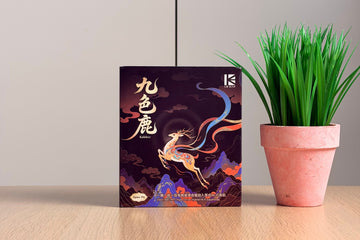
Packaging & Accessories: The retail box & the packaging of the Starsea is quite large with a star pattern which makes it look quite premium & sticks to its theme as well. The accessories are quite generous here, you get a 8-core silver platted copper cable, which is quite soft & extremely comfortable to use. It’s a 3.5mm cable (I would love the option to choose between a 3.5mm cable & balanced 2.5/4.4 mm one just like BQEYZ offers), it’s a 2-pin connector with an aluminum chin slider. The box also includes:
- Cleaning cloth
- Carrying case
- 3 pairs of silicone Ear-tips in 3 types (9 pairs in total)
- 2 pairs of foam Ear-tips
- Sim Ejector Tool
- Documentation/warranty


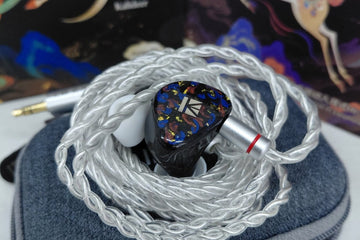
Design: TRI Starsea comes with a 3D printed, German imported resin shell, its mainly purple in color with hues of black & white glittered patterns. The faceplate looks absolutely gorgeous & is extremely lightweight. There are 3 tuning switches on the side of the shell, unfortunately these are too small to be operated via finger tips, you will need a tooth pick or sim ejector tool (provided in the box), to operate these tuning switches. My advice would be to use a toothpick as sometimes you need a bit of force to move these tuning switches & a sim ejector tool has a greater chance of scratching the surface or breaking the switches. The Starsea also offers a 2-pin connector, I am glad they decided to offer a 2-pin connection rather than mcmx. In the middle of the faceplate, there is a big TRI audio logo which looks quite attractive. There is long gold-plated aluminum nozzle meant for deep inserting & it has metal mesh included for protection.
Build & Fit (2.5/5): I wasn’t planning to include this section in my review but I was forced to do due to running into some issues with the fit of the Starsea. For me this is the biggest flaw in the Stasea’s design. There is a driver flex issue when using silicone tips of any kind, weird clicking noises happen when I try to fit it inside my ear. And also, after inserting there is a very weird air tight pressure feeling which leaves you uncomfortable & you won’t be able to enjoy the Starsea for long listening sessions (BA pressure build up). Although the driver flex issue does go away after a couple of minutes but the air tight pressure remains with silicone tips. I have tried a variety of silicone tips to remedy this issue, for example, BGVP A07, Final E Tips, Spinfit CP 145, stock Starsea silicone tips, stock BQEYZ Summer Spring 1 & 2 silicone tips but none of them could fix the driver flex or the air tight feeling issue. These issues were only fixed with Fiio FH3 stock foam tips, both driver flex & air tight pressure feeling were gone but I don’t like the fact that I am limited to using only a particular brand of foam tips to fix these problems. Note: Not even the stock foam tips provided inside the Starsea retail box could fix these issues. I let a few of my friends try out the Starsea with silicone tips & they all reported the same issues, there was one more user who ordered & bought from the same source I did & he reported the same problems as well. So bizarrely, it looks like I am not the only user facing these driver flex & BA pressure build up issues with the Starsea!
Drivability: Tri Starsea is a pretty sensitive IEM with its low impedance of 9.5 ohms, blasting it with huge amounts of power will result in messing up the frequency curve of the starsea. For best results it’s better to user gear with a low output impedance, the lower the better! And due to its bright nature Starsea pair very well with a warm source. For example, paring it with DDTC 35 opened up the bass extension a bit more. But at the same time details & and that spacious soundstage were missing which the BTR5 & my Hiby R5s easily accomplished. Driving Starsea from a K30 Pro made it sound tinny & lifeless, the notes were light & bass was all but gone, so its not like amping is not necessary with the Starsea. The maximum output impedance acceptable form a source for the TRI Starsea is 1.1875 ohm. I would like to give credit to @baskingshark for this part of the review, as he guided & advised me when I myself was confused regarding what would be the best source to drive the Tri Starsea.
Sound
Tuning: Ok so the Starsea has 3 different tuning switches which provides 3 different types of sound, although this definitely is not a gimmick but there are some similarities overall in the sound, I am going to cover the general tuning & sound of the Starsea fist. And then talk in details about the 3 tuning profiles & what differences they bring to the table.
Highs (4.3/5): TRI Starsea has very impressive Treble, it has very good extension & decent amount of air with the occasional hint of sparkle. Highs are crisp & very detailed but not so forward in the mix that it will cause fatigue, I myself am treble sensitive but the Starsea high’s felt smoother rather than fatiguing. There is no Sibilance present thankfully, instruments like cymbals, violin, high hats & electric guitars sound natural with a hint of sparkle as I had mentioned earlier.
Soundstage, Imaging & Separation (4.7/5): Starsea creates a very spacious sound with all 3 of its tunings, giving a headphone like feeling even though it’s an IEM with only 1 vent hole. Instrument separation is above average but nothing to write home about at the same time, the same goes for layering & imaging. Clarity & Resolution is definitely excellent for this price point & one of the highlights for the Starsea. I didn’t find any metallic sheen, the timbre was bit on the bright side but enjoyable none the less.
Mids (4.8/5): The Midrange is the star of the show! Its very forward in the mix, very thick & lush. Although there is an emphasis on upper midrange which lead to shouty-ness very occasionally with bright sources, pairing starsea with a warm source tames the aggressive nature of the upper midrange. It also balances out when using the “Beautiful Vocals” tuning profile regardless if you are using a bright or warm source. Lower mids are slightly recessed but not to the point of a deep V-shaped tuning. There is no bass bleed from the lower end, keep things clean.
Lows (3.2/5): If midrange is star of the show, then low end is its Achilles' heel, well that sounds a bit dramatic, it’s not like there’s a total absence of bass on the starsea but even with the “Amazing Bass” setting you will be left wanting more. Compared to other dynamic driver IEM’s which handle their low end, here the sub-bass extension is not the deepest, there is definitely no sub-bass rumble. Even though sub-bass is more in quantity compared to mid-bass it’s still not enough to satisfy the bass heads. Due to slow nature of bass listening to metal tracks on Starsea is just not ideal, even that amazing bass setting couldn’t save starsea in this genre, although it did marginally improve things.

Tuning Switches:
“Exquisite Pure Tone” (Both Switches Down): To me this was the brightest tuning of the starsea and second most favorite one. Treble, Mid’s & Low’s all had decent extension giving it a more rounded feeling, Detail retrieval was on point, background vocals & instruments were highlighted brilliantly. There was airiness in the treble but more sparkle would have been appreciated.
“Balanced Tuning” (Both Switches Up): Just as the name suggests TRI does an awesome job keeping all 3 frequencies as balanced as possible, still upper mids take more of a center stage but that’s to be expected given how the base tuning of Starsea is. Important thing to the point our that this tuning has the thickest lower mids out of three tunings. Sub bass has decent extension here but still more in quantity than mid-bass. Overall bass takes a back seat here & you can barely feel its presence.
“Amazing Bass” (Switch 1 Up & Switch 2 Down): This is my favorite tuning profile for the Starsea, it has a mild V-Shape tuning, the mids are still very thick & forward. Sub-bass rises more in quantity & still take priority over mid-bass. Bass has decent texture but even with this profile enabled you don’t get that fast, thumping bass that you do get from other similar IEM’s utilizing a DD for its low’s.
“Beautiful Vocals” (Switch 1 down & Switch 2 Up): Well, you might be wondering I have already pointed out that mids are forward in the mix with the other tuning profiles, especially there is an emphasis in the Upper mids, so what does this “Beautiful Vocals” profile actually do? Well to put in bluntly unlike the other profiles it takes the midrange and puts it more forward in the mix than any other frequency. Vocals are clearer, you are inclined to notice the high-quality resolution & details, which is more in your face & as a result this tuning may lead to fatigue for some during long listening sessions.
Conclusion: Wow, this is the longest review I have every written but my intention is not to bore the readers. What can I say? TRI Starsea is an interesting IEM & it does deserve your time & attention. Is it an all-rounder? No. Is it going to satisfy the bass junkies? No. Is it worth the price? Most certainly yes. Despite its weaknesses Starsea has one of the smoothest & interesting tunings I have heard so far. Sure, there are certain things which it can’t do or accomplish, but there are other things the Starsea does so well that no other IEM in this price bracket can do. If it weren’t for the driver flex & air tight pressure feeling I would give the Starsea a 4.5/5 easily, but alas for now ma rating is 4/5.

Comparisons: ??? Right now, I am in the middle of reviewing BQEYZ Spring 1, 2 & Summer along with Fiio FH3, so I felt it appropriate to review them individually first and then do a massive $100 to $150 range IEM battle, to see who takes the lead! So please stay tuned, like & follow my page The Audio Bloke for future updates if you liked this review. Thanks! Here is a link to my page for those of you who are interested

Spend Less Enjoy HIFI