






DISCLAIMER
I would like to thank CCA for providing the Rhapsody.
It can be gotten here: https://keephifi.com/discount/rhapsody-blog?redirect=%2Fproducts%2Fcca-rhapsody-2dd-4ba-hybrid-driver-hifi-iems-earphones-with-4-tuning-switches (no affiliate links).
I would like to thank CCA for providing the Rhapsody.
It can be gotten here: https://keephifi.com/discount/rhapsody-blog?redirect=%2Fproducts%2Fcca-rhapsody-2dd-4ba-hybrid-driver-hifi-iems-earphones-with-4-tuning-switches (no affiliate links).

SPECIFICATIONS
- Driver configuration: 4 x 31736 balanced armature drivers, 2 x 8 mm dynamic drivers
- Impedance: 15 - 20 Ω (depending on switch configuration)
- Frequency response: 20 Hz - 40 kHz
- Sensitivity: 102 dB
- Cable: 2-pin, 0.75 mm cable; 3.5 mm termination; silver-plated cable
- Tested at $50.99 USD for mic version; $49.99 USD for non-mic version
ACCESSORIES
Other than the IEM, these are included:
- 3 pairs of KZ "starline" silicone eartips (S/M/L)
- Cable
- Card pin
For a $50ish USD IEM, the accessories - or rather lack thereof - are disappointing. We have only one set of silicone tips, with no foam tips, nor even a carrying case or carrying pouch. I've surely seen cheaper IEMs with a better accessory spread.

KZ's classic "starline" eartips are included here, and they are serviceable from a fit and sonic perspective.

The stock silver-plated cable is not great haptically - it is very tangly and thin, with no chin cinch, and with microphonics in abundance. It is thankfully a 2-pin connector, which is usually more robust than MMCX at the budget segment. However, take note that this has a 0.75 mm terminal instead of the more common 0.78 mm one.

Don't lose the card pin, which is essential for flipping the tuning switches!
The rest of this review was done with the stock cable and stock silicone tips. No aftermarket accessories were used, so as not to add any confounders to the sound.
BUILD/COMFORT
The rest of this review was done with the stock cable and stock silicone tips. No aftermarket accessories were used, so as not to add any confounders to the sound.
BUILD/COMFORT

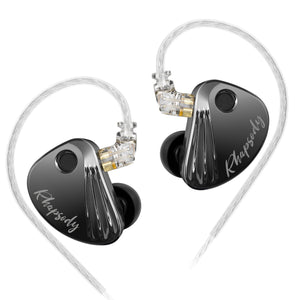
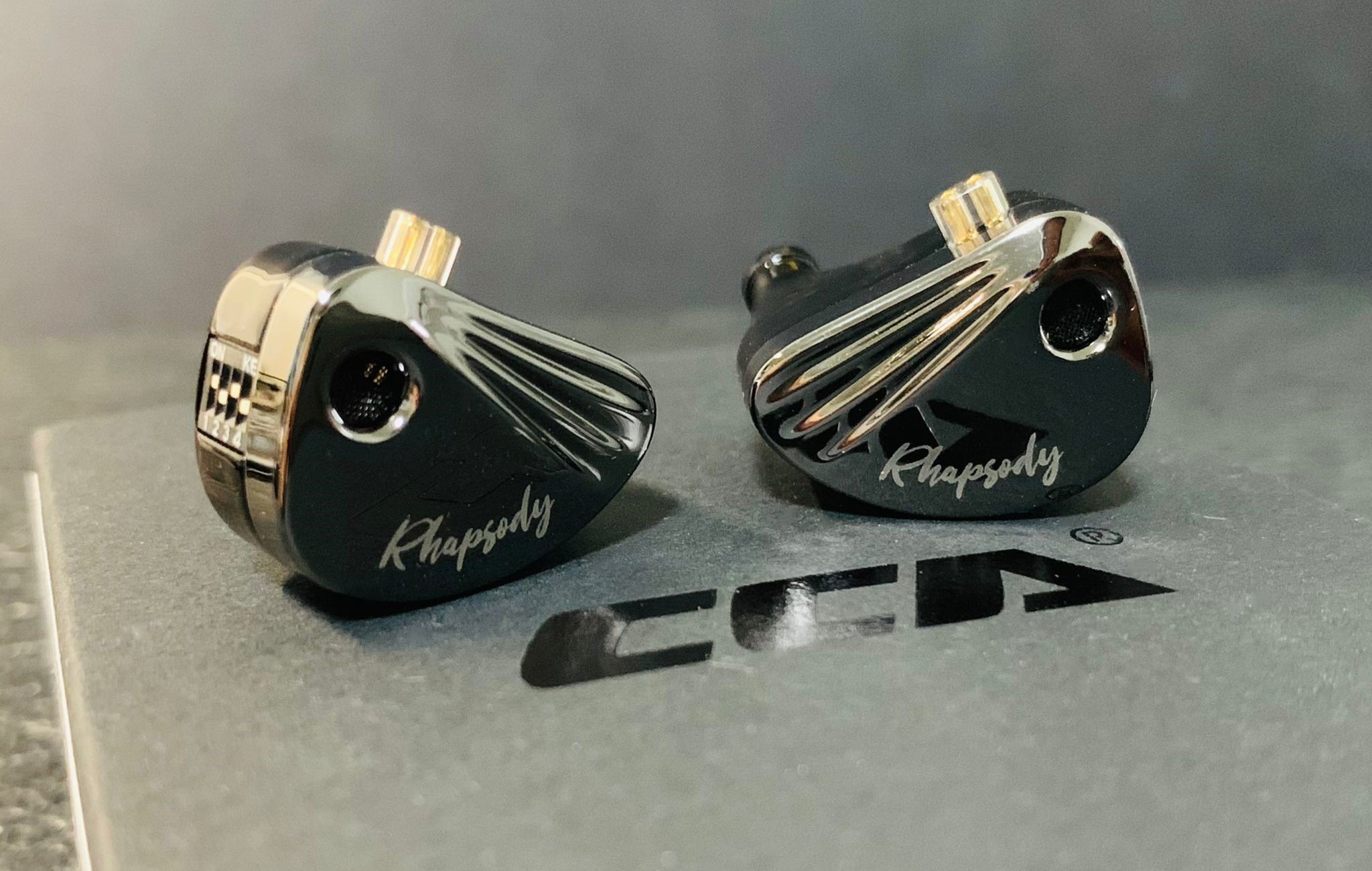
Fashioned from 3D-printed metal, the housings feature a mirror-like faceplate. While it does look quite elegant, this may be a fingerprint or scratch magnet. The inner aspect is made of plastic resin, allowing one to visualize the internals.

The Rhapsody has a large circular mesh on the housing, which confers a semi-open back design. As such, isolation is bang average. However, this aids in acoustic flow, with no driver flex noted on my pair.
While the shells are light, they are huge in dimensions. Thus, those with smaller ears might have fitting or comfort issues. YMMV.
INTERNALS/TUNING SWITCHES
The Rhapsody sports a 6 driver setup:
- Two x 8 mm dynamic drivers - one for the sub-bass, and one for the midrange.
- Four x 31736 BAs handle the treble and upper treble.
While the shells are light, they are huge in dimensions. Thus, those with smaller ears might have fitting or comfort issues. YMMV.
INTERNALS/TUNING SWITCHES
The Rhapsody sports a 6 driver setup:
- Two x 8 mm dynamic drivers - one for the sub-bass, and one for the midrange.
- Four x 31736 BAs handle the treble and upper treble.

2023 has been the year of the tuning switch craze, and it is no surprise that this concept is incorporated here. We have 4 tuning switches, to give a total of 16 tuning permutations:

Graphs of the CCA Rhapsody via IEC711 coupler.
As per the above graphs, the switches confer an 8 dB or so difference in bass to the lower mids, which does vary the sonics (ie this is not a total gimmick).
Thus, the Rhapsody can be converted from a Harmanish tone to a more sub-bass predominant profile. The former is crisper and leaner, and not so boomy in the bass, with better treble extension; whereas the latter is warmer, and slower in the bass, but with much thicker note weight.
Do explore with the various switch permutations to see what suits your requirements. Thankfully, the switches are easily manipulated with the card pin, and are not as microscopic as the KZ AS24's!
DRIVABILITY
I tested the Rhapsody with the following sources:
- Apple dongle
- Cayin RU7
- Fiio K11 DAC/amp
- Fiio KA13 dongle
- Hiby R3 Pro Saber 2022 DAP
- Khadas Tone Board -> Schiit Asgard 3 amp
- Questyle M15 DAC/AMP dongle
- Sony Walkman NW A-55 DAP (Walkman One WM1Z Plus v2 Mod)
- Sony Walkman NW A-55 DAP (Walkman One Neutral Mod)
- Sony Walkman NW WM1A DAP (Walkman One WM1Z Plus v2 Mod)
- Smartphone
The impedance does vary between the different switch settings, but overall, the Rhapsody is moderately easy to drive. While weak sources can drive the Rhapsody acceptably, it might benefit a bit from amplification in terms of scalability.
SOUND & TECHNICALITIES
The following sonic impressions are done with the least bassy configuration - DDDU - which provides a Harmanish sound.
On this setup, the Rhapsody is less bassy than the other profiles. There is a mid-bass focused soundscape, with a slight sub-bass roll-off. Bass quality is sadly not up-to-mark. We hear a bassline on the slower side, with some mid-bass bleed, in addition to a one-noted textureless bass. On complex or rapid bass tracks - for example Sting's Englishman In New York - the bass is noticeably slower than the treble, thus contributing to some incoherency.
The lower mids are depressed, but with the big bass bleeding into this region, it adds warmth and heft, rounding notes and blunting note definition. The upper midrange has a 9 dB ear gain, which pushes vocals forwards without overt shoutiness (at moderate volumes).
The lower treble continues on from this boosted upper mids, and sibilance is minimal. The upper treble rolls-off early thereafter, and the Rhapsody is not a very airy set. Trebleheads will find the resolution and treble extension wanting, but conversely, this is a suitable IEM for the treble-sensitive among stus.
Timbre is very decent for a BA containing hybrid - this is one area where many budget hybrids fail at. No complains for acoustic instrumentation playback.
With regard to technicalities, the Rhapsody is sub-par. It isn't too detailed or resolving, and instrument separation and layering is messy, which is more apparent when complex tracks with competing riffs come out to play. Soundstage is thankfully above average, though imaging is fuzzy when compared against other competitor budget hybrids.
COMPARISONS
Comparisons were made with other sub-$100 USD hybrids. Pure BA, pure DDs and planars were left out of the comparisons as the different driver types have their pros and cons.
Thus, the Rhapsody can be converted from a Harmanish tone to a more sub-bass predominant profile. The former is crisper and leaner, and not so boomy in the bass, with better treble extension; whereas the latter is warmer, and slower in the bass, but with much thicker note weight.
Do explore with the various switch permutations to see what suits your requirements. Thankfully, the switches are easily manipulated with the card pin, and are not as microscopic as the KZ AS24's!
DRIVABILITY
I tested the Rhapsody with the following sources:
- Apple dongle
- Cayin RU7
- Fiio K11 DAC/amp
- Fiio KA13 dongle
- Hiby R3 Pro Saber 2022 DAP
- Khadas Tone Board -> Schiit Asgard 3 amp
- Questyle M15 DAC/AMP dongle
- Sony Walkman NW A-55 DAP (Walkman One WM1Z Plus v2 Mod)
- Sony Walkman NW A-55 DAP (Walkman One Neutral Mod)
- Sony Walkman NW WM1A DAP (Walkman One WM1Z Plus v2 Mod)
- Smartphone
The impedance does vary between the different switch settings, but overall, the Rhapsody is moderately easy to drive. While weak sources can drive the Rhapsody acceptably, it might benefit a bit from amplification in terms of scalability.
SOUND & TECHNICALITIES
The following sonic impressions are done with the least bassy configuration - DDDU - which provides a Harmanish sound.
On this setup, the Rhapsody is less bassy than the other profiles. There is a mid-bass focused soundscape, with a slight sub-bass roll-off. Bass quality is sadly not up-to-mark. We hear a bassline on the slower side, with some mid-bass bleed, in addition to a one-noted textureless bass. On complex or rapid bass tracks - for example Sting's Englishman In New York - the bass is noticeably slower than the treble, thus contributing to some incoherency.
The lower mids are depressed, but with the big bass bleeding into this region, it adds warmth and heft, rounding notes and blunting note definition. The upper midrange has a 9 dB ear gain, which pushes vocals forwards without overt shoutiness (at moderate volumes).
The lower treble continues on from this boosted upper mids, and sibilance is minimal. The upper treble rolls-off early thereafter, and the Rhapsody is not a very airy set. Trebleheads will find the resolution and treble extension wanting, but conversely, this is a suitable IEM for the treble-sensitive among stus.
Timbre is very decent for a BA containing hybrid - this is one area where many budget hybrids fail at. No complains for acoustic instrumentation playback.
With regard to technicalities, the Rhapsody is sub-par. It isn't too detailed or resolving, and instrument separation and layering is messy, which is more apparent when complex tracks with competing riffs come out to play. Soundstage is thankfully above average, though imaging is fuzzy when compared against other competitor budget hybrids.
COMPARISONS
Comparisons were made with other sub-$100 USD hybrids. Pure BA, pure DDs and planars were left out of the comparisons as the different driver types have their pros and cons.

CVJ Mei
The Mei has only 4 tuning options via 2 tuning switches, but it has greater versatility in sonics compared to the 16 variations on the Rhapsody that just has a 8 dB lower mids/bass difference.
The Mei has only 4 tuning options via 2 tuning switches, but it has greater versatility in sonics compared to the 16 variations on the Rhapsody that just has a 8 dB lower mids/bass difference.

Graph of the CVJ Mei via IEC711 coupler. 8 kHz is a coupler peak.
It can be converted from a neutral bright set to an L-shaped bassy beast.
On the most resolving setup (both switches toggled up), the Mei is neutral bright, which has less bass and a greater treble extension/sparkle. The Mei's bass is tighter and faster, though it is more fatiguing and sibilant in the upper end.
The Mei has a more marked metallic timbre, but superior technicalities, besting the Rhapsody in imaging, soundstage, micro-detailing and instrument separation.
Truthear HEXA
The HEXA is tuned neutral with a sub-bass boost. It has much less bass than the Rhapsody, but the bass is cleaner and more textured. Additionally, the HEXA has more treble extension and a thinner note weight. The Rhapsody is thus more "fun-sounding", whereas the HEXA is more sterile/analytical in signature.
The HEXA has a slightly less natural timbre, but is superior to the Rhapsody in technicalities such as imaging, micro-detailing and instrument separation. Soundstage is about equal.
The HEXA is slightly harder to drive, though it has no tuning switches.
CONCLUSIONS
On the most resolving setup (both switches toggled up), the Mei is neutral bright, which has less bass and a greater treble extension/sparkle. The Mei's bass is tighter and faster, though it is more fatiguing and sibilant in the upper end.
The Mei has a more marked metallic timbre, but superior technicalities, besting the Rhapsody in imaging, soundstage, micro-detailing and instrument separation.
Truthear HEXA
The HEXA is tuned neutral with a sub-bass boost. It has much less bass than the Rhapsody, but the bass is cleaner and more textured. Additionally, the HEXA has more treble extension and a thinner note weight. The Rhapsody is thus more "fun-sounding", whereas the HEXA is more sterile/analytical in signature.
The HEXA has a slightly less natural timbre, but is superior to the Rhapsody in technicalities such as imaging, micro-detailing and instrument separation. Soundstage is about equal.
The HEXA is slightly harder to drive, though it has no tuning switches.
CONCLUSIONS

The Rhapsody is a smooth and non-fatiguing hybrid, with good versatility - it can be switched literally from a Harmanish tone to a more bass-laden signature. I appreciate that the Rhapsody has solid timbre for a BA-containing hybrid - something that cannot be said of most budget hybrids - coupled with a musical laid-back trademark.
There are some flaws though. There is a dearth of accessories, and it may be uncomfortable, what with the sumo-sized shells. Compared to other budget hybrids, technicalities are also lacking, with a slow and ponderous bass that doesn't fare well for complex bass tracks.
This set is also not for trebleheads due to a rolled-off treble with some deficiencies in resolution. On the flip-side - no pun intended - the Rhapsody is creamy smooth and will be a kindred spirit for our treble-sensitive brethren.
In a nutshell, I have mixed feelings about the Rhapsody. It is certainly a chill and relaxing hybrid, well-suited for long listening sessions, with an agreeable timbre, but if you are a technical junkie or value technicalities, it might be better to look elsewhere.
There are some flaws though. There is a dearth of accessories, and it may be uncomfortable, what with the sumo-sized shells. Compared to other budget hybrids, technicalities are also lacking, with a slow and ponderous bass that doesn't fare well for complex bass tracks.
This set is also not for trebleheads due to a rolled-off treble with some deficiencies in resolution. On the flip-side - no pun intended - the Rhapsody is creamy smooth and will be a kindred spirit for our treble-sensitive brethren.
In a nutshell, I have mixed feelings about the Rhapsody. It is certainly a chill and relaxing hybrid, well-suited for long listening sessions, with an agreeable timbre, but if you are a technical junkie or value technicalities, it might be better to look elsewhere.