







Intro
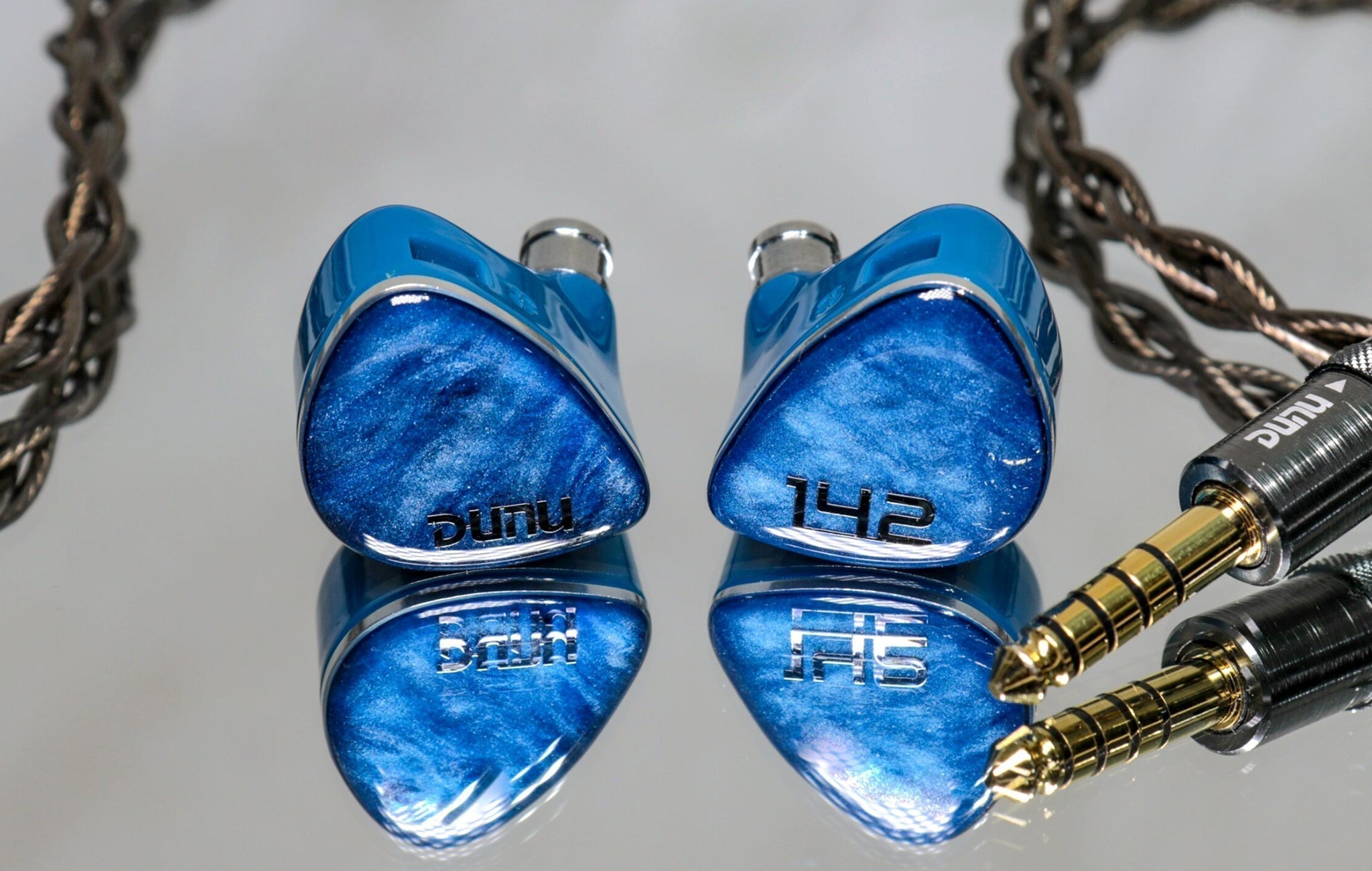
Another day, another feature review at Mobileaudiophile.com. This review covers one of the latest hybrid iems from the audio brand Dunu, named the Dunu DN142 ($249). I’m actually set to receive the DN142 in a matter of days, but I couldn’t help but relay some initial thoughts which were simmering inside of me. The DN142 is actually a seven-driver tribrid iem which consists of one dynamic driver, four balanced armature drivers, and two micro planar drivers. That thing simmering inside of me was the eagerness I have welling up in anticipation to check out Dunu’s version of a fun tribrid set. Of course, this is me with every single iem or audio device which gets sent my way, but after the last handful of Dunu iems… I can’t wait. Now, if you didn’t notice, Dunu did what many brands do anymore, and they tell you the driver count within the actual name. Dunu DN 1-4-2 for one DD, four BA’s, and two MP’s. However, the real question I have is “What is Dunu going to do with those drivers?”Dunu
I’ve done this many times in previous reviews, but I’ll quickly give you a quick synopsis of the genesis of Dunu. There’s actually one fun fact that I always seem to be impressed by and that is… Dunu has been a brand since 1994! Don’t worry, I’ll do the counting, that’s 32 years! Have any of you known this? That’s wild! Of course, quite a bit of those 32 years was spent doing what they created the brand to do and that’s manufacture OEM/ODM in Dongguan, China under their parent company Top Sound. It wasn’t until 2006 that Dunu began launching their own Dunu branded audiophile products which boasts many of the legend series like the Titan series, or the SA6 lineup and many others. I won’t bore you with everything they’ve ever made or accomplished, but I find it very interesting. For me, I’ve always looked at Dunu as one of those brands who will always release quality products. They have a huge global operation which boasts over 100 people on staff and some of the hottest audio products around. Here’s to 32 more.Reviews
I’ve owned quite a number of Dunu products over the years. So many got lost to time, sold, handed off to others. But some have stuck around too. However, I have been fortunate enough to review a handful of their iems as well. There have been a couple sets which I’ve turned down for review due to subjective reasons over the last couple years, but by-and-large this brand doesn’t seem to miss very often. In fact, I just reviewed the Dunu x-Koto Ito not long ago and it almost seems like a precursor to the DN142 is some illogical but totally understandable way for me. Many similarities actually. Man, I love the Ito! Anyways, I have been able to review their super popular Kima series iems with their neutral-natural sound and dope look. Sets like the Dunu Kima, Dunu Kima Classic, and Dunu Kima 2. I really enjoyed their open ear earbuds, the Dunu Alpha 3 too. Nevertheless, one of my absolute favorite +$300 iems on planet earth is the Dunu X-Gizaudio DaVinci which I gave very high marks to. So, I’ve been very fortunate to be able to creatively express my thoughts covering their products. The same goes for my partners at Mobileaudiophile.com who also reviewed a handful themselves like the Titan S, Dunu SA3 Mini, Dunu Titan 1es, Dunu Vulkan, Dunu Talos, and the Dunu Vivaldi. Once again, all high praise. That’s a pretty darn good track record. One product after another Dunu seems to read the room (so to speak) and produce products which are relevant to the times. I have to say folks, I am very pumped-up about this latest set, and I know I’m going to enjoy them. Hence why I’ve already written such a long intro before I’ve even gotten them. Lol.
Themes

We’ve been seeing a certain trend of late folks. That is… themed products. I’ve mentioned this in countless reviews and most notably in reviews conducted of all Kinera, QOA, and Celest iems and products. Though there’s many other brands following suit. It’s a very good thing to see too. These brands will adopt a certain motif, a theme with which they will base the artwork, some accessories (at times), the design, and the tuning of their iems. In the case of the DN142 its theme centers around Ao Bing, which is a character adopted from the 2019 feature film “Ne Zha” which casts Ao Bing as Nezha’s oceanic counterpart (if you will). Nezha is the character and theme chosen for the DN142’s older and slightly more expensive sibling, the Dunu DN242. So, the theme is getting played out at different price points. At any rate, the point is that Dunu is using the character traits, the colors, the feel of this character to design the DN142. Now, I haven’t gotten this set yet, but I love that I can sort-of guess what the tuning may be based on the theme that Dunu provides us. Honestly, I think that themes give us a groundwork as to what we should expect and really, it’s just a very creative way for these brands to market and design their products. I’m all for it.
They finally got here!
Well, that took longer than I would’ve liked, but the Dunu DN142 finally did arrive in one piece. I haven’t had a ton of time with them yet, but I can already tell that Dunu has a hot one on their hands with this set. I don’t always know right away, but with this set it was instantly apparent of its sonic skills for the cost. But it isn’t something which hits me right away. That is, if I’m going to spend the time reviewing something. I don’t speak about it very much, but I get a lot of products which simply don’t do it for me. Usually if I don’t dig something I’ll put it right into the burn in station for a few days to see if there are any changes. However, the DN142 goes to the burn-in station with my full confidence. Eh, I could tell there’s a touch of sibilance at times and so I’ll see if that gets reduced, but other than that the DN142 sounds like it will be a very high quality iem. This’ll be fun.
Competition is tough!
Of course, the big question is whether the DN142 will be good enough to steer your dollar to them, or away from them. I think we can all agree that competition in the $200 to $300 price point is rather bloated with fine sets of all different driver configurations. As good as the DN142 could possibly be, will it be able to usurp its will on the price point and become one of the more highly praised and sought after iems? The landscape is certainly chock full of great iems, there’s no doubt about that. However, this question is so much more nuanced anymore. We are beginning to see many different sound signatures, different tuning philosophies, and brands are making a much more value effort on getting the most out of their time, expertise, and market value using crazy driver configurations, vast amounts of R&D along with listening to the public. Basically, the hobby is absolutely nuts! In a good way. However, with all of these different styles and tuning options it makes a future for sets like the DN142 that much less promising. No doubt it’s an uphill battle, but remember, this is Dunu we are talking about. Anyways, with that I am ready to get into this. The Dunu DN142 everyone…(insert applause!)
Non-Affiliated Purchasing Links:
Gear used for testing
–Shanling UP6
–Shanling UA6
–Ifi Go Blu
–BASN PA60
–Surfans X10
–Hidizs S9 Pro Plus
–Shanling UA7
–Shanling H0
–Hidizs AP80 Pro Max
–Fiio JM21
–Hiby R3 Pro II
–Hiby R6 Pro II 2025
–Shanling M1 Plus
–IBasso DX240 with Amp8 MK2
–Shanling M6 Ultra
–Fiio Q15
-Many more sources used including weaker Android 3.5 set phones, iPad, and a few weaker 3.5 se dongles

Unboxing
Many days passed by waiting for this set to arrive, but when they did, I was very pleased to see what showed up. Actually, the box that the DN142 arrived in is basically the exact same rectangular box with the same dimensions (6” x 5” x 3”) as the Dunu x-Koto Ito. Just like the Ito the DN142 also has a sleeve which covers a plain black open top box. The sleeve of the DN142 has a very nice Ao Bing artwork with what appears to be a rainbow-reflective “DN142” as well as Ao Bing implanted right in the center of the box amongst thrashing waves of a very cool oceanic scene. It’s a very dope look. In fact, as far as artwork is concerned it is one of the more graphically intensive and neat designs that I’ve seen. Kudos to Dunu.
What’s Inside
Now, to get inside you must first pull the inside black box out of the cool looking sleeve. You’ll see a silver “Dunu” imprinted right in the center. Next, take off the top of the box and right away you’ll see the absolutely stunning ocean blue Dunu DN142’s sitting pretty inside of foam cut-outs. Then you have to take off that layer of foam which will uncover the Dunu hardcase underneath. I’ve always liked this case. Anyways, inside of that case you’ll find all of the accessories. That is, you’ll find the cable, the cable adapters, the bevy of eartips, a cleaning tool too. Now, underneath the case I was surprised to see three colorful and artistic trading cards based around the story “Ne Zha”. It’s a very nice unboxing in that you get all very solid accessories in a non-wasteful box which is very simple in its packaging style. Another good job by Dunu.

Eartips

Dunu provides three different types of eartips to help tune your brand-new DN142. That is nine pairs of tips in total provided in sets of three. The first set of three (S, M, L) are some light blue silicone tips with a longer flange, firm flange, and they fit very deep with a narrow bore. There will be moments that these tips are useful and great to have in your collection. The next set of three (S, M, L) are the Dunu Candy Tips which are a colorful bunch of silicone tips with a white flange, and differently colored stems per their sizes. Anyways, these are very nice semi-narrow bore tips with a firm flange, and they aren’t nearly as long as the first set that I talked about. Very nice tips that I use often and they can be sold separately too HERE. The candy tips will come in handy folks. The last set of three (S, M, L) are some of my absolute favorite eartips on planet earth. Those being the gray silicone square tips named the Dunu S&S tips (they can also be sold separately HERE). The S&S (Stage & Studio) tips are longer tips, deep fit, wide bore, firm flange, less rigid stem, and they seal beautifully for me. I adore them and use them routinely. Coincidentally, it’s the S&S tips that worked best for me when critical listening to the DN142. Anyways, I was very happy to see the assortment of eartips provided. Each style provided are good tips that will alter how the Ito sounds. Now, I do feel that you should go through all of the tips in your collection to find out what suits you the most when listening to the Ito. However, Dunu always does a fine job of adding a nice assortment.
Carrying Case

I’ve always been a fan of Dunu’s carrying case that they added into the packaging of the DN142. It’s the exact same case as we’ve seen with a number of their iems. It’s actually a tan colored hard zipper case cladded in fabric. It sits about 5” in length, 3” in width, and 1.5” in height. Really a great size for throwing into a bag without worry. Also, it’s a very sturdy case and so you really shouldn’t need to worry about your iems getting damaged. The beautiful thing is that the case can fit quite a lot inside. I easily fit the DN142 earphones, the cable, the adapters, the tips, and even a dongle dac as well. Another thing is that the case isn’t bulky. It’s actually pretty narrow height wise which makes it able to be put into a front pocket, if you so choose. One thing you’ll notice is that the zipper actually works very well. I’m telling you, this is an annoying problem I have with so many chifi carrying cases. The zipper gets stuck, it breaks altogether, or it comes out of its groove on so many of these cases handed out all willy-nilly within the packaging of each respective set. Anyways, the best part is that this is a case that I’ll actually use. I rarely use cases, but when I do it will be with a case like this.
Cable

The cable provided with the DN142 is clearly the best accessory provided in the packaging. We have seen extremely similar Dunu cables in the past. In fact, the cable provided is very similar to the Dunu Leo cable provided with the Dunu DaVinci and Dunu x-Koto Ito. Very similar. At any rate, this cable is actually a modular system arriving with two termination adapters of 3.5 single ended and 4.4 balanced. One of the cool aspects of the modular system is that it is actually proprietary to Dunu themselves with their patented Q-Lock Mini Modular Plug System. The material of build is 4-core silver-plated single-crystal oxygen-free copper in the Litz configuration and skin friendly outer cladding. This is actually a very thick cable at 22 AWG (the lower the AWG number means thicker) and extends 1.2 m in length. I find that it is a classy looking thicky-thick cable which looks awesome attached to the DN142. The best thing is that I have zero reason to cable swap at this time. This cable looks classy and cool, it’s made well, and it sounds good attached. Nice work Dunu… once again.


Build Quality
When it comes to build quality Dunu never-ever goes cheap on us. In fact, the DN142 shells and housing is actually made by the renowned brand “HeyGears”. HeyGears crafted a 3D printed shell using medical grade resin whilst collaborating on the faceplate design and build as well. This is a pretty good-sized set to accommodate seven drivers though it’s nothing that will be an issue for 95% of users. It’s a very ergonomically sound build with all the right curves in all the right places. Each earphone (right, left) is extremely lightweight at only 5.6 grams. Folks, that’s ridiculously light. The nozzles are right around average in length and have a width of 6.2mm using my calipers. So standard size. I really enjoy the DN142 nozzles in that they are made out of metal which makes a very classy look. I also notice a decent sized vent near the 2-pin connectors which helps very well with any suction issues. Overall, it’s a nice build, as always.
Aesthetic
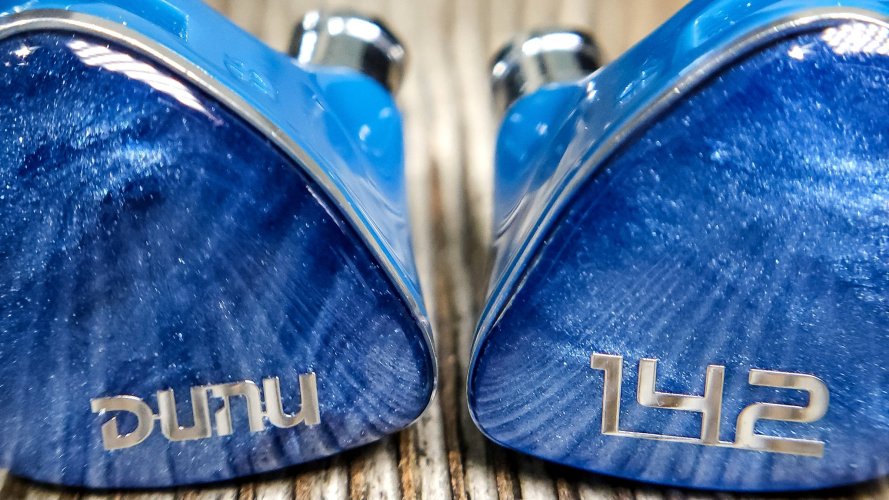
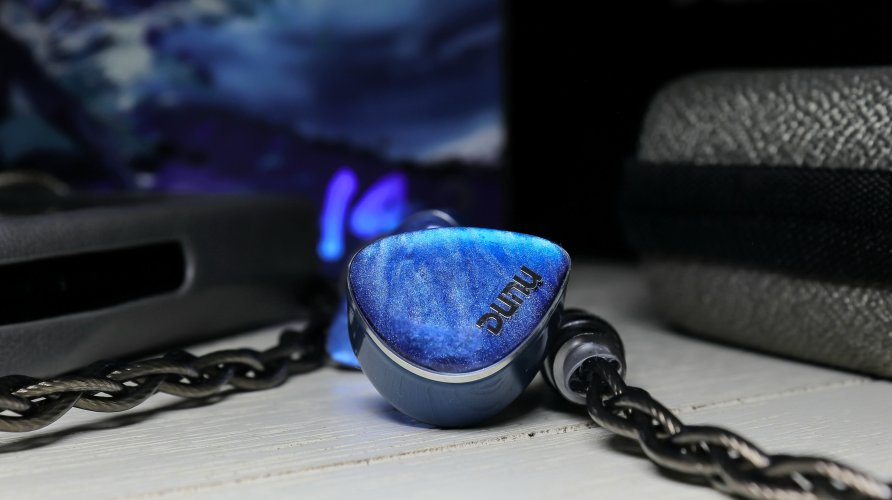
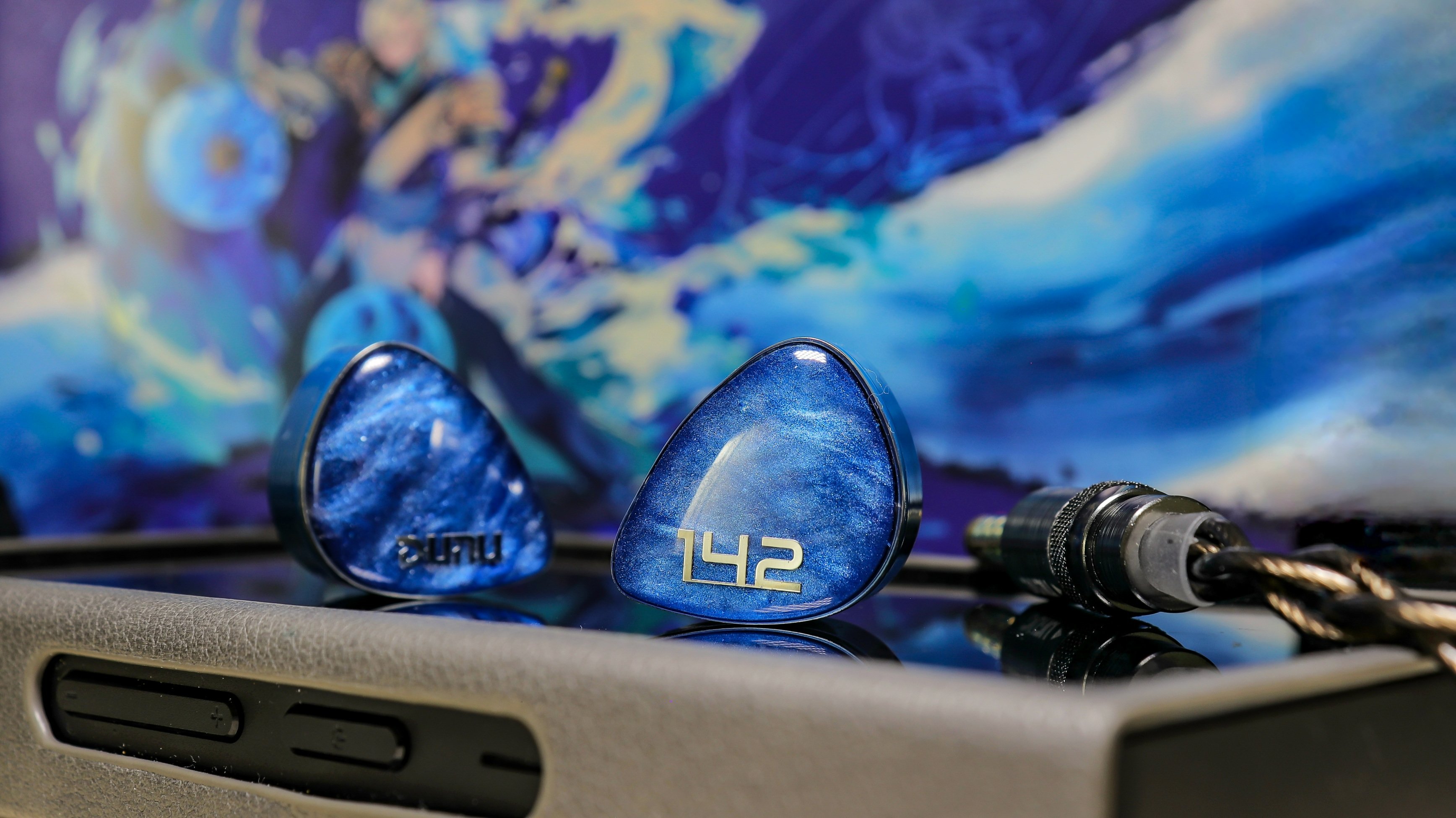
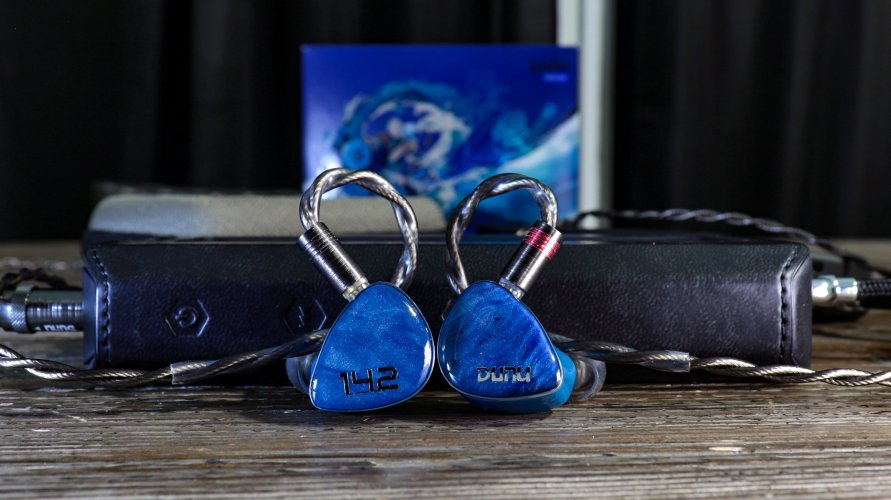
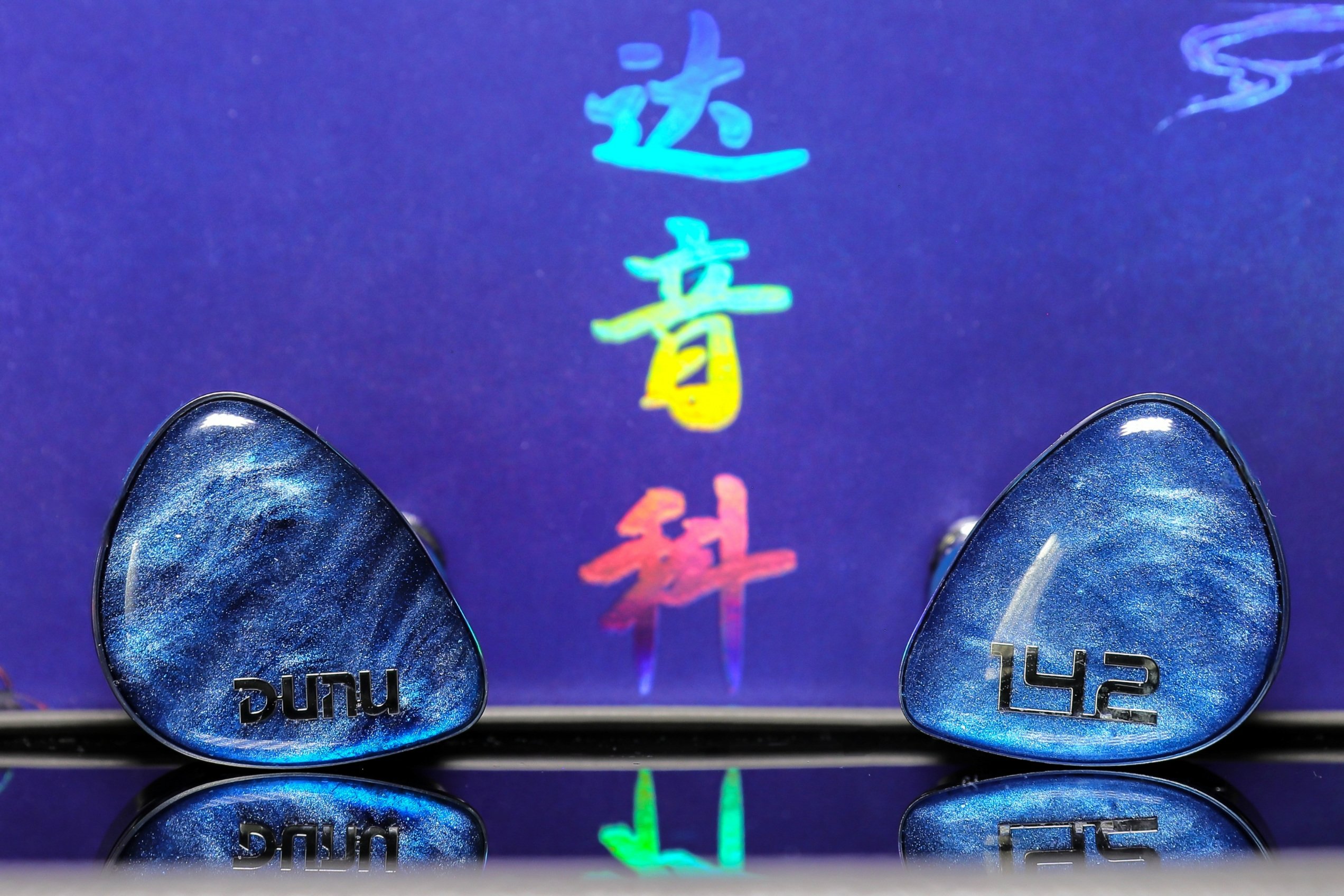
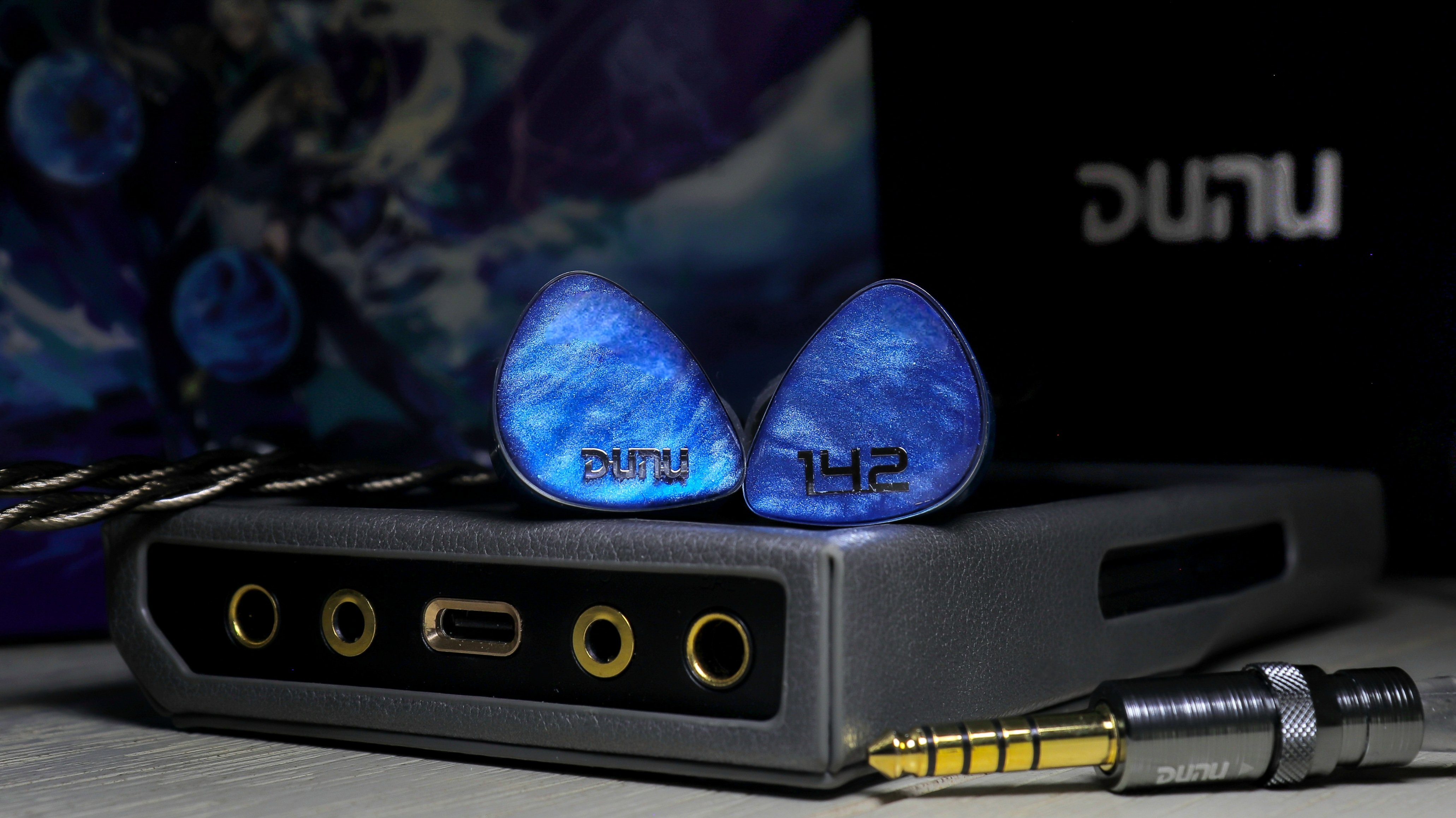
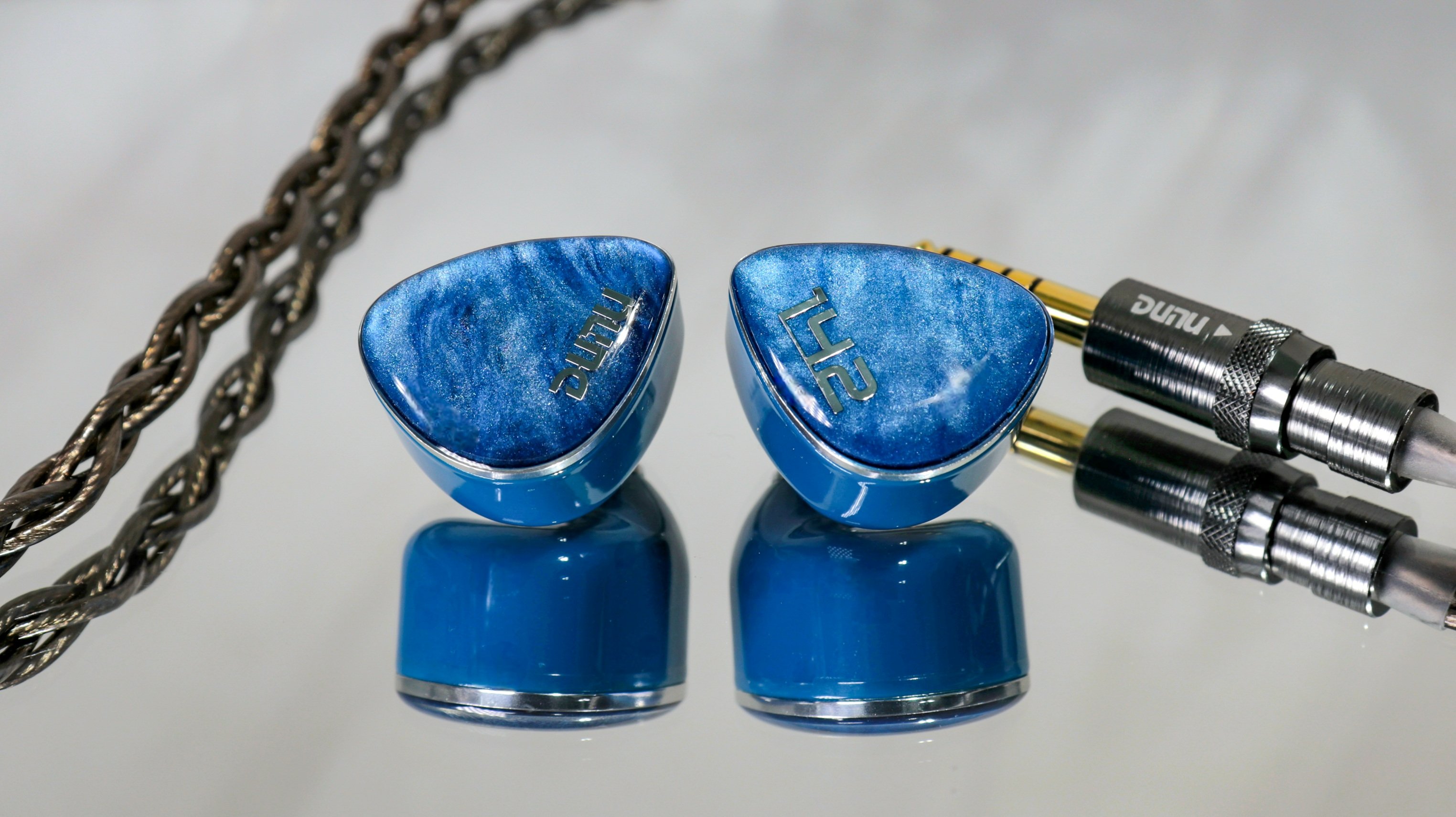
Now, I am very impressed by the aesthetic design language of this set. Made to appear like the waves in the sea so as to align with the character Ao Bing. The Shells are a flat darker opaque blue colorway while the faceplates feature this super cool wavy light blue gradients along with these embedded sparkles. You’ll also notice a very classy looking gold border which surrounds the faceplates adding the perfect contrasting color. On the faceplates you’ll see “Dunu” on one and “DN142” on another. Everything looks dope. One of the prettiest looking iems I’ve seen, for sure.

Internals
As I said a few times, the Dunu DN142 carries a large number of drivers. That is one dynamic driver, four balanced armature drivers, and two micro planar drivers. To be exact, the dynamic driver is a 10mm driver and I don’t know the actual material it’s made out of. The DD covers both the sublevels and mid-bass. Dunu added in four total balanced armature drivers as well. That is, two balanced armature drivers which cover the low-mids and mid-mids, and two BA’s to handle the upper-mids to lower treble. Lastly, Dunu made the good decision to use two micro-planar drivers for the lower treble through the upper treble. Again, I have no idea what make and module any of these drivers are. Dunu typically doesn’t name drop or hype the driver material. Thankfully. I think we go a bit too strong with driver material in this hobby. Just make it sound good. As far as crossovers, Dunu used a physical and electronic hybrid crossover system to delineate which rivers control what frequency to control signals and protect against phasing issues. Inside of the Shells are independent acoustic pathways via 3D printed wave guides. Pretty cool stuff. There’s more but you get the gist, Dunu did a good job on this one.
Fit / Comfort
As far as fit and comfort, I have absolutely zero issues with the fit. I really don’t feel that any of you will either. The DN142 is a very ergonomic iem which sits perfectly in my ears. It comes with a very slight concha bump and the perfect curvature for my ears. Once I found tips that work for me, I was in business. Add to that the shells only weigh 5.6 grams each, which is super light. Again, I really feel that the DN142 will fit most people very well.

Sensitivity
From Dunu’s DN142 web page I see that they listed it with an impedance of around 37 ohms and a sensitivity of about 107 db/mW. What this means for the consumer is that the Dunu DN142 is a pretty easy set to drive to volume and good dynamics with even weak sources. What do I mean by weak sources you ask? Well, I mean run-of-the-mill old school smartphones. You know, the ones which still had the 3.5 single ended jack. I have a few just for testing purposes and I make darn sure to use them in every review, without fail. I can tell you that the DN142 sounded better than fine with my old Samsung, or with my LG V60. However, I have many small, tiny, 3.5 single ended dongle dacs. The kind with cheap Conexant dac chips with weak amplifiers and the DN142 really did get nice dynamics. Sure, each of those dongle dacs have a slightly different tonal color, but they sounded fun, not so much disciplined, but exciting enough. I could listen and not grow tired of it. Beyond those, I always test with that weak KZ AN01 Bluetooth adapters, as well as my iPad. Full disclosure, I don’t spend hours listening friends. I listen to a few of my critical listening playlist tracks on each. Enough to know what to tell you. However, please don’t think I was done there because the whole time I was yearning to get back to my more powerful sources. I should also add that the DN142 most certainly scales with power and better sources.
Scalability
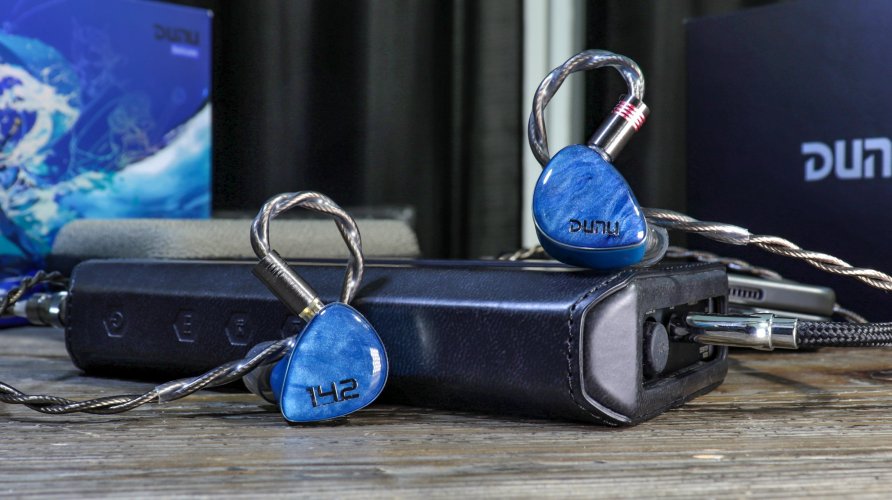
What is “scalability”? Seriously. We reviewers throw around this word so easily. They say that “power” will drastically change certain characteristics of your iems in the way they sound. Well, I think that’s partially true. I really do feel that power helps on 99% of in-ear monitors. That said, I think the biggest leap comes from power and better sources. I mean, better internal components, better implementations of dac chips, better and cleaner amplifiers and a million other internal parts and pieces which seem to cost more the better they are. Nevertheless, I found that the DN142 played tremendously awesome with devices like the Shanling UA7 and its warm timbre using its wonderful tube sound. Or, the Hiby R3 Pro II, the Shanling UA6, the EPZ TP50, Surfans X1 or the BASN PA60 and about 20 other dongle dacs with moderate levels of power. To be honest, as far as power is concerned, I’d try to get (at the very least) a dongle dac with a 4.4 balanced port and at least 150-200mW of max output power. That’s about where the power advantage plateaus with this set. However, it keeps scaling with quality sources as it plays to the source extremely well. I mean, I got my best listening experience with my Shanling M6 Ultra, my Fiio Q15, the iBasso DX240 with Amp8 MK2 installed, as well as a few other better devices. Albeit much more expensive devices. The point is the better source you feed this set with… it’ll reward you for it. I find it scales the most with clean and good power.
Source Pairing
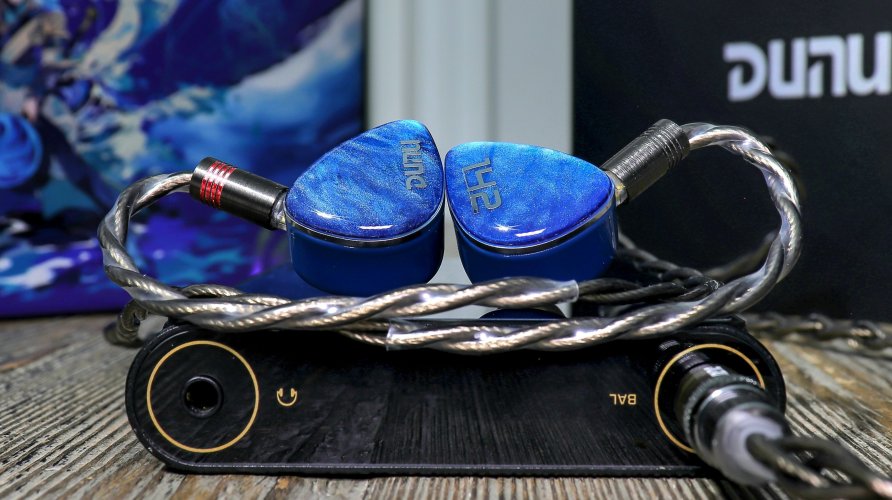
When it comes to source pairing you have to know what you like first. Every reviewer on planet earth is going to tell you what “they” think is the best pairing. Well, I don’t do that, because I’m not you. First know what you enjoy and remember that the DN142 has some heavy but tight bass (not very warmed), as well as some good and vibrant radiance up top. This is a V-shaped set folks. Now, do you enjoy more warmth, or do you enjoy something more pristine and more vibrant? I can tell you that I really like a slightly warmer device with this set. Sometimes. It depends on my mood. Now, I can also tell you that the DN142 sounds great (in my opinion) with any source tonal color ranging from warm/neutral to neutral. I tend to not like colder sources as sibilance tends to creep in as well as some sharpness and a slightly more artificial tinge to my music, I don’t like that. Who knows though, maybe you crave that. No judgment here. We are all different. To my ears the DN142 sounds as close to natural as it can sound with warm/neutral and slightly more organic, smoother sources. This is why I adore my Shanling M6 Ultra with this set. By the way, the M6 Ultra is truly an amazing device. I don’t care what came out after it, Shanling has to really work to match that dap, it’s a legend. But I digress, find out what you enjoy and then remember that the DN142 will change its tonal hues in accordance with the tonal color of your source. Remember that the DN142 does have those slightly brighter hues and so you have to decide whether you want those brighter hues to be exaggerated or subtly attenuated. Either way, the DN142 definitely will play to your source.


*Note: before I deep dive into the sound of this set, I have to make some points first. So, I burned-in the Dunu DN142 for three full days. That was all I could wait. Furthermoew, I can tell you with 100% assurance that this set needs it. I heard some sibilance on a few tracks that I used before burn-in that I did not after three full days of burn-in. Also, I should note that I check (usually) during the burn-in period and it wasn’t till around day two when the sibilance seemed to die down amongst other not so easy to discern changes. I’d burn this one in folks. Next, I used the Dunu S&S eartips for all critical listening and the provided Dunu cable as well. I listen mainly to flac or better files (some MP3) which are stored on my devices and rarely stream music. The Android music player of my choice is mainly UAPP (USB Audio Player Pro), Hiby Music Player (for some of my daps), and also Eddict Player (for a few of my Shanling budget daps).
What’s it sound like?
When I think of the Dunu DN142, I think of raw energy in a refined form. I feel that it strikes that nice balance of smoothly rendered cadence with crispy defined edges. I hear a rhythmically alive presentation that’s cohesive throughout, technically astute, transient tight, and vibrant where it counts. There’s nothing sterile here folks. You have just enough sublevel warmth and enough of a musical heart to this set, so the DN142 never comes across overly analytical or clinical. This set is a poster child for smooth/crisp balance under $300 without either attribute extinguishing each other as they seem to coexist remarkably well. Perhaps it’s the three-week honeymoon that I’ve been on, or I just liked things that are well tuned, but the DN142 is this effervescent, visceral, and totally melodic creation that I find to be an easy rec. Yes, I said that already. Is it perfect? Absolutely not. This set will be one which may get judged harshly by some yet adored by others. More so the latter for sure. The DN142 has a little bit of everything, mastering nothing except its special brand of sound and performing admirably in almost every metric for a set costing $249 US. It’s fun, it’s fluid, it’s fine-lined, but it’s also smooth. Energized with this physical cleanliness that never feels oversaturated anywhere. Frequency wide there’s an unmistakable dynamic balance that cohesively plays together as equal parts of a whole, as the bass, the mids, and the treble all do their part as a team without one sole focus burdening the mix. It’ll make you move your feet as easily as it’ll capture the sentiment of an emotionally charged track. Again, it isn’t perfect, but that’s to be expected. It is very good for the price though.
Timbre & Tonality

The sound of the DN142 is grounded, prioritizing presence across the mix without forcing any one area. Timbre leans natural, yet not perfectly organic, and not earthy either. This isn’t a sound which uses warmth to create realism. Note weight is not super rich, perhaps “semi-rich” as you don’t have those weighted midrange male vocals and instrumentation and there are certainly some moments of subtle dryness. While the sound isn’t overly warm in coloration, it is most certainly influenced rhythmically by the lifted sublevel response and lifted upper treble forming a slightly V-shaped sound. However, the midrange is not your typical “V-shaped” recessed and pushed to the rear midrange. So, not quite V-shaped, not W-shaped, and certainly not L-shaped. Perhaps a slight U-shaped sound is what best describes this set. I say that because the mids tend to have decent presence as they aren’t buried under a veil of bass or recessed. Again, not overly colored, just a smidgen. Furthermore, the treble doesn’t add any profuse and bright taking prominence over the mids. Tonally, I would call the DN142 neutral with a sub-bass lift. The sublevels tend to elevate the low-end providing foundational authority while the midrange stays semi-forward and very clean and the treble adds that gentle sparkle producing a sense of air without sounding offensive. Add all of that up and what you have is a smoother character that’s also well defined. Bassy enough for Hip-hop, smooth enough for Jazz, pronounced enough for nice vocals, yet also transients are swift enough for more complex genres and tracks. Again, great dynamic balance, very diverse in what it can play, it’s clean-lined, fine-lined, and totally tuneful. It’s a dope set.
Smooth & Crisp
I’ve already touched on this but the Dunu DN142 is one of those sets that comes across as a great mix of smooth and crisp, musical and analytical, rhythmical and technical. One of those sets which can replay with a melodic and emotionally gratifying way whilst also separating instruments, sounding airy, and illuminating all of the details too. In my opinion, I’d most certainly say that the DN142 has an “all-rounder” style tuning. Sure, it may be better for some than others and I’ll cover that at the closing of this review, but I haven’t heard anything sound outright “bad” on this set. If I were to offer a musical/analytical split, I’d say the Dunu DN142 is around 55/45 for me. The impressive thing that I enjoy is how fun this set can be while offering exceptional clarity. No doubt due (in part) to the earlier mid-bass roll off coupled with the boosted upper treble making the sound come across nicely crisp, good edge detail, and very-very well textured across the board. However, the DN142 also has a very smoothly rendered cadence helping those hotter moments not sound quite as knife-edged or sharp. So it’s a very nice performer for the cost and really does give the listener a high sound value if they can get with the tuning. I’ve personally really enjoyed this set.

Thank you to Tone Deaf Monk for the graph!

In my opinion the bass region of the Dunu DN142 is one predicated on engagement, physicality, and precision. Well, as precise as a 12 dB bass shelf can sound anyways. The bass is tight, nothing lagging, nothing even remotely muddy, oversaturated, or slow. Folks, the bass on the DN142 is tastefully emphasized. Big enough to sound authoritative and bullish yet without sacrificing control. I hear nothing that sounds plasticky, as the timbre done low doesn"t have that woody feel and so it comes across reasonably correct. Bass guitar, kick drums, toms, and even synth subs sound full-bodied but also very well textured. This isn’t a softly cladded low-end folks. The DN142 has those clean-lined and clear note outlines which never sound pillowy, or plush. That harder edged note attack with a surface texture that sounds more like clearly defined wood knocks rarher than a hammer wrapped in cotton. Sorry, these descriptors make sense in my head. Lol. Dunu did a very fine job.
Speed & Cleanliness
However, I think the greatest asset of this bass is its note definition down low. I find that the way Dunu tuned the DN142 giving it a bigger sublevel lift with the early mid-bass drop-off really helps the transient speed, structured note contours, while never really clogging the blank space between notes. Of course, the mid-bass slam and fullness may be a hair shy of bass-boi authoritative, but the sub-bass more than makes up for that with its guttural depth, and palpable physicality. I love a strong showing down low, a bigger bass, a fun bass, and a bass which has the ability to rumble deeply and boom with some aggression. Yet even more I love that bigger emphasis in a condensed, compacted, and more rigid form, like the DN142. Decay isn’t stretched out either as the DN142 doesn’t have a widely rendered or bulbous note body. It’s concise, fast on attack, natural on decay, and leaves room for other areas to shine through. Basically, you get a sense of weight but with a clean and agile release. It’s a bass which can easily sound more distinct and precise rather than melting into mush. Individual hits sound clean enough that quicker basslines, bass guitars, any drums, low piano keys all sound contoured. Even in complicated bass passages the DN142 performs very well. Now, there are drawbacks to this type of tuning, which I’ll explain later, but for the most part the DN142 does an excellent job of balancing boom and body without the type of lingering atmospheric decay which casts its warm and gooey veil frequency wide. Also, there’s nothing “polite” about this low-end, which is nice when I want to hear something that really satisfies.
Sub-Bass

If ever there was a region where the Dunu DN142 raises its fist and plants its flag… it’s the sublevels. Most certainly the DN142’s low-end is a sub-forward style, deeply extended, and with very clearly carved octaves in the deepest depths from this single bass DD. Looking at the graph you can see that the DN142’s bass recedes and begins to flatten close to 175-200hz and so it really doesn’t have a bulbous mid-bass "ballooning" or "swelling" the resonances in the region. Again, a fairly concise, rigid, and pretty well defined note body for a lifted sub-bass region. To my ears the sub-bass has this guttural and rumbly undercurrent which shows up when called upon without causing congestion, sounding bloated, and for all of its emphasis its resolution doesn’t sound reduced. Furthermore, the soundstage doesn’t feel collapsed, or closed in. Another solid quality is the haptic recognition I get from every sublevel note. That vibratory and tactile feel that a good and fun sub-bass can evoke. Truly a well-done region for anyone seeking out that physical sound and palpable “feel” in the deepest depths of their music. I have so many tracks to call on for this. However, one which comes to mind is “All of it All” by Lukas Graham. The DN142 has that dark vibrant push on every bass guitar note. Every pluck is heard, clear, clean. I feel the weight of the bass while it comes across nuanced and clean-lined rather than smoothened, blunted, or too rounded. It’s actually awesome. Another very satisfying track is “Oil” by the Gorillaz. It has this copiously convex and full-bodied synth-processed bass guitar that sounds big and precise without smearing or masking the rest of the mix. The sub-bass is very nice.
Mid-Bass
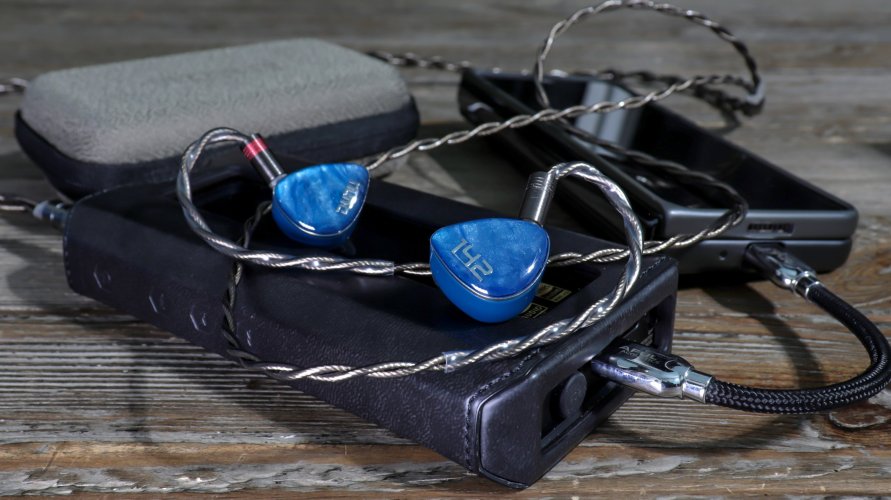
This brings us to the mid-bass, which is certainly less forward, less pronounced and less prominent in the mix than the sub-bass. To me, the mid-bass sounds as though it was tuned more for punch, definition, and nimble dexterity more-so than sheer quantity. Obviously, this tuning style promotes a cleaner midrange helping males to have better clarity, albeit… slightly thinner note body as well. I’ll cover that in a moment. However, I still get a solid impact on kicks, a nice “knock” on drum hits, and defined snap on attack, while that special grip and pluck is retained on stuff like bass guitars. I’d also say that the mid-bass in general has great grip. This is a fast, stop-and-go style, stop-on-a-dime, quick acceleration type of mid-bass with an impactful enough boom to represent most any genre or instrument adequately. Certainly not an overtly atmospheric, laggy, bulbous, or basshead-booming style. You don’t get that warm mid-bass here. You don’t really get that earthy warmth, or the swelled mid-bass slam either. Sure, some tracks may go against what I am saying, but generally things stay pretty tight on the DN142. Big enough to really erupt when a track calls for it but not nearly emphasized enough to produce frequency-wide warmth. If that makes sense. Basically, the mid-bass stays in its lane. The upside is solid definition, good separation, and better clarity than you may think. I’d say the only real issue may be for those hobbyists who simply want more bass lift. Still, in my opinion the mid-bass certainly isn't weak, isn't pillowy (in the slightest), and the mid-bass can sound very full-bodied. Maybe some drums won’t come through quite as chesty with a slightly less profuse “thud”. However, somehow it works wonderfully paired with that mean and juddering sub-bass producing a clean low-end which doesn’t muck up the clarity on this set.
Downsides to the Bass Region
This style of tuning which features the emphasized sub-bass to the much less emphasized mid-bass is somewhat of a turn-off to many listeners. Of course, many are okay with it, but the mid-bass can sometimes lack that chesty-kick and boom that some may want in their music. Not everyone wants such a tightly wound and concise density in their bass. Certainly, the bass region is skewed towards rumble over slam. I still find bass guitars, kick drums etc. to have plenty of muscle, but this may be a turn-off. Also, the bass as a whole may be simply too obese for some folks who’d much rather have a lean and clean bass predicated on preserving every last nuance and bass articulation whilst never coming even close to clouding or masking. There will be some folks who declare that the DN142’s bass region is too fatiguing for them. It’ll happen. I also need to add that while the bass isn’t “planar” fast or dry, it is quick. Now, that quickness almost creates a less natural sound down low. Almost as though there’s not enough atmosphere and resonant decay. Some acoustic stuff really sounds better with a slightly longer and more natural sustain. That’s just my opinion though. Of course, you can’t please everyone. When it comes down to it, I find the bass on the Dunu DN142 to be extremely satisfying. No, it isn’t perfect. I could use a few more mid-bass db’s, or a slightly less rolled-off version of this bass, but it’s very good, very well resolved, and it also kicks very hard, dense, and in a very physical manner on the right track.

Okay, so the midrange to me is one which comes down to vocal preference, preferred sound coloration, and if you like things clean and clear, or rich and organic. To my ears, the midrange comes across as almost crystal clear. This is not a very warm range. Still with good note density, natural texture, and note body, but simply not warm and organic. I’d say closer to cool/neutral with a penchant for propping up clarity and precision. Certainly, leaning dry, at times anyways. No doubt the DN142’s midrange has plenty of hidden musicality and harmonious qualities and has the capability to sound downright tuneful on many tracks and genres. But it won’t be that fully musically rendered, lush, and creamy midrange with overly moistened vocals that sounds smooth everywhere. Is it my favorite? No, it isn’t. Has brain burn helped me to enjoy this midrange? Absolutely. I’ve heard so many sets tuned similarly, but the DN142 seems to put it all together a bit better. There’s a natural cohesion which feathers in transitions very-very well, helping the overall presentation to sound great to my ears. With some caveats. The DN142 excels in texture, especially delicate textures like breathy vocals, the sparkle of string harmonics, precise attack without too much edge to them. Also, while the midrange note body isn’t what I’d call thick, there’s enough natural density to carry an emotionally charged track without sounding dry and frail. Definitely a great mix of musicality and clinical nuance. There is a lot to like about what Dunu created in this set, and the midrange plays a big role in that, if you dig this type of presentation.
Midrange cont…
The midrange on the Dunu DN142 shows off those tighter transients with a snappier attack, crispened, vibrant, and possibly a hair too pronounced towards the upper areas of the midrange. I find the pinna gain to be just fine, but I’m not you (I’ll cover that later). Anyways, I hear very nice detail retrieval illuminated from the airy sound, the radiant atmosphere, the clean-lined note delivery, and those slightly more rapid transients that I was talking about. Due to that clarity and resolution, I find it easy to say that the DN142 has a well articulate and transparent sound. Having said all of that, I also don’t find the midrange to come across abrasive or coarse. This was a big deal to me as that’s almost a deal breaker. However, there are some smoother inflections, some definite rhythmic qualities and a non-knife-edged cadence to the flow of this set which helps it to all come together well, as I said before. I also hear plenty of semi-crisp bite helping to define certain instruments. Fundamentals of a cymbal strike sound fairly sculpted, non-splashy, and snares have that tacky snap when hit. Very nice to hear. Strings have the right amount of natural edge and woodiness as I hear the textured pluck. Sure, baritones may sound a hair less full, velvety, and sonorous, but they sure sound lucid, rigid, and you can feel their guttural resonance. So, there’s a lot of good, and some subjective things which may not seem as good to some.
Lower-Midrange

The low-mids are not the type which sound beefy with that warmth infused robustness. Again, the bass tends to roll-off before that which is great for clarity and overall transparency but won’t sound quite as velvet as some would like. Having said that, the biggest win in this region is the clarity, with a very clean separation from the bass. Male vocalists never sound clouded, veiled or overly smoothened. Always crisp, pointed, but not abrasive, with great side to side separation for voices and instruments, as well as easy to hear texture to most any male singer. Usually the lower-mids will be the less aggressive and less coherent range and are always subject to being recessed or pushed back. Well, on the DN142 the low-mids actually sound nicely present, never polite, and with enough concentrated solidity to sound bodied. Basically, the low-mids didn’t need the warmth of a bass region to sound substantial. Having said that, the low-mids are slightly less forward than the upper-mids. Now, while timbre isn’t perfectly organic, I do find that males like Dermot Kennedy in the track “Rome” sounds very authentic as this set flows easily with an edgy and dense voice like his. So natural timbre comes and goes by the track. Another is Chris Stapleton in the track “Broken Halos”. Wow, does he sound good. Especially with the Shanling M6 Ultra as the vehicle behind the DN142. Chris’s voice has that southern rasp with his ever-charming vocal masterclass that he puts on with any track. The DN142 does his voice justice. Males in the higher registers especially sound great. Voices like Chris Cornell for instance really thrive with the additional upper mid energy.
Upper-Midrange
The upper mids are decently well controlled. It is not easy to tune a set that’s this lively and this forward in the range without also sounding glaring. Dunu managed to do just that as the upper-mid presentation is the most forward and vibrant portion of the DN142’s midrange. To my ears, the upper-mids are more intimate, more engaging, with just enough forward vivacity to add some glitter and some sparkle to a track without tipping over into aggression. Note weight is a hair thinner and slightly dryer than the rest of the midrange without losing that natural feel to the region. There is a vibrant authenticity to the sound which can be very charming. However, Dunu has been at this game for a long time, and they cut off that vivacity just prior to the point that it becomes glaring, for me. Most upper mid notes have an uncanny knack for cutting through those bigger sublevel mixes relatively easily. Which is especially helpful for female vocalists to shine through well enough. A cleanly displayed, multi-layered presentation, highly detailed, with a timbre which comes across semi-natural but crisp. No egregious sharpness, nothing at all metallic, nothing nasally and the cohesion isn’t disjointed. Also, sibilance seems to be held back too. For the most part. Honestly, the clarity in this range provides an almost crystalline canvas without a whole lot of masking from the bass range. So, to recap, the upper midrange has some vibrancy, some upbeat energy, certainly forward, very crisp and well controlled, and doesn’t tip-over the line into radiant sharpness. Also, females sound pretty darn nice…
Females
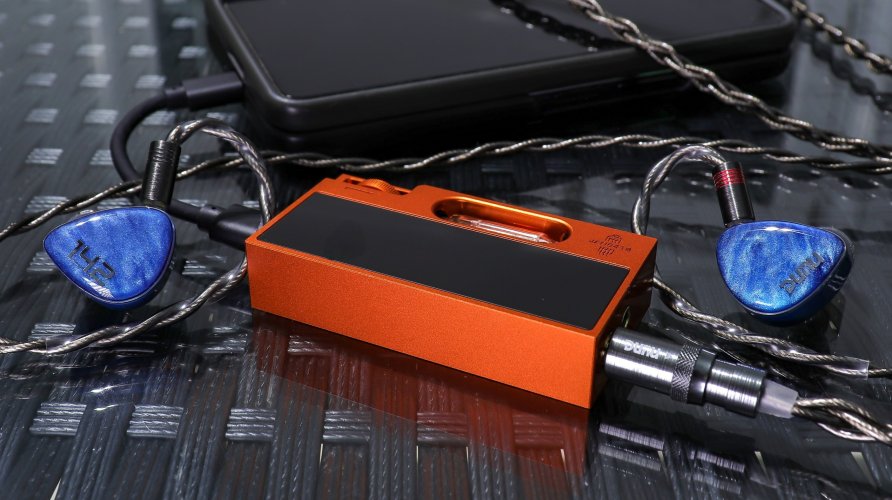
I am a sucker for a beautiful female vocal track, and I love an engaging sound. I would say that the DN142 mostly has just that. Perhaps a hair thinner and less organic than I’d like, but very engaging, very immersive with that intimate presence in female led tracks that I do enjoy. I want to hear those breathy inflections close to the ear, and I want to feel the emotion within a female voice. “Mariana Trench” by Gabrielle Aplin is a track which does just that. Her voice has that forward, softly sweet vibrancy, subtly dry, but intimate. Absolutely lovely. Or “Blameless” by Caitlin Rose, again, beautiful. Every softened inflection within Caitlin’s voice sounds soothing with an embossed presence, forward, inches from the ears, with an airy feel, and totally engrossing. Of course, there are some tracks which may sound a hair too intensive like the more rambunctious moments in “Unstoppable” by Sia. It’s certainly a give and take situation with the DN142. It’s a brighter tilted upper midrange and so you have to be very understanding of that before you plop down the money for this set. However, most females are wonderful to my ears. Just be weary of those brighter tracks. Dunu did a nice job of keeping this tuning in check and this rarely becomes a problem for me, but no set is perfect.
Downsides to the Midrange
I would say that the number one complaint that people will have concerning the Dunu DN142’s midrange will come from those people who more enjoy a natural/warm sound in this region. Like I said, the DN142’s mids carry some brighter hues making it a less warm sounding midrange. I find this set very inviting, just not in that way. If you are someone who enjoys that push, rich, moistened, and effortlessly smooth sound, well, this is not the set for you. I can name you many which fit that mold, but not the DN142. The DN142 midrange actually doesn’t suffer musicality for this tuning choice either, but the mids do sound slightly more dry, less viscous, smooth but also well contoured and very vibrant. Also, the upper midrange pinna gain may be too forward for those sensitive to this region. I feel that Dunu did a decent job of keeping the pinna rise in check with a mostly gradual and feathered-in rise & transition into the lower treble, but it can get at least somewhat vivacious. Though, there’s no doubt that the DN142’s upper midrange may be a hair too forward for some. Again, Dunu brings the midrange sound all together so very well though.

I really like the choice that Dunu went with to produce this non-offensive but sparkly treble. As I said before they used two balanced armature drivers to smoothly render the bulk of the treble, but they also made the smart choice of using two micro-planar drivers for the upper treble, the highest of highs. It’s that upper treble air and sparkle which really defines this region for me while the BA’s do a tremendous job of cohesively blending into the midrange for a smooth and feathered-in sound. The overall timbre of the treble is actually fairly accurate in my opinion. I’d say the treble is closest to “neutral/bright” and very smooth, nothing overtly harsh, nothing forced or forced resolution, no peaky resonances either. Honestly, a great job on Dunu’s part whether you like a slightly brighter treble or not. Now, when it comes to treble bite, edginess, or analytical dry crispness, the DN142 is definitely more towards the musical side. Yes, I said this treble is brighter, but it isn’t clinical. This is a smooth treble. However, that doesn’t mean it is without bite, or even some haptic treble punch. It’s just that these BA’s are much more rendered to glide rather than etch. More wavy than spiky. Sorry for my explanations but that’s just how my mind works. Understand, this is a treble which smoothes, even blunts some peaks rather than celebrates them or sharpening the edges. Enough bite for cymbal attack, maybe some hi-hat snap on attack, or even some zing added to the harmonics of a guitar. But you won’t hear anything too ultra defining. This treble won’t force you to examine every detail or track every subtle but of minutiae within your music. Smooth, clean, transient natural, great clarity, solid resolution… just not ultra dry, ultra clinical, and precise in its edge detail.
Extension
I love the line that Dunu walked in the upper treble where it comes across just rolled-off enough to avoid stuff like the smeared splash from the secondary harmonics of a cymbal strike, or any strong sibilance. However, the upper treble is still very nicely extended to provide some air to the sound, add some luminance for details. Almost as though it’s emphasized enough to sound airy and extended, yet without necessarily drawing attention to that region. If that makes any sense. The micro planars do a fabulous job of creating those widened spatial cues without the nasty sizzle. Again, I love the addition of micron planars because when they are tuned well and implemented well you can clearly see the benefit of them. We are beginning to see many sets of all different ranges using them and there is definitely a pay-off. The Dunu DN142 avoids any of the real hangups which follow an over extended or forced upper treble. I don’t typically hear any sizzling treble tizz brought on by a heightened treble recording and I never had to turn my volume down.
Example

Now, I would say that the treble is generally pretty fast and so you won’t hear a ton of smearing or blending of sounds. I do find the treble is airy enough and clean enough to sound well separated between different instruments and vocals. I wouldn’t call the treble expertly crafted, and I don’t feel that treble heads are going to adore what they are hearing either. This is a treble which plays its role and does so well. But it can keep up with faster passages which focus heavily on the treble. I always use Billy Strings. His music is chock-full of harmonious and fastly played treble activity and perfect for testing. Tracks like “Cabin Song” with its aggressive and fast paced mandolin and banjo rolls along with rapid fire guitar riffs which can only be cleanly displayed by a solid performer. Hence, the reason why I use his music. They’re all rapid fire. Now, the DN142 handles this track well. I wouldn’t say at an expert level. You can see that it isn’t the most analytical of sets up top. But it speedily makes its way around every note just fine. Certainly, a hair smoother, less clean-lined, and perhaps less biting than a more analytically tuned iem, but fantastic for a smoothly rendered tuning. These BA’s and micro planars are fast folks. Transients with this song land fairly precisely, banjo strings have some snap, some realistic metal zing, and there’s enough air and separation brought in by the MP drivers to keep the guitar picking organized and spatially intelligible. If that makes sense, because it does to me.
Example cont…
However, please don’t expect treble head worthy knife-edged separation, and don’t expect super expressive cymbal sparkle and crash. Those picks and harmonics sound very well controlled and clean, just not as fast, razor sharp, or agile. So, very good for the tuning. I think that’s a fair assessment. Also, can I just add that for this set to get that peak performance I’m afraid it would undo everything which makes the DN142 special. Let’s just put it this way; if the treble on this set was treble head worthy… then you probably wouldn’t be reading a review of this set by this guy. It would upend the beauty of the tuning too much and probably sound too disjointed with lack of cohesion for me. Or, at the very least you’d be reading a much different review. I always make way too many notes and I have five other songs that I spotlighted which showcases how melodic and sprightly the DN142’s treble can be. Tracks like “Evil Twin” by Lindsey Stirling which offers incredibly tight and intricate violin work which is reciprocated very well by the DN142 sounding timbre correct, tight transients, but not abrasive or peaky. Another is “Bishop School” by Yusef Lateef which has all sorts of treble activity with its super playful and upbeat flute leads sound articulate, very well textured, and airy. The trumpet has bite as it’s stacked on the sax and trombone nicely. But I like how these treble melodies come through crystal clear against the bass without any sort of mud or smearing.
Downsides to the Treble Region
The DN142 has such a wonderful cohesion of both driver types and frequency ranges. It has expertly tuned crossover work which has blended these seven drivers in such a way that the sound is very melodic without lacking precision and all comes together homogenized and clear. The treble makes up a very important part of that tuning. However, it isn’t perfect for everyone. First off, treble heads aren’t going to be enamored with the DN142 treble. It lacks that ultimate energy and bite with what I’d call “reserved expression”. No ultra-defined sharp transient snap, clean-edged pick attacks, focused treble punch, etc. Sure, it’s these qualities are there, just not so acute and pronounced as a treble head would enjoy. Also, I said that the DN142 has good extension, but it isn’t “great extension” into the air region. You get good space and air, but simply not that super contrasted sounds that something electrostatic could make. Perhaps a MP driver could, but it isn’t that way for the DN142. Still very good though. Enough to be a “Pro” for me. Not treble-boi worthy. Lastly, the imaging up top is good. Like, very good. However, the DN142 doesn’t have that laser focused treble to define the image as well as a more treble focused iem would have. Granted, I have to say again that this would be an entirely different review if any of these qualities changed, but for those who want that treble head style sound… you aren’t going to find that here. For the record, I like what Dunu did on this treble and wouldn’t really change anything. Not everything is for everybody, plain and simple.

Soundstage
To me the soundstage width and height isn’t anything to be blown away by. I find the stage to be airy, open sounding, and cleanly imaged, but not some hall-like or stadium-like experience. The height is airy and nice enough, but not some cathedral venue. Still very nice though. Nothing closed-in at all or congested. What I find to be the real hallmark ability as far as stage size is concerned has more to do with the DN142’s stage depth. The sound field on this set is somewhat intimate, closer to the listener, not pushed back, not an oval in front of me. It surrounds me and there is clearly front to back layering happening. Without question the stage is outclassed by more expensive iems, but very good for $250. I hear a legit 3D bubble (so to speak) which has everything to do with the DN142’s ability to render depth of field. I do hear a reasonably holographic sound as well. The promising thing is that nothing sounds too intimate, closed-in, or congested (as I already said). The DN142 presents a nice sound field folks.
Separation / Imaging
One thing that I noticed right away is how well the Dunu DN142 presents instrument separation. I wouldn’t say it’s top class or anything, but you can hear a distinct enough sound field with partitioned-off elements of the stage fairly easily. Again, the DN142 has tight transients, it’s got great clarity, nice enough air to the sound, and it comes across pretty precisely too. I should also add that generally this set has a pretty black background as well. So, separation is solid. Imaging is just as good with excellent placement of elements of the sound field. Left to right panning is wide enough and clean enough to recognize these elements well. Enough to focus on any single instrument. Vocals are typically dead center of field too. Also, the DN142 layers the sound field very well from front to back with obvious depth, as I spoke of earlier. The only issue that I would bring up is super bass heavy tracks or very poorly recorded tracks (I’m assuming). I’ve heard a few times the bass can mask a bit. Also, while imaging is good, placement is good, and layering is also good, it isn’t top notch razor sharp in its edge definition. So, while that really isn’t an issue, it is an observation.
Detail Retrieval
Detail retrieval is nice. For a musical set the DN142 also has a very clean sound. Add to that, this set has a nice dynamic balance of the frequency too. Again, tighter transients, no lagging and swelled harmonics, nothing muddy, and notes are generally clean-lined. I can pick out details very easily on simple tracks and pretty darn good on complicated tracks. Technical stuff like resolution and micro-dynamics, along with note texture make this set a pretty strong detail retrieval iem. However, the DN142 is strong in detail retrieval for a musical iem, and not crazy analytical or ruthlessly clinical and dry. So don’t expect top tier detail retrieval here. There is a limit to what this set can resolve. Still, very strong for the type of tuning. Nice work Dunu.

Comparisons

Binary Dynaquattro / Dunu DN142 / Dunu x-Koto Ito / Dunu x-Gizaudio DaVinci
Binary Dynaquattro ($233)

The first comparison I have for you today is with the Binary Dynaquattro which I reviewed about a year and a half ago (Dynaquattro Review) and praised it for many of its qualities. This set is a very well-tuned three dynamic driver and one passive radiator multi-driver set and stood out for its quality tuning upon its release. In truth, it still stands out very well. I was and still am enamored with its natural and organic sound. However, how does the DN142 stack up to it and what are some of the differences?
Non-Sound Stuff
To begin, the DN142 costs a hair more at $249. When it comes to unboxing experiences, both iems are of high quality. Both with a nice modular cable, both with solid carrying cases too. However, the DN142 has much better eartips, and its cable is clearly a higher quality. However, that pelican style hard case that comes with the Dynaquattro is better. Both sets have a good unboxing though. Also, both sets are made using HeyGears style resin with the Dynaquattro’s being more matte feeling and the DN142 looking glossier. Coincidentally, both sets also fit nicely, and both are lightweight enough too. No issues there. However, the Dynaquattro is a touch larger in width while the DN142 is a touch deeper. Now, as far as aesthetic, the Dunu DN142 mops the floor with this set. Really. While I like the gears design on the Dynaquattro, it can’t touch the DN142. Simple as that. Both sets offer a nice purchase for their respective costs, and both replay the spectrum very well. That’s next.
Sound Differences
I should start by saying that the Dynaquattro is a very hard set to drive properly. You need a lot of power. At least a good powerful dap. The DN142 is much easier but both sets scale well. The DN142 simply has a wider range to scale with. I find the DN142 is more for fun and musicality whereas the Dynaquattro is more for natural dynamics and cohesion of the spectrum, the Dynaquattro is closer to neutral tonally with a more V-shaped signature whereas the DN142 is closer to U-shaped with a touch more warmth. I think the DN142 is more influenced by its sublevel charm and weight and musicality along with its technically strong showing, while the Dynaquattro seems to be a hair more clean-lined, more organic, with that DD style timbre and naturalness. Both are fantastic. I really mean that.
Between the 20’s
The bass region of the DN142 is closer to a bass-boi style with deeper and more haptic lows, more guttural, while the Dynaquattro is more balanced and textured along with a hair more mid-bass slam. The DN142 has tighter control over its bass, even with its more robust sounding sublevel rumble. The midrange of the DN142 is closer, more intimate, better for female vocalists. However, the Dynaquattro wins on timbre with its natural DD goodness. Both have a well composed midrange, both very clean, but the DN142 has a touch better layering abilities with a bit better depth of field to my ears. Also, the smoothly rendered vocals kind of do it for me a bit more. The treble of the Dynaquattro is more analytically inclined, more precise, sharper details. Though, the DN142 is smoother, easier on the ears with apparently better extension for me. Both sets offer good detail retrieval, neither has overtly bloated or masking bass replays. Both iems separate well, both image the sound field well, though the DN142 seems to layer sounds a hint better. I find the soundstage of both sets is solid with the Dynaquattro being wider and taller but the DN142 offering more 3D depth of field while also sounding more intimate. I happen to enjoy them both but prefer the DN142 a hair more just for its fun sound, and its smoother take on the mix.
Final thoughts on this comparison
You cannot go wrong with either set. I still feel the Dynaquattro is without question one of the best multi-driver sets that $230 can afford you. However, as similar as these two are, they are also fairly different and do complement each other. The Dynaquattro is more for timbral accuracy, and its organic, balanced sound. The DN142 is more for its easier going energy and sublevel fun with better upper treble sparkle. Better at vocals too. I’d go with the DN142.

Dunu x-Koto Ito ($199)

I quite literally just reviewed the x-Koto Ito (Koto Ito Review) a couple weeks ago and praised it for its bombastic and fun sound. The Ito is a four-driver hybrid iem consisting of two dynamic drivers and two balanced armature drivers. It’s also a three-way collaborative effort between HiFiGo, Dunu, and the Japanese YouTube personality (reviewer) Kaji Kaji. Folks, this set was built and made for fun. Right at the cusp of being considered basshead worthy for many and a joy to listen to. Also, it hit the market around the same time as the DN142 making it a solid competitor for this set. Let’s take a look at some differences shall we…
Non-Sound Stuff
Okay, I am going to make this very simple for you. Basically, these sets are identical in unboxing. Same tips, same modular cable, same case, same box style. They are also identical in build, lightweight (5-6 grams each), and both are made of the same HeyGears resin. Literally identical. The difference comes in the aesthetic design language. Now, I couldn’t for the life of me say which I like better as I love the way both of these sets look. I will say that both are unbelievably dope looking with both sets showing off awesome artistic integrity and ability. Dunu is clearly one of the best brands in the business when it comes to design. Of course, the DN142 is $50 more in price, and so I intend to find out if it’s worth the extra change.
Sound Differences
To start, the Ito delivers a warmer, more organic and earthy sound. The DN142 comes across crisper, more balanced, still very fun but cleaner and more dialed-in technically. Between the two, the Ito is fleshier and rhythmically geared. While the DN142 has flashes of that rhythmic ability, but also more precise, airier, and downright better controlled. I think I know where the $50 went. Both sets are very easy to drive and both scales very well. I find the Ito needs a more neutral source to better balance or contrast whereas the DN142 needs more of a warm/neutral style source to do so. Both are absolutely awesome. I love both of these iems.
Between the 20’s
Between the 20’s I’ll start with the bass where the Ito clearly has the more pronounced and brutally authoritative bass. Much closer to basshead. While both have deep and haptic sub-bass, the Ito’s mid-bass boom and slam is much bigger and more forceful than the DN142’s bass. The DN142 offers a tighter, better defined, better separated, and altogether a higher quality bass where technicals are concerned. The mids on the Ito are warmer, more organic, more earthy (as I said), with a smoother take on my music. I like the DN142’s cleaner and better clarity for more complicated tracks, better detail retrieval, macro-dynamics, and micro-dynamics, along with tighter transients. However, vocals are creamer on the Ito and a touch more intimate while vocal presence is better on the DN142. Of course, the bigger bass of the Ito contrasts its treble better leaving a less fatiguing sound, while the DN142 can be a hair more vibrant and dare I say… “shouty” for sensitive listeners (I still don’t find this set shouty). The treble of the DN142 is crisper, more bite, better extended, more luminant, with a sparkler sound. Let’s be clear, the treble of the DN142 is better for those who appreciate a higher quality treble. The Ito is less offensive, less dynamic, but easier on the ears too. Also, it has a smoother treble across the board. It really comes down to preference. The DN142 is better technically across the board. Name a technical attribute and the DN142 wins-out. Bigger, wider stage, better depth of field, better detail retrieval, cleaner layering, more distinct note outlines, and simply more clean-lined throughout.
Final thoughts on this comparison
Friends, please hear me, this comparison is the definition of a “preference battle”. That’s a name that I coined while doing comparisons so feel free to use it or change it. At any rate, this is a preference battle in the way that you’ll know right away which style you’ll prefer as they are so contrasting. Oddly enough, as different as the two are, they also have a lot of similarities too. Still, a preference battle all the way. I mean, do you want something bassier, smoother, warmer, more organic, richer, and less fatiguing? Or do you want something fun, but also cleaner, more balanced, better technically with a higher quality sound that offers better control of the spectrum. Both sets provide two different looks at my music, and both occupy a space in my large carrying case of my favorite sets. My “rotation” of sets. Having said all of this, I do feel that the $50 price difference is legit. Three more drivers which clearly make for a more fine-lined sound and better technical ability with a tuning which is far closer to an “all-rounder” status. I love ‘em both.

Thanks again to Tone Deaf Monk for the graph!
Dunu X-Gizaudio DaVinci ($295)

What a sweet iem folks. I have loved this set since its genesis as it hit my tonal palette perfectly. I reviewed the DaVinci (DaVinci Review) in June of 2024 and it has had a place in my rotation since. Yes, that’s #3 Dunu sets which sit comfortably in my big “rotation” carrying case. Anyways, the DaVinci is a six-driver hybrid iem which houses two dynamic drivers and four balanced armature drivers. The DaVinci is also a collaborative effort between Dunu and Gizaudio (a popular YouTube channel). The DaVinci is also one of the first “Meta Tuned” iems which graced the market. Meta or not, this set sounds very-very good. However, there are most certainly ways that the DN142 outduels it. That said, does the DN142 make sense coming in at roughly $50 less than the DaVinci? Let’s see.
Non-Sound Stuff
So, once again we have two sets which have almost identical unboxing experiences. Indentical eartips, identical carrying case, and both sets offer a dope modular cable featuring Dunu’s proprietary Q-Lock system. Also, once again, both sets are built identical. Identical size, resin, and overall shape. Both are large and both house a bunch of drivers. As far as design I am smitten with both sets. Have you seen the DaVinci though? My word is that set slick looking! I think they are both crafted with very experienced and creative people to look downright awesome, but I do prefer the DaVinci a hair more.
Sound Differences
This is a tale of two tuning philosophies, in my eyes, er… ears. The DaVinci is all about tonally balanced warmth and luscious bass, richness, with smoothness everywhere. Now, the DN142 on the other hand is all about U-shaped immersivity and engagement with a focused sub rumble and MP crispness and air. The DaVinci is clearly warmer to the DN142’s more neutral take on sound coloration. The DN142 offers thinner notes across the board but also comes across more technically proficient too. Once again, just like the Ito, the DaVinci simply doesn’t have quite a cleanly layered and precise style sound. That said, the DaVinci is about as refined as $300 will get you. So, there is a definite difference there. Anyways, both sets have their own sound, very different, both occupy a different space tonally, and I’d also call this a preference battle as well as a price to performance battle. Both iems are relatively easy to drive properly and both are very musically inclined.
Between the 20’s
Between the two, the DaVinci has the more full-bodied and visceral authority to its bass delivery. The DN142 has that more concise sub-bass rumble with a cleaner punch, better defined. However, that’s only because the DaVinci has much more body to its mid-bass, bleeds further, and does have deeper extension into the subs with less contrasting treble energy. It just sounds bigger but the DN142 sounds cleaner. The midrange of the DaVinci is all about organic warmth, rich notes, creamy at every inflection, and better warm tonal balance with closer to natural timbre. While the DN142 has the more contrasted tonal balance, bigger macro-dynamics, more distinct micro-dynamics, better detailed, yet also shoutier too. The DaVinci is more intimate, fantastic for vocalists both male and female. The DN142 has more vibrance, bite and crispness. Next, the treble of the DN142 is more energetic, crisp, with better extension into the upper treble with better acute resolution. The DaVinci is easier on the ears, smoother, but still somehow very clean itself with very good detail retrieval. I should note that even with the DaVinci’s thick and rich sound, it is still pretty clean in the process. Technically speaking the DN142 does seem to have better note separation, more distinct separation, easier to identify details (by a hair), and more of a focused ability to hear layers to the sound. Though, the DaVinci wins-out when it comes to stage. Bigger in width, more chasmic, better height, and both have good depth. Both layer very well though (like I said) the DN142 simply comes through cleaner.
Final thoughts on this comparison
Once again, I decided to pit two sets that I really do enjoy a lot against each other. Also again, both sets also have a different style tuning and sit in my rotation for different reasons. It’s difficult to say if the DaVinci is worth the $50 premium to purchase, but that set really is very refined with its warmness, richness, and awesome organic and earthy timbre whilst still having very nice detail retrieval and such a grand stage. However, for $50 less you can have a fun and musical sound with better technicals and a sound which is cleaner overall. Two different styles, both are great.

Tone Deaf Monk, thanks for the graph man!

The last month or so I’ve had a couple really great Dunu review periods after reviewing the x-Koto Ito and then the DN142. I am very impressed with this brand’s ability to offer the market different quality looks at tuning. Distinct styles. The DN142 is a set which really does capture that “all-rounder” moniker and fits that description rather well. Sure, some genres are better than others, but that is for the end of this review. The point is that the DN142 is truly a perfect set for anyone who wants to hear a quality tribrid iem which sits atop its price range as one of the better sets that $250 can get you. I really do believe that. I don’t feel it is head and shoulders above any of the top sets, but I also don’t feel that any one set is head and shoulders above it. At least as far as an all-rounder style tuning is concerned. I feel that this is an easy rec, and I feel that $250 is a great price for what you are getting as it compares positively/favorably with just about any iem which comes to mind between $200 and $300 US. Having said that, there are a mountain of quality sets, and I don’t think the DN142 offers some landslide victory or anything. It still takes you doing your homework and knowing what type of signature that you feel you enjoy most. Still, easy rec and $250 worthy.
The Why…
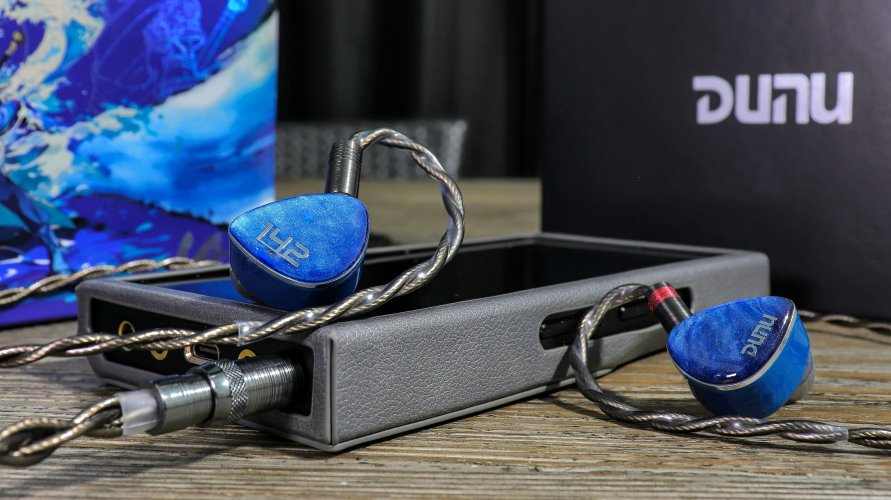
Because the unboxing experience is just like any Dunu iem… it’s very good. Everything that you get is quality, feels and looks premium, and everything is actually useful that Dunu adds to the whole unboxing experience. They really did a nice job. The DN142 is slightly larger than your average set, but it’s lightweight (5-6 grams) with a very ergonomically friendly build. Basically, I feel that they’ll fit most ears well. Also, look at this set folks! Look at its faceplate in these pictures. The design is absolutely SICK! That blue is engrossing, so handsome, and very unique too. Looks great in the ear. The DN142 isn’t difficult to drive and sounds perfectly good off of weaker sources. However, it’ll also scale to your source power and cleanliness very well. Furthermore, the DN142 sounds good with a very wide tonal range for sources too. Which brings me to “that sound”.
That Sound
The hallmark best quality of the DN142 and the reason why anyone would plop down $250 to purchase it is without a doubt the sound it offers. I love that deep, pointed and rumbly sub-bass which never seems to clog lanes, never veils either. It’s simply fun. The mid-bass offers just enough slam to sound gratifying while not bleeding into the midrange and corrupting its clarity. The midrange is energetic, vibrant, neutral-ish, and it has great cleanliness and resolution. Note separation is clear and defined, great layering abilities, nice imaging, and detail retrieval within the range is good with solid spatial cues. The treble is sparkly, well extended, it’s smooth, but it also has good note contour and definition. Technically the DN142 is very solid across the board with nice detail retrieval and great dimensionality to its sound field with wonderful depth of field. Really folks, you can’t lose with this set unless you enjoy a drastically different signature. Again, an easy recommendation from this guy. I like this set a lot, nice work Dunu!


When it comes to modern tunings which lean fun and musically impressive, the Dunu DN142 most certainly could be labeled an “all-rounder” type of iem. Granted, some genres are better than others, but no genre truly sounds bad on this set. Let’s just get that out of the way. The tuning is one which seems to fit well with most genres in my opinion. Again, a solid set to test the hybrid/tribrid waters under $300. Below I’m not going to go through every genre on planet earth. I’m rather going to give you a snapshot of my thoughts on which work well, and which genres are less perfect.
Genres which work well
I feel that all Rock genres work out nicely with the DN142. That is; Alternative, Hard Rock, and Classic Rock too. I find the sub-bass doesn’t muddy the waters, and guitars and vocals pierce through very well. Also, Metal works very well too. Very satisfying. I find that any EDM or Electronic style genre sounds wonderful with those hard synth bass drops. The clean deep rumbly bass of the DN142 shines like a star. Also, those high synth notes come across sparkly and non-fatiguing too. Any genre which is female lead and Vocal forward. Pop music sounds nice too. Also, most definitely Hip-Hop, R&B, and Hard Rap tracks work like a charm. I like Folk music on this set, Blue Grass stuff is good, and I generally love Country music with the DN142. If you ask me, the Dunu DN142 works well with close to 80-85% of popular music and old school stuff too. It simply has that versatile tuning which is needed to cover a wide range of genres.
What genres aren’t perfect
Again, I’m not saying these genres “don’t” work well, but in my opinion they aren’t perfect. However, it isn’t really “genres” that won’t work perfectly, it’s really certain types of tracks within some genres. For example, I could say that neutral purists aren’t going to dig the lifted sub-bass. However, there are full genres which may not be perfectly ideal. Genres like Jazz. Especially Jazz with male leads as the subtle recession and less authoritative feel don’t bode well. It just lacks the warmth that I enjoy for a good Jazz track. Still sounds good here and there. Another genre which doesn’t sound quite as great is with Classical or Orchestral music. I only say that because the DN142 misses just a bit of note body for me to be perfectly suited. Also, the DN142 doesn’t have quite the stage width and height to be “perfect” for a typical Orchestral production. Having said that, I barely agree with myself on that. Lol. Next, super dense technically complicated metal tracks. Again, not really a genre, but a type within the genre. The DN142 doesn’t perfectly separate fast multi-layered and intricate passages of multi-guitar moments with the scalpel that they deserve. Still pretty darn good. I’m really being picky now folks. Actually, I could go further and more precise with my comments but I’m going to stop there. I think I gave you at least a snapshot of what may or may not work. Of course, you have different ears, different preferences too and you may totally disagree. Which is fine, and guess what… neither of us is wrong.

To conclude my full review and feature of the Dunu DN142, I first have to thank the people over at HiFiGo for providing this set. Friends, HiFiGo is such an easy partner on these reviews. They have never, not one time, ever, asked me to speak a certain way or pushed me to review anything. They don’t give me time limits either, which is wonderful and advantageous for everyone. Message me and I’ll explain why. Anyways, they have always been very good to me and our awesome website, mobileaudiophile.com (MBA). Thank you. Also, thank you to everyone who decided to click the link which got them here today. Thank you very much. You are the reason that we do what we do and the reason that we are even around. Thank you very much.
Other Perspectives
Now that I’ve thanked you for checking out my review, I also hope that you’d check some other reviewers’ thoughts about the DN142. There are so many good reviewers out there folks. Just solid people who really do a good job breaking down these products. Many of them are my friends, and many of them have fantastic takes personal only to them which may help you better understand the DN142. I hope you’ll listen to, watch, or read other reviews and perspectives so that you can gain an even better understanding of what you are getting with the Dunu DN142. Folks, we are all very much different. The guy sitting right next to me may have a completely different opinion than I do. I think you know that I really like the DN142, but the next guy may not. He may hate this set, who knows. Or maybe he loves it too. The point is, it’s just more info to help you make an informed purchasing decision. I am not the last word on audio, and I do have my own subjective likes and dislikes, so does the next guy. So please click on some more links. Okay, with that all said I think I’ve covered it all. Please take good care, each and every one of you. Stay as safe as possible and always… God Bless
More hifi audio gears at KEEPHIFI