Pros:Very tastefully coloured tuning Midrange focus, but well extended Great timbre Treble is smooth but detailed Ergonomics are excellent (for me) Tiny 3.5mm plug housing is great size for portability
Cons:Cable is relatively thin compared to competition Accessories severely lacking for the price Simple aesthetic design not competitive
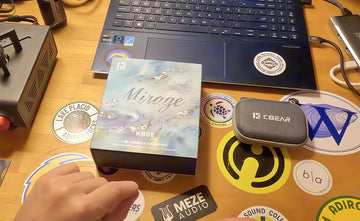
Introduction & Disclaimer Many thanks to KEEPHIFI for sending me a sample of KBEAR’s flagship model for reviewing. The KB16 ‘Cepheus’ is KBEAR’s most expensive IEM to date, featuring 2 dynamic drivers in an isobaric configuration and 6BA drivers, for a total of 8 drivers per side. It retails for just under $250 and is available in both blue, or violet. More info can be foundhere(non-affiliate link)
For the couch potatoes:
Build, Design & Ergonomics Everything about the KB16 reminds me of my favourite IEM, the Kiwi Ears Orchestra Lite. The main differences are: - The KB16 is more expensive - The KB16 has 2 dynamic drivers for bass, instead of balanced armatures - The KB16 is vented while the Orchestra Lite is ventless
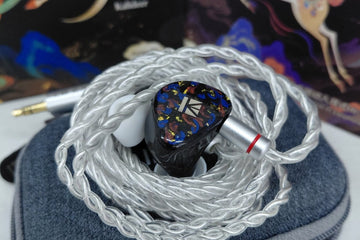
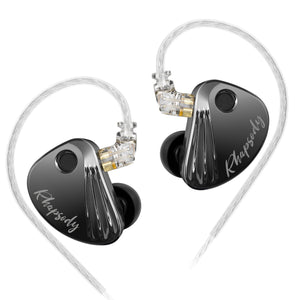
Almost everything else is the same. The KB16 has a very similar shaped resin shell with deep ‘wings’ that fit snugly into my ears. The shell is actually smaller than the Orchestra Lite, so the fit is incredibly good for my ears. They both have resin nozzles, transparent shells showing off the driver placement and internal tuning ports. They even share near identical accessories right down to the quantity and colour of silicone tips provided.
Looking inside the shells shows a very neat and tidy build, something definitely worth showing off, with no signs of glue bubbles or lazy construction. The faceplate is a simple resin swirl of black, metallic blue and glitter, which is again very similar to the Orchestra Lite.
There are two big differences in the accessories however. The KB16 case appears to be the same case provided with the Kiwi Ears Aether and Airoso, which seems to be a hard-wearing pleather type material. I’m not a huge fan of these cases and it’s a very low-effort case for a product at this price. The KB16 silver cable is also a much thinner gauge than almost any IEM I’ve tried in this price bracket which is very disappointing; it tangles more easily than thicker cables and doesn’t reflect the price tag. I am however a very big fan of how tiny the plug housing is. It’s significantly shorter than any standard 3.5mm plug I’ve seen, so they fit really well in the pocket. This is a welcome departure from the norm, where plugs are actually getting longer in order to accommodate plug-switching for 3.5 and 4.4mm plugs.
The Sound So how do they sound? This is going to be my easiest review ever…
They are basically an Orchestra Lite with more bass and a more elegant treble. Switching between the two, they sound like direct siblings. The fact that they look and feel similar adds to the illusion. Long-time viewers of this channel already know how much I enjoy my Orchestra Lite, so it shouldn’t come as a surprise that I really like how the KB16 sounds. Despite how close they sound, and how nearly perfectly their frequency response graphs overlay, there are some slight differences in timbre and presentation.
The KB16 is a touch smoother in both midrange and treble presentation, despite appearing to have a touch more upper midrange energy in the graph – something that is very much balanced out by the increased bass. This gives the effect of being a more relaxing listen overall, but should not be misunderstood as being less detailed. The Orchestra Lite puts a slightly harder edge to every note, which gives the impression of greater detail and incisiveness, so while it sounds more revealing, I don’t think it offers greater detail except for perhaps in the bass, where it does sound incrementally more textured and clean; perhaps a by-product of having a more relaxed bass tuning, or it’s use of BA drivers.
The ports are front-facing and do a slightly above average job of resisting wind noise. It has the usual dull-rough-cardboard-scratching kind of sound to it but at least it’s not as clearly audible as other IEMs.
Comparisons Obviously I don’t need to compare the KB16 with the Orchestra Lite, that horse died long ago.
Kiwi Ears Astral A little more expensive than the KB16, the Astral offers a more V-shaped sound with a fuller sub-bass. The midrange is less present than the KB16, so instruments and vocals have a more mature presentation on the KB16. The Astral is the definition of taking V-shape as far as it will go before over-doing it, so it’s just more of a ‘fun’, bigger sound. Kiwi Ears Aether Staging is bigger on the Aether, with a very clean, dry and neutral overall sound. The Aether is the antithesis of most IEMs with a soft edge to every note, giving a bigger sense of scale, and a very understated kind of presentation. Two completely different types of sound. The KB16 in this case sounds more fun, but is a little reigned in.
Simgot EA1000 Midrange resolution and clarity are about on par here, both giving a more lively musical performance to vocals and instruments than the others. The Simgot’s weaker bass volume gives the impression of being more detailed and midrange and soundstage focused.
Final Thoughts The KB16 Cepheus aptly takes it’s name from one of hundreds of Kings in Greek mythology. Ranked highly due to his association with the gods the KB16 fairly joins the ranks of mid-tier bang-for-buck products.
However, in this price bracket, I think it might be the most severely lacking in accessories I’ve reviewed so far, so whether it’s very tasteful tuning is enough to convince you to ignore that, on top of it’s entirely resin shell build is up to you.
We’re used to getting a lot of value for money from KBEAR, which has previously meant getting a lot of sound quality per currency unit. Now that there’s many of those units attached, I would have expected a lot more product as a whole and value for money. The KB16 is putting a lot of faith in the tuning alone and somewhat rightly so, it is definitely one of the more carefully crafted I’ve heard and I personally enjoy it a lot. But, and this is a big but; the product as a whole is quite frankly disappointing.
Maybe just slap on an upgrade cable and it might feel closer to it’s asking price – it kinda worked for me, but at the same time, I shouldn’t have to.
I almost gave these 3.5 stars because of the accessories, but that I think would be a disservice to the objective sound quality.