







Introduction
At the end of May 2022, the OG version of the KBEAR Ink was released.
Unfortunately, they passed under the radar for many reasons, among which the crowded market and the fact that they weren’t as good as other brands’ offering at the same price (at the time of their release).
KBEAR has been working behind the scenes to improve the original Ink, and in this review I’ll be presenting you the new KBEAR Ink MK2 that was kindly sent to me as a gift before even being released. The Ink didn't really make it in my top list so maybe they thought I should give these a listen, and I am happy to see that their usual shell is still unchanged.

Technical Specifications
- Configuration → 1 x 8.8mm DD with DLC Diaphgram
- Sensitivity → 102 ± 3 dB
- Impedance → 16 ± 2 Ω
- Frequency Response → 20 Hz – 20000 Hz
- Cable → 1,2m 8-Core OFC Silver Plated cable with 0.78mm PINs, no microphone
- Plug Type → Straight gold plated 3,5mm jack
Packaging
The box is identical to the one in which the previous KBEAR Ink were shipped, and also contains the same stuff. Precisely:- The KBEAR Ink MK2
- A detachable cable
- A set of 5 KBEAR 07 tips of different sizes
- A set of 3 KBEAR 10 tips
- A pleather carry case
- A small brush for cleaning
- User manual


Design and Build Quality
The materials are great, the earpieces are sturdy, the connectors are solid and there’s really nothing to complain about when it comes to the overall assembly.
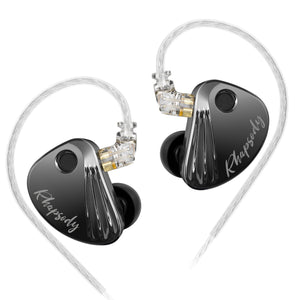
The design is clean and the faceplate is very similar to the one used for the KBEAR Believe, which was one of the most appreciated IEMs of the company. This could lead to some “confusion” as at first sight they look very similar, with the only differences being the shade of the blue color and the KBEAR logo (golden logo on the Ink MK2, silver logo on the Believe), which could not be as noticeable if one doesn’t have the two IEMs close together.
Last, but not least, the shells are rounded and smooth with no sharp edges, and the shell itself is almost the same (not really identical, but the size differences are negligible) that was used for the KBEAR Believe, OG KBEAR Ink and KBEAR Diamond.


Cable
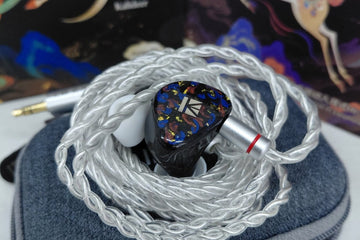
The cable is the same that was shipped with the OG Ink and it’s a very solid cable with no tangling issues. It sports a chin slider but there’s no chance to get a microphone on it.

Comfort and Isolation
Comfort is one of the real strengths of this type of shell: the rounded shells with no sharp edges can guarantee superb comfort even during long listening sessions. They’re keeping this shape design and it’s probably a very good idea (even though I would like to see KBEAR putting more effort on the faceplate design).
Isolation is pretty good too.
Sound
GEAR USED FOR THE TEST
DAC: Topping E30
AMP: Topping L30
Mobile phones: Samsung Galaxy S7 Edge
Dongle: Apple Type-C dongle, Truthear SHIO
Portable DAPs: Benjie S8/AGPTEK M30B
Other sources: Presonus AudioBox iONE
Do they need an amplifier?
No, they don’t strictly need an amplifier.
Sound signature
The KBEAR Ink (MK2) are V-Shaped.
Lows: the lows are powerful, with a rumbly sub-bass and nice extension.
Bass is very punchy and forward with nice textures, and its moderate speed gives it a good weight without giving up a lot of agility.
This is something suitable for bassheads but I’d say it could easily please other kinds of listeners too.
Mids: the mids are recessed with good warmth in the lower mids, and vocals come up in a vivid way even though they’re not “in your face”. Female vocals could use more intimacy, but I guess it’s a tuning choice to make them a bit more distant so that they seem like they’re sounding in a bigger stage.
Instruments have a warm timbre and this is good news for acoustic instruments, and the overall separation is actually pretty good.
Sibilance is rare but could occur in those tracks that are usually prone to expose it.
Highs: highs have good details, even though very small nuances are not the easiest thing to achieve. Treble extension is surprisingly good, with hit-hats and snares being engaging and clear in the mix, even though this comes with the expense of being not for everyone. In fact, those who are very sensitive should stay away from these.
Soundstage is pretty good, with good width and nice depth too, whereas height is average. Imaging is more than good, although not effortless or perfect.
Some comparisons
KBEAR Ink MK2 vs KBEAR Ink (OG)
These two IEMs share a lot of their sound, and let’s say that the MK2 are a sort of “refinement” over the first version.
The bass and sub-bass are more present in the mix with better extension, whereas the midrange, although being on the same volume level in the mix, is more pleasant and has a warmer timbre.
The upper-midrange is tamed down on the Ink MK2, which makes female vocals less energetic and forward but also less sibilant and fatiguing, and the upper treble is rolling off in a more smoother way with less brilliance up top if compared to the previous version.
Details were slightly better on the OG Ink, but this new tuning makes the Ink MK2 a lot more enjoyable, with less overall harshness and better coherency along the spectrum.
Soundstage feels slightly wider on the OG Ink and deeper on the Ink MK2, whereas height is about the same. Imaging is a tad better on the Ink MK2.
Build quality, materials, cable, comfort and isolation are exactly the same.
There’s no match overall: the newer revision is much more interesting and appealing sound-wise.
KBEAR Ink MK2 vs KBEAR Aurora
The KBEAR Aurora were in a higher price bracket when they were launched, as they were a sort of “dynamic driver flagship” for KBEAR after the big success of the KBEAR Believe.
These are pretty different sound-wise, and the comparison could be easily summed-up by saying that the Aurora are a smoother, warmer, safer and more refined set . This does not mean that the Ink MK2 are bad, just that they’re different due to their more lively, brighter and fun signature.
In fact, the low-end of the Ink MK2 is a lot more fun and punchy, whereas the Aurora are slightly more neutral and feature better bass textures. The lower midrange is a bit less deep with male vocals being a tad inferior with respect to the Aurora, that also happen to have better female vocals.
The Ink MK2 come back with a more open upper end, but the Aurora manage to be a bit more detailed while still sounding smoother and safer.
The soundstage is a tad wider on the Ink MK2 and deeper on the Aurora with similar height on both. Imaging is better on the Aurora.
Build quality is great on both, even though the Aurora feel more premium thanks to their glossy metal shell.
The cable is practically the same, and it’s a pretty good cable overall.
The Ink MK2 could be preferable in terms of comfort considering their smaller shell size, whereas isolation is on par more or less.
Overall, the two are very different, but the Aurora seem to be using a more capable driver that takes them to the lead in terms of technical performance (the price is much higher too). The tuning is also different, though, so it really depends on budget and personal tonal preferences.
Final Thoughts
The Ink MK2 are a well done set, nothing more, nothing less. They don’t manage to “excel” in particular things, nor are they the technical monsters one would one for long listening sessions of live orchestra, but they’re definitely fun, punchy, lively and very engaging.
The first version of the Ink was overlooked by many, and for a few good reasons if I have to be honest, but this new one is a very interesting set that V-shape lovers should really take into consideration.
Good job KBEAR, keep it up!