

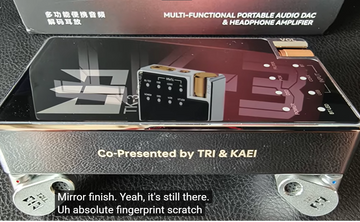


In the portable Hi-Fi universe, most manufacturers handle user feedback with a perfunctory nod—they thank you politely in public, but their next product remains completely unchanged. However, the TRI TK3 ($399), co-developed by TRI and the KAEI design , stands out as a rare and triumphant exception.
Its predecessor was a textbook case of a love-hate relationship. The sound was legendary, but the headache list was exhausting: charging gremlins, the weight of a physical brick, zero battery status indicators, and a catastrophic 20Ω balanced output impedance that brutally warped the frequency responses of highly sensitive IEMs. The love was so intense that some hardcore DIY fans literally modded the old chassis themselves just to cram a Bluetooth module inside.
The TK3 was not conceived to chase speculative specs or launch a lazy cash-grab. It is a precision-engineered, high-sincerity tech course correction, born because the team bent down and genuinely read the community's complaints.

A real review measures success by solved pain points. The TK3 delivers two massive hardware upgrades that hit audiophiles exactly where it matters:
• Sub-1Ω Balanced Output Impedance: The engineering team dropped the balanced output impedance straight to below 1Ω. To test the empirical truth of this claim, we paired it with the ultra-sensitive, multi-driver hybrid Canpour 622B. The result was stunning: a pitch-black background, absolute zero hiss, and complete silence. The dark days of high impedance causing bloated bass and rolled-off treble are dead. What you get here is stable, uncolored, and thoroughly trustworthy acoustic reproduction.
• A Multi-Status LED Array with Purpose: The information-black-box anxiety is gone. Dedicated LEDs now broadcast your power status, DSD/PCM filters, Bluetooth connection, and active input sources. While it presents a bit of light pollution in a dark bedroom with its high-frequency blinking, and the protective silicone sleeve slightly obscures the labels, it stands as proof of a purely functional design engineered to eliminate guesswork.

If the sub-1Ω impedance is the TK3’s foundation, then the "high-power + premium Bluetooth" combo is the heavy-hitting reason that will make you ditch your expensive dedicated digital audio players.
Traditionally, high-power portable rigs are purely wired metal bricks, while wireless adapters are acoustically anemic. The TK3 shatters this compromise. It integrates a flagship Qualcomm Bluetooth chipset supporting full-spec HD codecs like LDAC and aptX Adaptive (up to 24-bit/96kHz), while simultaneously retaining a monstrous 1.2W of driving power.
This configuration unlocks luxury levels of situational flexibility. In real-world testing, the wireless transmission distance is vast and rock-solid. You can leave your phone deeply tucked away as a pure digital library, leaving the heavy lifting of premium decoding and massive amplification entirely to the TK3. This decouples the audio processing from the phone’s noisy internal circuitry and rivals wired performance.

Sonically, the TK3 inherits the coveted "analog organic sound" philosophy deeply rooted in the KAEI team's tuning traditions: an expansive, airy, and beautifully open soundstage; deep, authoritative bass with natural decay; and a smooth, lush, velvet midrange dripping with analog and vinyl-like texture. This profound acoustic warmth yields a phenomenal pairing synergy when introduced to modern, analytical gear.
If you pair it with headphones that lean overly bright, analytical, or slightly aggressive (such as the HiFiman 400i or the Unique Melody MEST MkII), the TK3 acts as an exquisite acoustic filter. It rounds off the piercing digital glare, transforming sterile notes into a rich, fluid, and endlessly non-fatiguing musical tapestry.
Furthermore, the multiple inputs offer distinct acoustic flavors: the coaxial input provides lower jitter and a more natural presentation, while the USB input excels in transient response and speed. This duality allows audiophiles to actively match the input flavor to the specific sound signature of their headphones.
The hardware Bass-Boost switch (+4dB below 500Hz) is another stroke of genius. This is not a cheap, muddy bass cannon toggle. Instead, it operates as an intelligent equal-loudness contour compensation tool, meticulously designed to rescue low-end details during low-volume listening sessions or when driving demanding planar headphones.

While the TK3 excels in acoustic performance, it exhibits a few minor ergonomic quirks. The stunning, highly reflective chrome-mirrored back panel is undeniably premium but acts as a fingerprint magnet. Driven by its high-power circuitry, the substantial 5000 mAh battery yields around 3.5 hours of continuous playback in full Bluetooth mode. Fortunately, the multi-stage LED battery indicator completely eliminates sudden low-battery anxiety.

The TK3 isn't an archaic Hi-Fi brick meant only for rigid, stationary listening sessions. As the reviewer candidly concludes, put it in your pocket, hook up your headphones, and even if you're doing laundry, mowing the lawn, or running chores, it gives you a golden musical experience. This is the ultimate expression of modern mobile fidelity: wireless convenience without the sonic downgrade; all-encompassing utility wrapped in a timeless, highly-musical analog soul.
At $399, the TRI TK3 firmly stakes its claim as a technical and experiential benchmark in the portable space. If you want to recapture the emotional weight of the vinyl era in today's boundless digital streaming landscape, look no further—this is your endgame solution.
This article is adapted from and compiled based on a YouTube video
Click to watch the original video: https://www.youtube.com/watch?v=jDk2mRuVJf4
More hifi audio gears at KEEPHIFI

Spend Less Enjoy HIFI


